















Compare OpenCode vs Claude Code on pricing, models, memory files, and EU privacy. Discover whether managed Opus or open-source BYOK fits your team.
Deciding between OpenCode and Claude Code comes down to a clear balance of model lock-in, speed, and privacy. You can pick Claude Code for turnkey terminal automation and flat-rate frontier reasoning. Alternatively, you can select OpenCode for complete provider neutrality, local model execution, and direct control over your API costs. This deep operational review of OpenCode vs Claude Code breaks down every technical and economic difference between the two terminal agents.
TL;DR
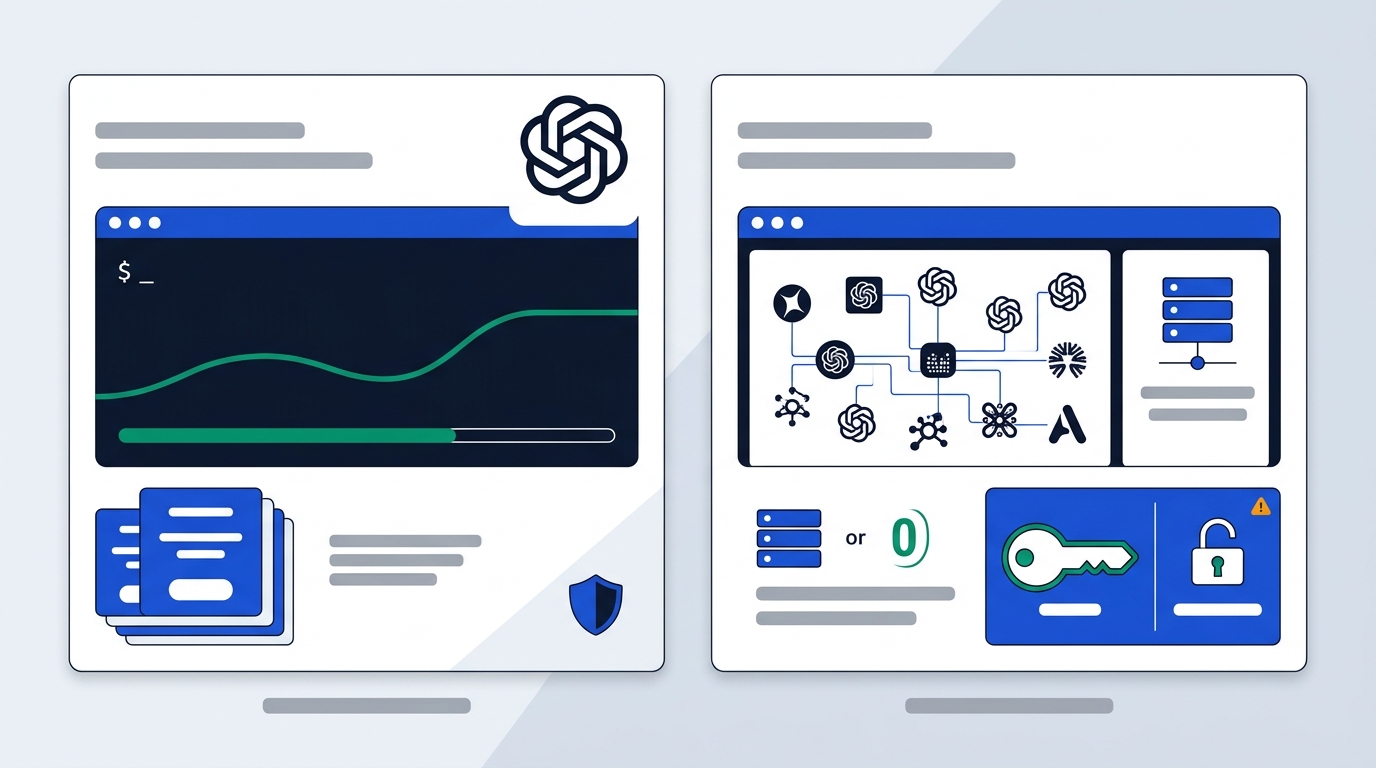
Claude Code suits developers who want managed speed and state-of-the-art models. If you want zero setup, flat-rate Claude Opus reasoning, and built-in operating system sandboxing, Claude Code is your best choice. It fails teams that require non-Anthropic models, strict air-gapped local execution, or inspectable open-source code.
OpenCode suits developers who demand model freedom, local privacy, and cost control. If you want to connect to 75+ model providers, run zero-egress local models via Ollama, or use low-cost open-weight models, OpenCode is built for you. It fails developers who want subsidized consumer subscriptions for Claude Opus, because Anthropic blocks third-party harnesses from using flat subscription seats.
OpenCode vs Claude Code at a glance
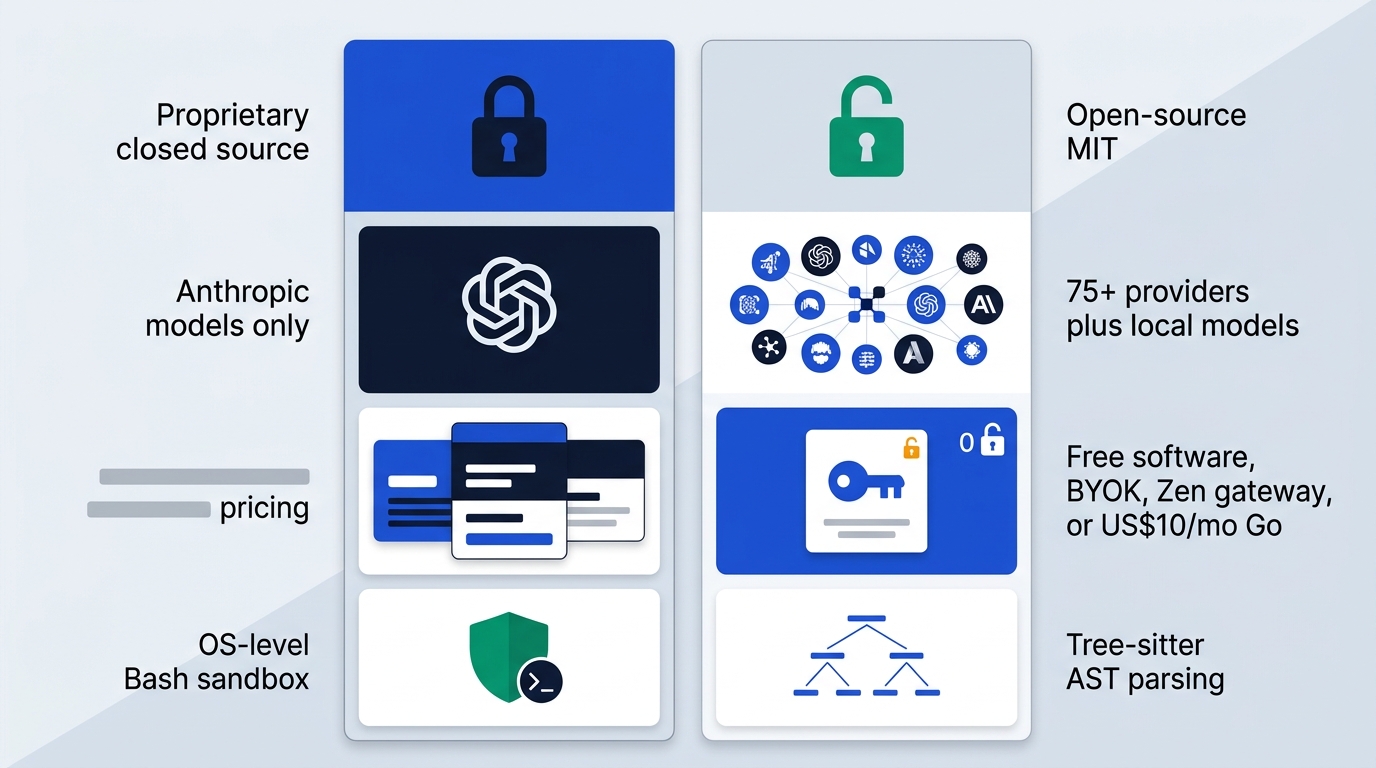
The debate around OpenCode vs Claude Code centers on a fundamental engineering question. Do you want a managed agent tied to one frontier lab, or an open platform you control completely? Both tools live in your terminal, inspect your repositories, edit code across files, and run shell commands. Yet their underlying architectures and commercial arrangements lead to very different developer workflows.
OpenCode has risen as an open-source coding agent in true David vs Goliath fashion. Maintained by Anomaly, founded by SST creators Dax Raad and Frank Wang, OpenCode reached roughly 171,000 GitHub stars and 1.38 million weekly npm downloads by late May 2026. Developers who use OpenCode swear by it. It is built specifically for engineers who want deep efficiency and complete workflow control.
Claude Code is Anthropic's official terminal tool and the market leader in proprietary terminal automation. Setup takes under two minutes via npm. It turns your terminal into a full development environment that plans architectures, fixes bugs, and ships pull requests. But where do they actually differ, and when should you choose one over the other?
Quick verdict and core trade-offs
Pick Claude Code if you want rapid setup, subsidized Claude Opus reasoning, and built-in operating system sandboxing. It handles complex multi-file refactoring without requiring custom model configurations. Pick OpenCode if you need provider freedom, zero-egress local execution with Ollama, and transparent token pricing without surprise account blocks.
| Dimension | Claude Code | OpenCode |
|---|---|---|
| Software License | Proprietary closed source | Open-source MIT |
| Model Selection | Anthropic models only (Opus 4.8, Sonnet, Haiku) | 75+ providers via Models.dev, plus local models |
| Pricing Model | US$20 to US$200/mo subscription or API key | Free software, BYOK, Zen gateway, or US$10/mo Go |
| Context Compaction | In-context /compact command, older tool outputs cleared | Output buffer pruning with raw history in SQLite |
| Shell Safety | OS-level Bash sandbox with allow/ask/deny rules | Tree-sitter AST parsing without native OS sandbox |
| User Interfaces | Terminal, VS Code, JetBrains, Desktop app, Web | Polished TUI, Tauri desktop app (Mac/Win/Linux), IDE |
| Project Memory | CLAUDE.md hierarchy (project, parent, user) | AGENTS.md vendor-neutral format (falls back to CLAUDE.md) |
| Extensibility | Skills, hooks, subagents, mature ecosystem | Deep hooks, background subagents, configurable pipeline |
Source: vendor pricing pages, public repository data, and official documentation, checked June 2026.
Feature matrix and target developers
Claude Code suits engineering teams that want zero-setup terminal automation with frontier models. If your developers already work inside Claude Pro or Max workspaces, Claude Code lets them start coding immediately. You do not need to manage external API keys or tune system prompts. It fails teams that require strict local data residency, self-hosted hardware, or non-Anthropic models.
OpenCode suits developers who demand model neutrality, local open-weight execution, and budget predictability. You can direct routine tasks to cheap open models while auditing every command that touches your machine. However, it fails developers who want subsidized flat-rate access to Claude Opus. Anthropic restricts consumer subscriptions to its native CLI. You can review verified commercial terms on our Claude pricing and plan breakdown.
To evaluate how these target personas split in practice, consider your team's tolerance for setup complexity. Claude Code prioritizes immediate output. You run one npm command, log in through Anthropic OAuth, and begin refactoring immediately. OpenCode requires you to select a provider, supply an API key, or configure a local Ollama instance. If you enjoy tailoring your developer environment, OpenCode provides endless customization. If you want your agent to work out of the box, Claude Code delivers a turnkey experience.
Choosing the right agent for your workflow
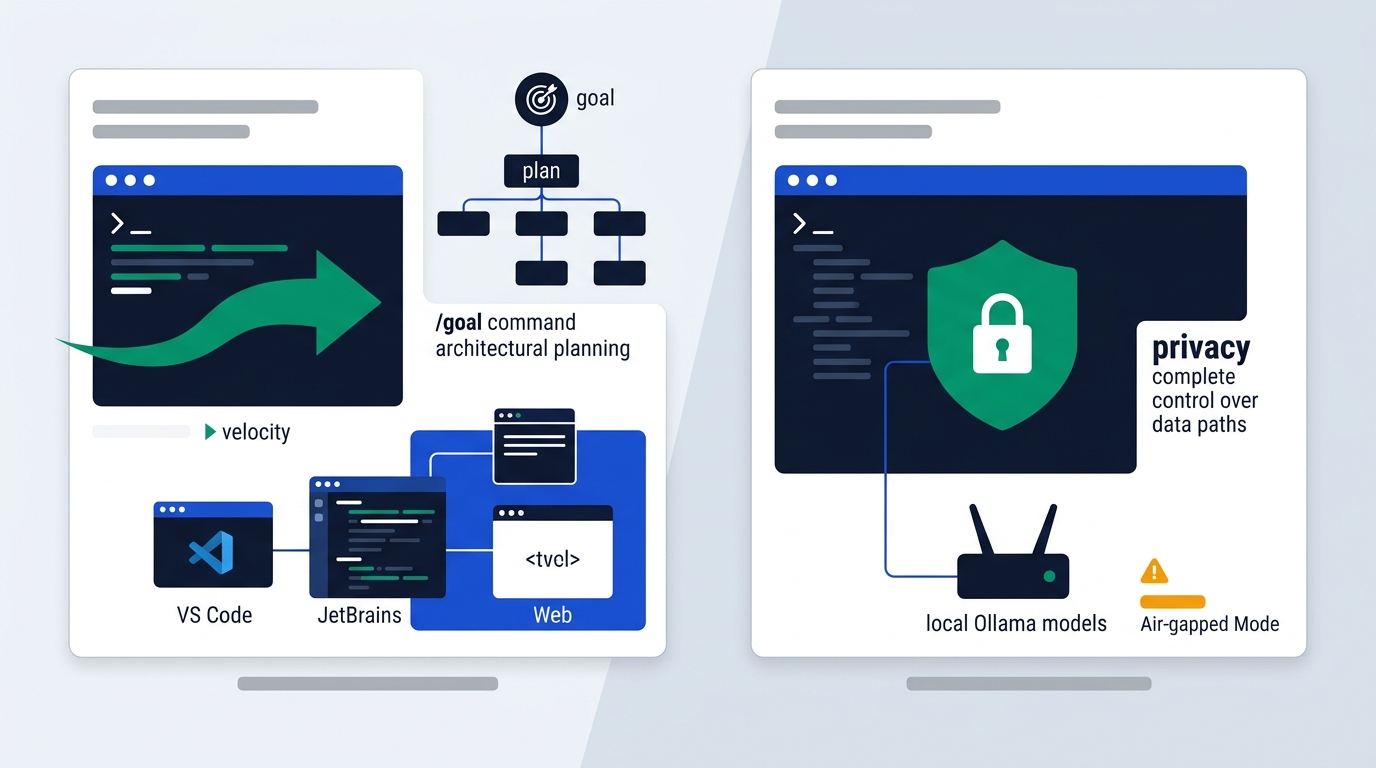
Terminal coding agents represent a major shift from standard code completion extensions. Instead of suggesting single lines inside an editor, these tools read directory structures, execute build scripts, and verify their own output. Deciding which tool fits your daily development depends on your organization's security posture, tooling maturity, and task complexity.
When Claude Code delivers better velocity
Claude Code excels at rapid prototyping, architectural overhauls, and deep refactoring sprints. Its native extended thinking capability allows the agent to pause before changing code. Instead of rushing to edit files, Claude Code drafts a structural plan to solve complex problems, resulting in fewer bugs and less churn.
The tool includes dedicated workflows for high-level task management. Its /goal command lets the agent pursue complex multi-step objectives while managing background subagent orchestration. If you run a fast-paced software agency building greenfield applications, this managed automation saves substantial development time.
Recovery is another place where the managed approach pays off. Claude Code pairs its Agent View fleet and /goal runs with instant rewind, so a bad autonomous run can be rolled back quickly. OpenCode also runs background subagents, but undoing a change is manual. If you let agents work unattended while you review pull requests, that difference is worth weighing.
Claude Code is also deeply optimized for speed. Anthropic tuned the agent harness specifically for low latency between user prompts and agent actions. It handles cross-file edits quickly without running repetitive verification steps unless instructed. For engineers working on tight release schedules, this rapid feedback loop keeps project momentum high.
Teams already invested in Anthropic's subscription tiers gain immediate productivity. Because the CLI connects directly to your existing account, you avoid setting up external credit balances or tracking individual token usage. The developer experience feels integrated across all supported surfaces, including terminal shells, VS Code extensions, JetBrains plugins, desktop applications, and web interfaces.
When OpenCode fits privacy and flexibility
OpenCode shines when you need complete control over data paths and model execution. Regulated organizations in healthcare, defense, and European finance often prohibit sending source code to third-party commercial clouds. By running OpenCode in Air-gapped Mode with local Ollama models, you keep all prompts and source files on your local machine.
The platform acts as a universal adapter for artificial intelligence. Rather than locking you into one vendor, OpenCode standardizes prompt delivery, tool execution, and context management across 75+ model providers. You can switch models mid-session without restarting your work. A developer can start a task using a lightweight open model, realize the problem requires complex reasoning, and immediately switch to a frontier engine within the same shell interface.
OpenCode also offers a dedicated desktop application built with Tauri for macOS, Windows, and Linux. The desktop UI displays active Model Context Protocol (MCP) server connections, execution logs, and project files visually. It allows you to toggle easily between Plan mode and Build mode. You can use Plan mode to architect changes safely before switching to Build mode to write files and run terminal commands.
Many engineering teams deploy both tools in tandem. Developers reach for Claude Code when planning complex cross-repository architectures that benefit from flagship Opus reasoning. Then, they open OpenCode for routine test generation, local refactoring scripts, and continuous integration checks where open-weight models deliver strong results at a fraction of the cost.
Subscription costs and true token costs
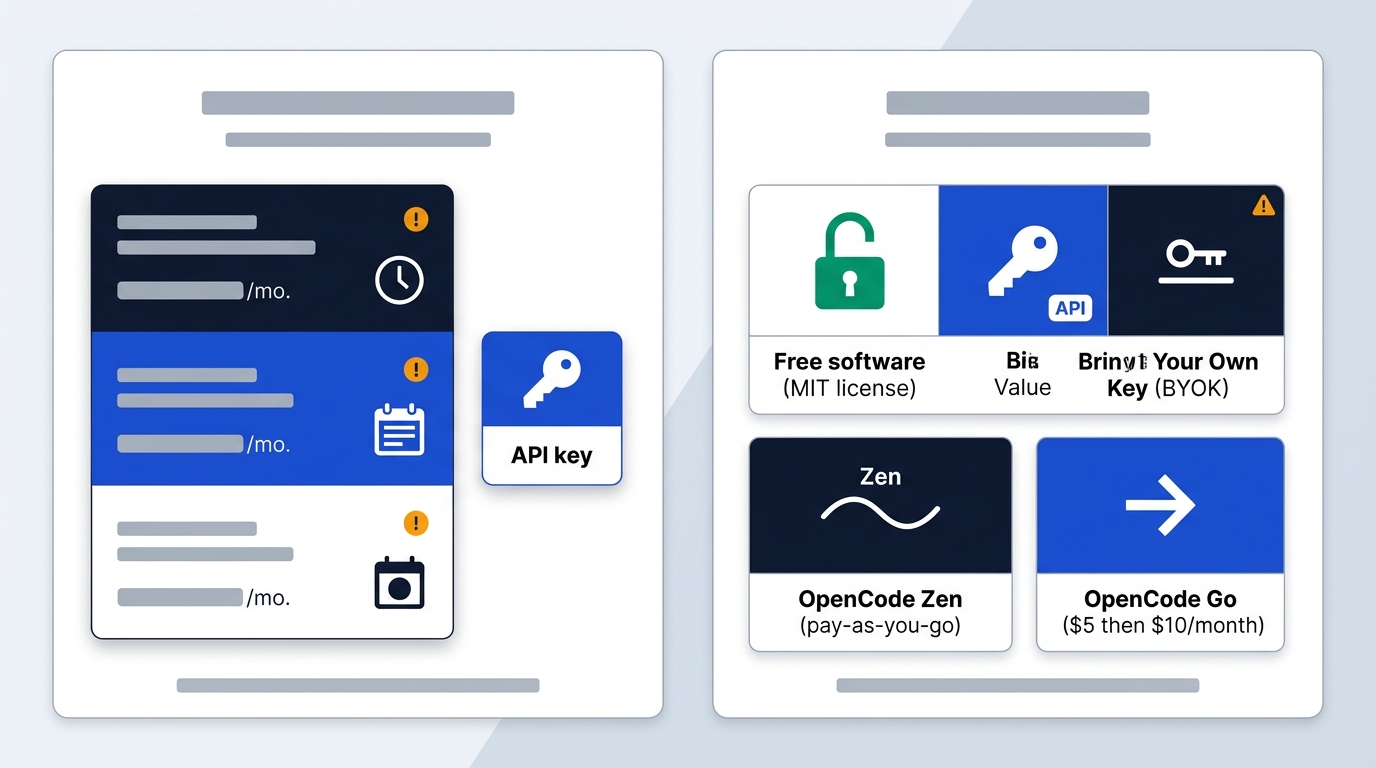
Pricing represents the sharpest operational difference between these two coding agents. Claude Code packages frontier intelligence into flat monthly subscriptions or per-token console billing. OpenCode provides free MIT software where you pay only for raw model compute or bundled open-weight access.
Comparing flat plans and usage gateways
Claude Code operates through two distinct billing paths. The primary method uses your standard Claude subscription. The Pro plan costs US$20 per month, granting access to Sonnet and Opus models subject to baseline context caps. For high-volume development, Anthropic provides Max subscription tiers at US$100 per month for 5x usage, and US$200 per month for 20x usage.
Usage on Claude Code subscriptions is governed by a rolling 5-hour budget alongside a weekly cap. In May 2026, Anthropic doubled these request limits to accommodate heavier agentic workflows. Alternatively, you can run Claude Code using an Anthropic Console API key. Under API billing, you pay strictly per token used with no subscription limits.
OpenCode takes the opposite approach. The core application costs US$0 under the MIT license. You choose how to supply model compute through three distinct options:
- Bring Your Own Key (BYOK): Connect your direct API keys from OpenRouter, OpenAI, Anthropic, or any OpenAI-compatible provider at published vendor rates.
- OpenCode Zen: A pay-as-you-go hosted gateway managed by OpenCode, offering low-latency routing across dozens of commercial and open models.
- OpenCode Go: A dedicated tier priced at US$5 for the first month, then US$10 per month thereafter. It provides generous request pools for leading open-source models, including GLM-5.1, Kimi K2.6, MiniMax M3, Qwen3.7 Max, and DeepSeek V4. You can use your Go tier subscription across any agent, not just OpenCode.
Check what the Go roster actually contains before you subscribe. It is made up of open models from Chinese labs only, so it will not stand in for Claude Opus. If your organization has a policy on where models come from, read that list first.
There is also a counterpoint on cost visibility. Paying per token makes your spend easy to see while you are counting. A user on r/ClaudeAI observed that once you settle on a flat Max plan and stop counting, that advantage fades.
Estimated monthly spend across real workloads
Understanding total cost of ownership requires looking at token consumption across different activity levels. Coding agents consume far more tokens than standard chat tools. Every interaction sends directory maps, file diffs, terminal outputs, and system instructions back into the model context window.
Independent analysis by SemiAnalysis benchmarked Claude Code subscription tiers against raw API pricing for identical coding tasks. The findings confirmed that Anthropic's flat subscription plans are heavily subsidized. A heavy developer on a US$200 per month Max tier can consume an Opus token volume that would cost over US$1,000 if billed through raw Console API keys. Anthropic absorbs this cost to drive adoption of its native agent environment.
Here is how estimated monthly spend breaks down across typical real-world developer workloads:
- Light workload (occasional bug fixes and single-file edits): Running OpenCode with local Ollama models costs US$0 per month. A Claude Code Pro plan costs a flat US$20 per month.
- Medium workload (daily feature development and test writing): OpenCode Go costs US$10 per month, absorbing high request volumes across GLM-5.1 and DeepSeek V4. Claude Code on the US$20 Pro tier may hit its rolling 5-hour limit during intense sessions, forcing a migration to the US$100 per month Max tier.
- Heavy workload (autonomous terminal agents running continuously): Claude Code Max 20x provides predictable billing at US$200 per month. Paying for that same Opus token volume via raw Console API keys can easily exceed US$1,000 per month.
Why API Keys Override Your Claude Subscription
Watch out for the silent API key trap in Claude Code. If your terminal environment contains an active ANTHROPIC_API_KEY environment variable, the CLI silently bypasses your flat Claude Pro or Max subscription. Instead of using your prepaid monthly allowance, it bills every single turn and tool invocation directly to your Anthropic Console account on a per-token basis. You must explicitly unset this variable to ensure your session runs under your flat subscription plan.
The Anthropic subscription restriction explained
In early 2026, the terminal agent ecosystem experienced a major disruption. Thousands of developers discovered that routing their Claude Max subscriptions through third-party harnesses suddenly stopped working. The resulting changes permanently separated managed Anthropic subscriptions from open-source terminal agents.
How the third-party harness ban unfolded
The standoff began on January 8 and 9, 2026. Developers opening OpenCode found that routing Claude Pro or Max credentials through third-party OAuth plugins failed immediately. GitHub issue trackers filled with reports titled "Broken Claude Max" within hours. Anthropic had deployed automated system blocks to halt external tools that spoofed the official Claude Code CLI harness.
The crackdown progressed through clear legal and technical steps over the following months:
- January 8-9, 2026: Anthropic blocks OAuth token routing from third-party harnesses. An Anthropic engineer confirmed on X that the block was designed to stop unauthorized applications from mimicking the native Claude Code client.
- February 20, 2026: Anthropic updates its legal terms of service, explicitly prohibiting third-party coding tools from utilizing consumer subscription credentials.
- March 19, 2026: OpenCode lead maintainer Dax Raad merges Pull Request #18186, titled "Remove anthropic references per legal requests." This change removed all bundled Anthropic subscription workarounds from the OpenCode codebase.
- April 4, 2026: Anthropic announces billing enforcement rules via TechCrunch. Claude Code lead Boris Cherny explained that consumer subscriptions were never designed to absorb the continuous, high-volume token loops generated by independent agentic harnesses.
One detail from this timeline gets misreported. A widely shared Hacker News post titled the March 19 pull request "Anthropic takes legal action against OpenCode", but the link pointed to the pull request itself. No court filing exists, so read it as compliance with legal requests rather than a lawsuit.
Anthropic's official compliance documentation states that OAuth login is intended exclusively for first-party subscription use. The company does not permit third-party developers to route requests through Free, Pro, or Max plan credentials on behalf of their users. If you want to run Claude models inside OpenCode today, you must provide a direct Anthropic API key and pay per token.
The cost impact on Claude models in OpenCode
This enforcement fundamentally altered the economics of using Claude models inside third-party clients. Because you cannot use a flat US$20 Pro or US$200 Max subscription inside OpenCode, running flagship models like Claude Opus 4.8 via OpenCode requires pay-as-you-go API keys.
For heavy agentic sessions involving large repository context maps, Console API charges escalate rapidly. A complex multi-file refactoring task using Opus 4.8 can cost US$5 to US$20+ for a single session when billed per token. Running those same tasks repeatedly throughout a work week can yield API invoices hundreds of dollars higher than a flat Claude Code Max subscription.
If you are migrating, check your setup against the current rules. OpenCode's own provider documentation says that plugins for using Claude Pro or Max models exist, that Anthropic explicitly prohibits this, and that the bundled plugins were dropped as of version 1.3.0. If an older guide tells you to install one, treat that guide as out of date.
For engineering leads, this restriction clarifies your tooling strategy. If your primary goal is maximizing access to Opus reasoning at a predictable price, Claude Code's US$100 or US$200 Max subscriptions provide exceptional financial value. If you prefer OpenCode's customizable interface, you should lean into open-weight models like DeepSeek V4 or Kimi K2.6 rather than paying un-subsidized API rates for Anthropic endpoints.
Frontier models versus open weight execution
Model selection dictates both code quality and operational resilience. While Claude Code limits you entirely to Anthropic's model catalog, OpenCode functions as a universal adapter for modern artificial intelligence engines.
Ecosystem lock-in versus 75 provider connections
Claude Code operates inside a single-vendor ecosystem. The CLI relies exclusively on Anthropic's flagship Sonnet and Opus models for structural planning and complex edits, while lightweight Haiku models handle background chores. You cannot redirect queries to alternative frontier systems, even if another provider releases a superior model for a specific programming language.
To be precise, Claude Code is not sealed shut. Its CLI and VS Code surfaces document some third-party provider routing. Even so, the product is tuned for Claude and assumes Claude, so treat that routing as an exception rather than a design goal.
OpenCode connects to over 75 model providers through Models.dev. You can execute code using OpenAI models, Google Gemini, Moonshot's Kimi K2.6, GLM-5.1, MiniMax M3, Qwen3.7 Max, and DeepSeek V4. You can switch model providers in the middle of a chat session. If you want to compare OpenAI subscription options for terminal workflows, view verified tiers on our ChatGPT pricing analysis.
This neutrality gives engineering teams leverage against vendor lock-in. When a new open-weight model reaches state-of-the-art benchmark performance, OpenCode users can adopt it immediately by changing a single configuration setting. You do not need to wait for a vendor to update its proprietary CLI harness.
Zero-egress local runs and dual-tier routing
Air-gapped development represents a major operational advantage for OpenCode. By pairing the agent with local model engines like Ollama, you can run automated code edits completely on local GPUs. No source code, prompts, or directory structures ever leave your workstation or private infrastructure.
Local runs carry their own costs, though. If you run open-source models yourself, you need hardware that can run them, and even with GPUs in the rack you still pay for electricity. Setup also takes more effort than Claude Code: you download the model, then connect it to OpenCode. Count both before you promise a team a free agent.
OpenCode also supports configurable dual-tier model routing. You can configure a lightweight, low-cost model to handle routine chores like formatting, docstring generation, and basic syntax checking. When the harness encounters a complex architectural problem, it escalates the prompt to a high-capacity reasoning model. This dual-tier approach optimizes your monthly compute spend while maintaining execution quality.
Claude Code also uses a dual-tier architecture internally, using hidden Haiku instances for small workspace tasks while routing main prompts to Sonnet or Opus. However, Claude Code's model routing is entirely fixed. You cannot swap out the underlying models or adjust the escalation triggers yourself.
Project memory with agents md and claude md
Coding agents require persistent instructions to understand project architecture, coding standards, and build steps. Without dedicated memory files, agents burn context tokens re-analyzing your codebase on every new session. Both platforms approach repository memory through Markdown configuration files, but their file structures and stacking behaviors differ.
Instruction files and migration rules
Claude Code relies on a hierarchical memory system anchored by CLAUDE.md files. The CLI scans project roots, parent directories, global user settings, and auto-memory buffers, stacking instructions into a unified memory context. This structure allows developers to set global preferences across all projects while maintaining custom build commands for individual repositories.
OpenCode champions the vendor-neutral AGENTS.md standard. You commit this file directly to your git repository, establishing shared instructions that any developer or open-source tool can parse. To make migration smooth, OpenCode includes an automatic fallback mechanism. If an AGENTS.md file is absent, OpenCode automatically reads your existing CLAUDE.md instructions. You can migrate your team to OpenCode without rewriting your existing repository documentation.
Claude Code does not return the favor. It reads only CLAUDE.md files and ignores AGENTS.md instructions entirely. If your team standardizes on Claude Code, you must maintain Anthropic-specific memory files across your repositories.
Prompt caching and session compaction
Context window management is critical when agentic sessions run for hours. Claude Code leverages Anthropic's static prompt caching mechanics. It structures system prompts, tool definitions, and project instructions into cached context blocks. Because these static elements remain cached across turns, long development sessions become faster and more cost-effective over time.
OpenCode cannot assume any of that machinery. It reads the model's context limit from provider metadata and builds the session around it, then normalises provider differences such as tool-call IDs, cache support, model limits, and tool-calling formats. That is the integration tax of supporting everyone. The risk is that the harness misreads a less common model, so try a new model on a small task before you hand it a large refactor.
When context windows reach capacity, both agents prune conversation history, but they handle raw data differently. Claude Code clears older tool outputs first before running its /compact routine to summarize prior interactions. OpenCode prunes old execution outputs while preserving full conversation records inside a local SQLite database. If context compaction removes a crucial detail during an OpenCode session, you can inspect the SQLite store to retrieve the unedited history.
Harness security shell execution and speed benchmarks
Granting an artificial intelligence agent access to your terminal requires strict safety boundaries. A rogue command can delete files, overwrite databases, or expose secret keys. The two harnesses implement fundamentally different security architectures to protect your local environment.
Sandboxes and Tree-sitter command parsing
Claude Code provides enterprise-grade safety through a multi-layered security model. It wraps terminal operations inside an operating system level Bash sandbox. Commands pass through strict allow, ask, and deny permission rules. System-level guardrails block risky operations and prevent scripts from accessing files outside your active project workspace.
Claude Code also features SOC 2 compliant data security. Customer code processed through Anthropic's commercial environment is isolated and protected against external leakages. Furthermore, flagship models like Claude Opus 4.6 and 4.8 exhibit low hallucination rates, rarely inventing non-existent libraries or invalid command parameters.
The same guardrails have a cost. They block certain system commands, which can slow down workflows that rely on unrestricted shell access. Because Claude Code is closed-source, you also cannot inspect the codebase or swap in a different model provider to work around it.
OpenCode inspects shell commands using Tree-sitter Abstract Syntax Tree (AST) parsing, the same parsing engine used by modern code editors like NeoVim. Rather than relying on simple string matching, Tree-sitter analyzes the structural syntax of bash commands. It reliably detects destructive operations such as rm, mv, chmod, or file paths pointing outside the workspace root.
However, OpenCode lacks a native operating system sandbox by default. It operates with higher default permissions, placing responsibility on you to define tool execution rules. To compensate, OpenCode provides inspectable plugin hooks that allow developers to intercept, modify, or block tool calls before they run on the system.
Builder.io benchmark numbers and LSP self-correction
Independent benchmark testing reveals distinct operational priorities between the two agents. A head-to-head evaluation conducted by Builder.io in early 2026 tested both agents using Claude Sonnet 4.5 on identical coding assignments. The results highlight the trade-off between pure execution speed and rigorous verification.
| Task Assignment | Claude Code Execution | OpenCode Execution |
|---|---|---|
| Cross-file rename | 3 minutes 06 seconds | 3 minutes 13 seconds |
| Isolated bug fix | ~40 seconds | ~40 seconds |
| Test suite writing | 73 tests in 3 minutes 12 seconds | 94 tests in 9 minutes 11 seconds |
| Total session completion | 9 minutes 09 seconds | 16 minutes 20 seconds |
Claude Code completed the total session nearly twice as fast, finishing in 9 minutes and 9 seconds compared to OpenCode's 16 minutes and 20 seconds. However, OpenCode generated 94 comprehensive tests compared to Claude Code's 73 tests, representing a 29% increase in test volume. OpenCode took longer because its default harness settings execute full test suites and safety checks after major code modifications.
Whether that extra time is worth it depends on your tolerance for regressions versus speed. If a regression costs you more than the minutes saved, OpenCode's defaults lean your way. If you iterate quickly and review diffs yourself, Claude Code's lower latency counts for more. Note too that both agents ran the same model here, so the gap reflects the harness, not the model.
OpenCode also incorporates active Language Server Protocol (LSP) integration. During code edits, OpenCode spawns background LSP servers to capture real-time compiler diagnostics and type checks. If an edit introduces a syntax or type error, the compiler feedback is fed directly into the model's next turn, allowing OpenCode to self-correct code before completing the task. Claude Code added LSP support in version 2.1.121, but does not use diagnostic feedback as aggressively in its core editing loop.
European data residency and B2B VAT rules
For European organizations, software procurement requires strict adherence to data protection laws and proper tax accounting. Deploying a terminal agent that scans internal codebases introduces specific compliance requirements under European Union regulations.
GDPR compliance and local data sovereignty
Anthropic provides commercial business users with a Data Processing Addendum (DPA) incorporating European Union Standard Contractual Clauses (SCCs). Under Anthropic's commercial terms, customer inputs and proprietary code snippets are not used to train AI models. However, primary model processing occurs on cloud infrastructure located in the United States, including Amazon Web Services and Google Cloud data centers. For detailed contract guidance, review our comprehensive overview of GDPR data processing addendum rules.
OpenCode delivers a complete solution for strict European data sovereignty. When deployed in Air-gapped Mode with local models via Ollama, zero data leaves your local machine or private European server. This setup completely eliminates cross-border data transfers, simplifying compliance under GDPR Article 28 for defense, healthcare, and financial institutions operating in the EU.
EU reverse charge and UK VAT handling
When purchasing commercial Claude subscriptions or Anthropic API billing credits, European businesses must manage Value Added Tax (VAT) correctly. Anthropic invoices EU-based business customers without charging local VAT, provided you enter a valid VAT identification number during account setup. European business buyers must self-account for VAT locally using the reverse charge mechanism. You can verify step-by-step procedures in our EU VAT reverse charge guide.
For businesses located in the United Kingdom, different tax rules apply. The UK is no longer part of the European Union VAT system. Instead, Anthropic B2B billing follows HMRC VAT Notice 741A place-of-supply rules for international cross-border services. UK registered businesses must self-account for output and input VAT under the UK reverse charge procedure on their standard VAT returns.
Frequently asked questions about coding agents
Developers evaluating terminal coding agents often have specific questions regarding offline execution, subscription mechanics, and platform compatibility. Here are verified answers based on current technical documentation.
Common setup and billing questions
Can I use a Claude Pro or Max subscription inside OpenCode?
No. Anthropic explicitly prohibits using consumer or enterprise subscription credentials inside third-party harnesses. In March 2026, OpenCode removed Anthropic subscription login options following legal requests. If you want to use Claude models in OpenCode, you must supply a direct Anthropic API key and pay standard per-token rates.
Does OpenCode Go include access to Claude Opus or Sonnet?
No. The OpenCode Go plan priced at US$10 per month provides high request limits for leading open-weight models, including GLM-5.1, Kimi K2.6, MiniMax M3, Qwen3.7 Max, and DeepSeek V4. Anthropic models are not included in the Go subscription roster.
What user interfaces are available for each tool?
Claude Code operates across terminal shells, VS Code, JetBrains IDEs, a dedicated desktop application, and web workflows. OpenCode provides a polished Terminal User Interface (TUI), a cross-platform desktop application built on Tauri for macOS, Windows, and Linux, and standard IDE extensions.
Data protection and workflow compatibility
Can Claude Code run completely offline without an internet connection?
No. Claude Code is a proprietary CLI tied exclusively to Anthropic's cloud infrastructure. It requires an active internet connection to process prompts through Claude models. If you need complete offline execution, you should run OpenCode in Air-gapped Mode with local Ollama models.
How does OpenCode handle existing project memory files built for Claude Code?
OpenCode includes an automatic fallback feature. If an AGENTS.md file is missing from your repository root, OpenCode automatically searches for and reads CLAUDE.md. This allows your team to migrate to OpenCode without editing existing repository guidelines.
Will my codebase be used to train AI models when using Claude Code?
Anthropic's commercial terms state that customer code, prompts, and tool outputs submitted through Claude Pro, Max, Team, Enterprise, or Console API accounts are excluded from AI model training by default.
Which terminal AI coding agent to pick
Claude Code and OpenCode represent two distinct philosophies for modern AI-assisted software engineering. Claude Code delivers a managed, turnkey experience. If you want subsidized access to state-of-the-art Claude Opus reasoning, low-latency execution, OS-level sandboxing, and zero configuration overhead, Anthropic's official agent is exceptionally effective.
OpenCode is the superior platform for developers who demand sovereignty, model choice, and inspectable open-source code. It eliminates vendor lock-in, supports zero-egress local execution for sensitive codebases, and slashes operational costs through open-weight model economics. Its active LSP diagnostic loop ensures high code quality even when running cost-effective open models.
Reliability is a quieter factor in the decision. Claude Code changes under you and cannot be pinned, while OpenCode lets you pin a model and harness combination so it will not move. If your team needs repeatable results across a quarter, that favours OpenCode. If you want the newest improvements with no effort on your side, it favours Claude Code.
If you manage an engineering organization, consider testing both tools on active projects. Deploy OpenCode with Ollama on sensitive internal repositories to verify local privacy compliance. Simultaneously, provision a Claude Pro or Max seat to evaluate Claude Code's velocity during heavy refactoring sprints. Many productive teams ultimately integrate both tools into their daily development workflows.
Sources and how this was compiled
Compiled by the SaaSEuro team from the vendors' official documentation; we have not hands-on tested these products. Facts last checked in November 2026.
Bottom line
Choose Claude Code if you want managed speed, zero setup, and subsidized access to frontier Claude Opus models within Anthropic's secure environment. Choose OpenCode if you require provider freedom, complete local data sovereignty via Ollama, and cost-effective open-weight execution with open-source MIT software. To review full commercial pricing details for Anthropic subscriptions before buying, see our verified Claude pricing and plan breakdown.
