
















European businesses choosing between Gemini vs ChatGPT find EU prices, plan limits, AI models, and GDPR data privacy compared to make the right choice.
Gemini by Google and ChatGPT by OpenAI are leading AI chatbots. Each brings powerful capabilities to the table. For European businesses, the choice often comes down to integration with existing workflows, specific AI capabilities, and data privacy compliance under GDPR.
Adopting AI tools is becoming crucial for businesses aiming to enhance productivity, foster innovation, and maintain a competitive edge. Navigating the diverse offerings of AI chatbots requires a clear understanding of their underlying models, feature sets, and how they align with your operational needs. This comparison will help you evaluate their offerings, considering factors like pricing, core AI capabilities, multimedia content creation, developer tools, ecosystem integration, data handling capacities, and the critical aspects of European data privacy and compliance.
Gemini shines if your business is deeply embedded in the Google ecosystem and needs strong native video and music creation. ChatGPT often leads for advanced coding tasks, complex reasoning, and creative text generation. It also has a rich third-party plugin environment.
TL;DR: Gemini vs ChatGPT for European Business
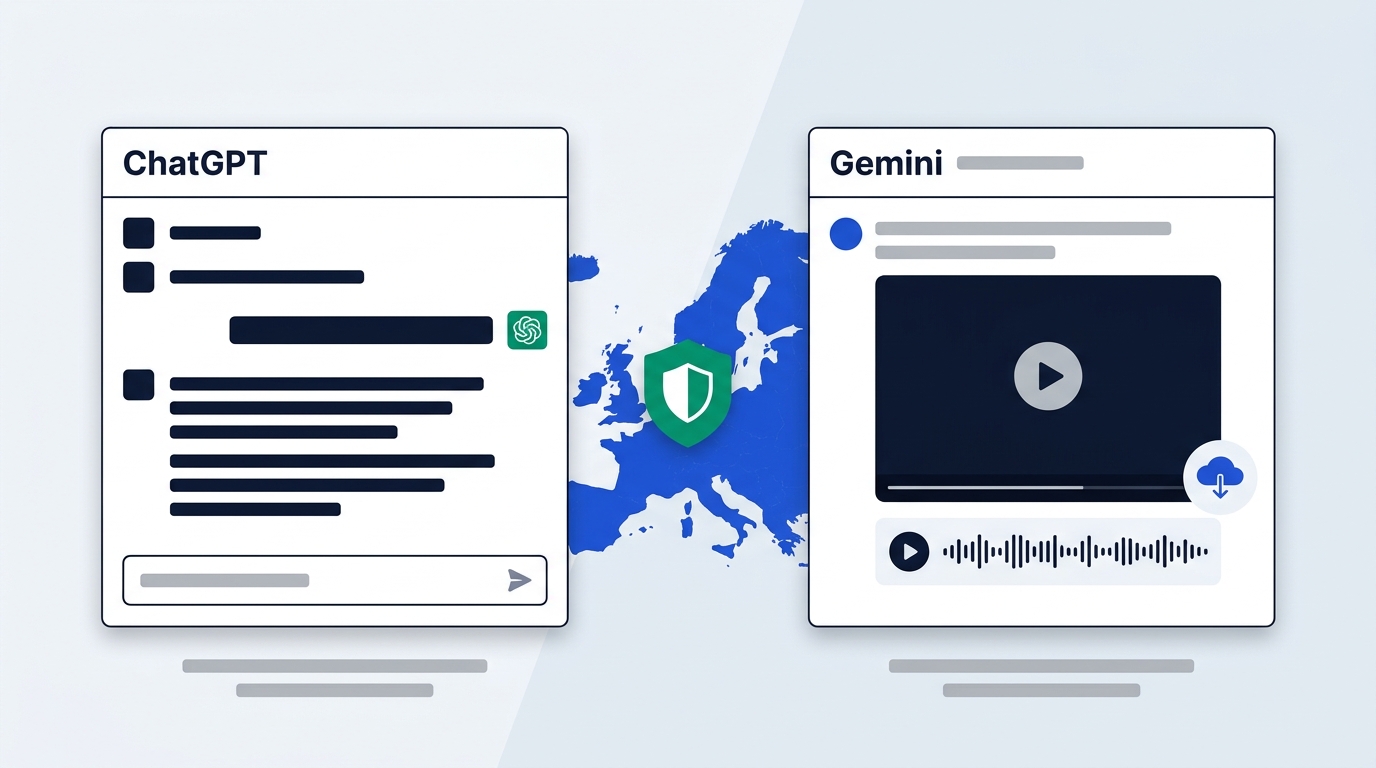
Gemini, backed by Google, is a strong fit for businesses already using Google Workspace. It excels if you need powerful multimedia generation, particularly video and music. It also benefits from bundled Google services like generous cloud storage. Its Enterprise plans offer critical data residency options for European companies, ensuring less friction for teams already on that stack.
ChatGPT, from OpenAI, is generally preferred for advanced coding, complex logical reasoning, and nuanced creative writing. Its extensive ecosystem of third-party plugins makes it versatile for integrating with various business tools. It is a solid choice for those needing raw AI power and custom AI agents, appealing to those building bespoke AI solutions.
For any European operation, data processing agreements (DPA) and the physical location of data storage are non-negotiable for GDPR compliance. Both tools offer free plans, but their specific limits and included features vary. This makes a close look essential for entry-level AI exploration. Your choice should align with your core business needs, existing tech stack, and paramount data security requirements.
| Feature | ChatGPT | Gemini |
|---|---|---|
| Free Plan | GPT-6 Luna (limited), text chats, limited uploads, image creation, voice. | Flash-Lite, image creation, Deep Research, Gemini Live, Canvas, Gem, Google Flow 3, 15 GB cloud storage. |
| Paid Plans (Individual) | Go (US$8/mo), Plus (US$20/mo), Pro (from US$100/mo) | Google AI Plus (₫132.000/mo), Google AI Pro (₫489.000/mo), Google AI Ultra (from ₫2.250.000/mo) |
| Flagship AI Models | GPT-6.1 Sol, GPT-6 Astra, GPT-6 Sol, GPT-6 Luna, GPT-5.6 series | Flash-Lite, Flash, Pro, Gemini 4 Argon, Veo, Lyria |
| Video Generation | No (Sora model discontinued) | Yes (Omni, Veo models, Google Flow 3) |
| Music Generation | No | Yes (Lyria 3 Pro) |
| Image Generation | Yes (GPT Image 2) | Yes (Nano Banana 2) |
| Max Codebase Input | (Not specified beyond general coding assistance) | 30,000 lines |
| Data Location (EU options) | Primarily US, EU SCCs for data transfers. Excludes training data for paid plans. | General Google infrastructure (global). Enterprise Standard/Plus offers explicit data residency options within EU. |
| Agentic AI | 'Dots' (Pro), Custom GPTs (Plus, Pro) | 'Gems' (all), Google Antigravity (Pro/Ultra), Project Genie (Ultra), Workflow Builder (Enterprise Business), ADK (Enterprise Standard/Plus) |
| Ecosystem Integration | Plugins, Connectors (Google Drive, SharePoint, GitHub, Dropbox) | Deep native integration with Google Workspace (Gmail, Drive, Docs, etc.) |
| Platform Availability | Web, iOS, Android, macOS, Windows desktop apps | Web, iOS, Android, macOS app, integrated into Google app on Windows |
Free Plans: What You Get
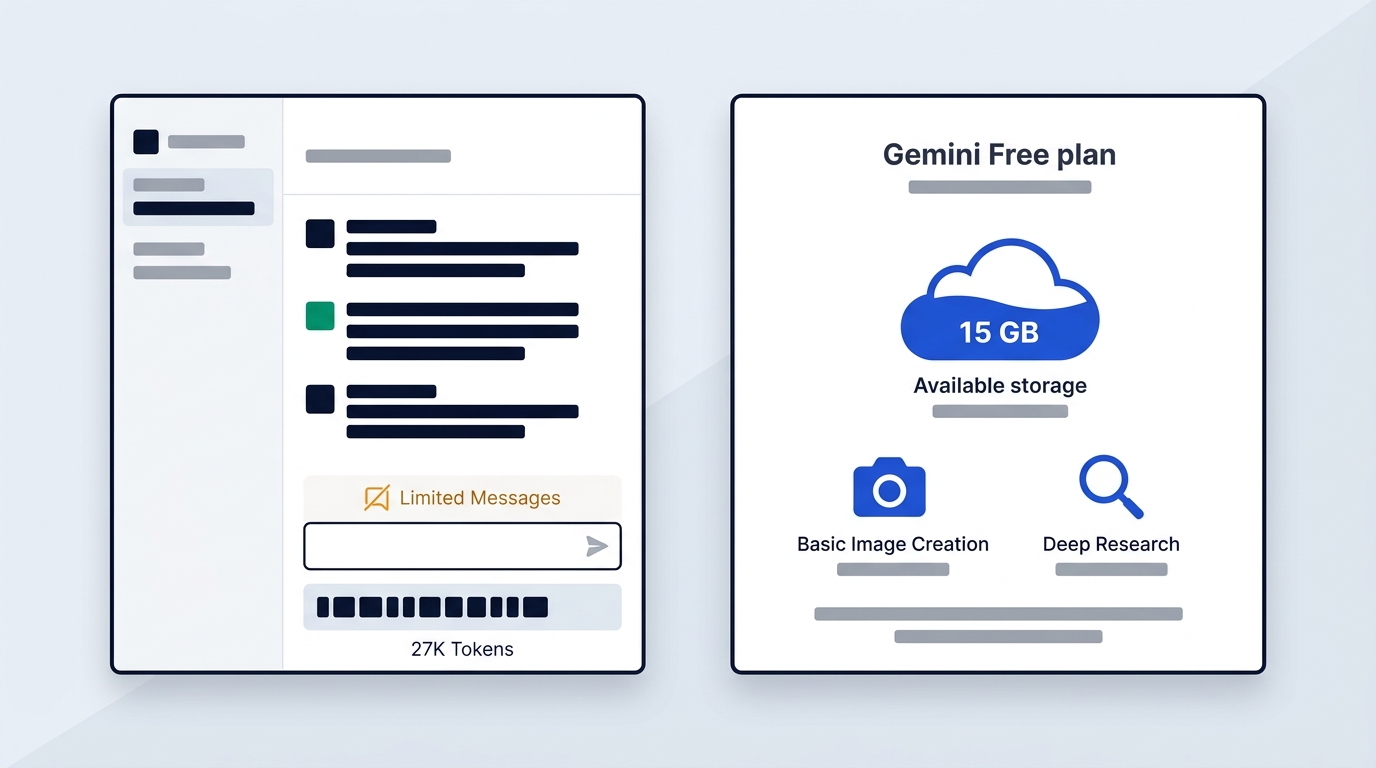
Both ChatGPT and Gemini offer free plans. These provide a taste of their AI capabilities without upfront cost. These tiers are useful for basic tasks and for evaluating which tool aligns better with your initial needs before committing to a paid subscription. Understanding the scope and limitations of these free offerings is essential for businesses looking to experiment with AI on a budget.
ChatGPT Free: This plan offers unlimited text chats using the GPT-6 Luna model. However, it comes with limitations on the number of messages, file uploads, image creation requests, and voice chats. You also get limited access to deep research capabilities, memory, Codex, and the ChatGPT Work desktop app. The GPT Instant total context window for free users is 27K tokens, which translates to an input maximum of approximately 12 pages of text. This plan focuses on giving broad access to core chat features with usage caps. (Source: ChatGPT pricing page, checked October 2026)
For a small startup or a solopreneur, ChatGPT's free tier is ideal for brainstorming initial content ideas or drafting short emails. However, a business user might quickly hit the limited message cap when trying to develop a marketing campaign or perform extensive research. The context window limits how much information the AI can process in a single interaction. This means you might need to break down complex tasks into multiple smaller prompts, which can be time-consuming.
What does Gemini Free offer?
Gemini Free: You get access to the Flash-Lite model, which is suitable for everyday tasks. This plan includes basic image creation, Deep Research, Gemini Live, Canvas, Gem, Google Flow 3 for AI filmmaking, and Gemini Notebook. A key differentiator here is the bundled 15 GB of shared cloud storage for Gmail, Drive, and Photos. Gemini's free offering integrates more deeply with Google's ecosystem from the start. (Gemini pricing page, checked October 2026)
Gemini's free plan is particularly beneficial for individuals or small businesses already embedded in the Google ecosystem. The inclusion of 15 GB of cloud storage adds immediate practical value, especially for those managing files and communications through Google services. Its basic image creation and Deep Research features make it suitable for initial explorations into visual content or quick market overviews. For example, a small business could use it to generate basic social media graphics or conduct preliminary competitor analysis. The "limited messages with uploads" on ChatGPT Free, compared to Gemini's more integrated approach, highlights a different philosophy for entry-level use.
When comparing the two, ChatGPT's free tier prioritizes core conversational AI with usage restrictions across modalities. You can do a lot with text, but other features like file uploads or image creation are quite limited. Gemini's free plan, conversely, offers a broader suite of Google ecosystem services and creative tools. The inclusion of cloud storage and specific creative tools like Google Flow 3 might provide more immediate value for businesses looking for basic AI assistance that touches on more than just text, without needing to integrate external services.
Free plans are for testing, not heavy tasks
Neither free plan is designed for heavy-duty business tasks or extensive, mission-critical operations. They both serve as excellent entry points to test basic AI assistance, generate initial ideas, or perform simple research. For European businesses, understanding these limits is important before committing to a paid plan. The free tiers can help validate whether the AI's core capabilities align with your workflow without financial investment. Evaluating how quickly you hit usage caps or how well the AI handles your typical tasks can guide your decision towards a more suitable paid tier or an entirely different platform.
Paid Plans: Features and Value for Business
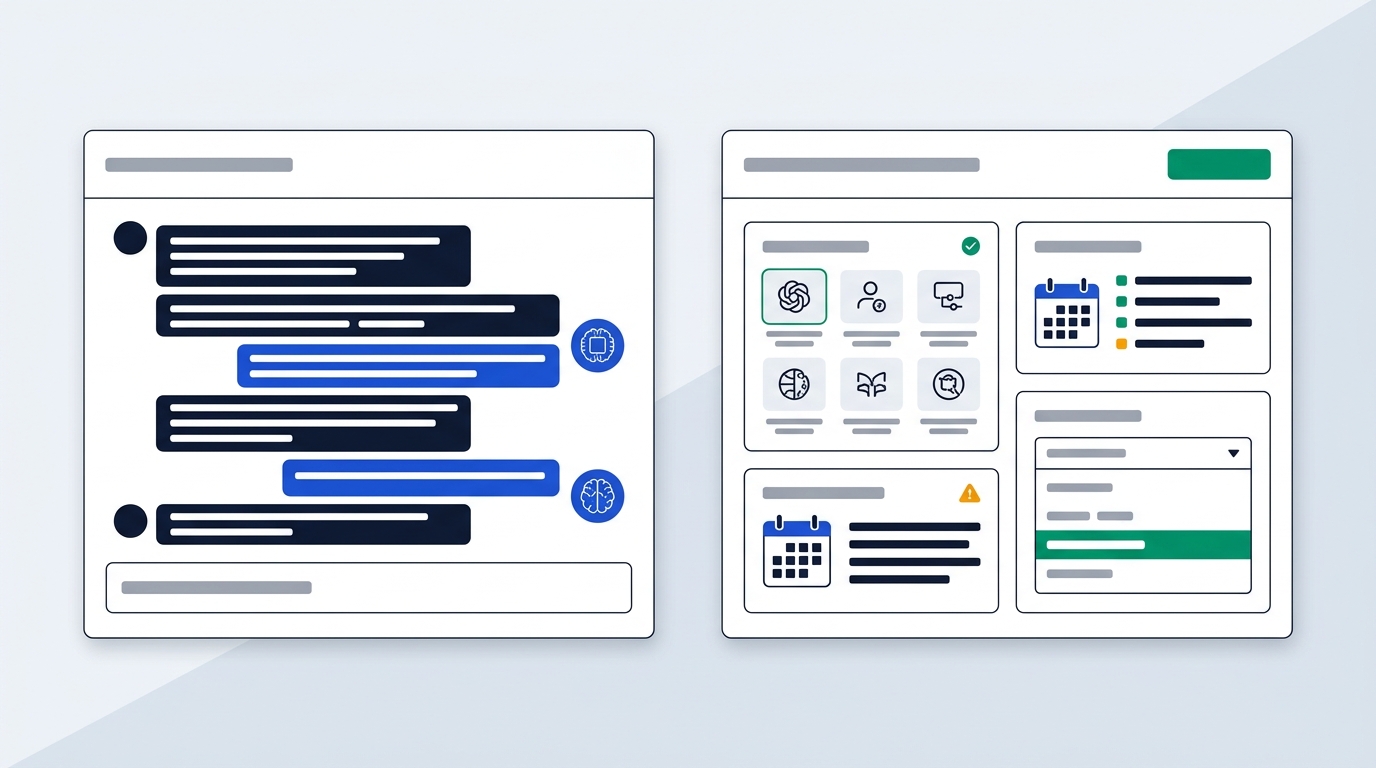
Moving beyond the free tiers, both Gemini and ChatGPT offer a range of paid plans. These are designed to cater to varying business needs, from individual professionals to large enterprises. The value proposition for each platform extends beyond just AI model access. It often bundles additional services that can significantly impact a business's operational efficiency and cost-effectiveness. Choosing the right paid plan requires a careful assessment of your team size, specific AI use cases, and budget.
ChatGPT Paid Plans (prices in US$):
- Go (US$8/month): This plan offers more messages, uploads, image creation, and voice chats compared to the free tier. It also includes longer memory. This plan may include ads.
The Go plan is designed for individual users or very small teams who need more capacity than the free tier but do not require advanced features. It is a stepping stone for those who find the free limits too restrictive for daily tasks like content drafting or basic research. The "longer memory" means the AI can retain context over more turns in a conversation, making interactions smoother. It suits budget-conscious users who want enhanced general AI assistance without the full suite of professional tools. - Plus (US$20/month): Building on the Go plan, Plus provides access to advanced reasoning models like GPT-6.1 Sol, GPT-6 Astra, GPT-6 Sol, and GPT-6 Luna, along with GPT-5.6 series models and Legacy models. It expands message and upload limits, offers more complex image creation, and enhanced deep research. You also get projects, scheduled tasks, custom GPTs, and expanded access to ChatGPT Work on desktop, web, and mobile. Early access to new features is also included.
The Plus plan is ideal for professionals and small teams focused on advanced work and productivity. Access to models like GPT-6.1 Sol and GPT-6 Astra enables more complex problem-solving, strategic planning, and nuanced content generation. For example, a marketing team could use it for in-depth market analysis or generating diverse content formats. "Expanded deep research" allows for more comprehensive reports, while "projects" and "scheduled tasks" help integrate AI into daily workflows for greater automation. Early access to new features ensures users stay at the forefront of AI capabilities. - Pro (from US$100/month): Aimed at research and coding, the Pro plan offers a choice of three usage tiers. It features Pro reasoning powered by GPT-6 Astra, longer Codex and ChatGPT Work sessions, and includes 'Dot,' an always-on agent. You get unlimited and faster image creation, maximum deep research, and expanded memory and context. This plan provides a 128K GPT Instant context window and a 400K GPT Reasoning context window. It also offers monthly API credits to build your own applications and agents. (ChatGPT pricing page, checked October 2026)
What does the Pro plan offer?
The Pro plan is tailored for R&D teams, AI product developers, and researchers who require maximum AI power and flexibility. "Pro reasoning powered by GPT-6 Astra" indicates superior problem-solving for highly complex challenges, such as scientific simulations or advanced code optimization. "Longer Codex and ChatGPT Work sessions" are crucial for developers needing extended coding assistance. 'Dot' as an always-on agent provides continuous, proactive assistance, automating monitoring or data collection tasks. The substantial context windows (128K GPT Instant, 400K GPT Reasoning) allow for analysis of massive datasets or extensive codebases. The inclusion of API credits is a significant advantage for businesses looking to embed ChatGPT's AI directly into their own applications or develop bespoke AI solutions, offering a pathway for deep, custom integration and automation.
Gemini Paid Plans (prices in VND for individual plans, US$ for Enterprise):
- Google AI Plus (₫ 132.000/month): This tier offers access to the Flash model and provides 2x the usage compared to the free plan. It includes 200 Google Flow credits, 400 GB of shared cloud storage, and Gemini integration in Gmail and Vids.
The Google AI Plus plan is suitable for individuals or small content creators who want to leverage Google's AI capabilities more extensively. Access to the Flash model offers faster responses for simpler tasks. The 200 Google Flow credits enable more creative video projects, and 400 GB of shared cloud storage is a significant upgrade for managing digital assets. Integration with Gmail and Vids streamlines common workflows, such as drafting emails or creating short video snippets directly within Google applications. This plan offers a good balance of enhanced AI features and practical Google ecosystem benefits for everyday productivity. - Google AI Pro (₫ 489.000/month): With this plan, you get access to Gemini 4 Argon, Pro, and Flash models, offering 4x the usage of the free plan. It provides 1,000 Google Flow credits, Google Antigravity (a basic limit for the agentic coding platform), 5 TB of shared cloud storage, and YouTube Premium Lite.
Google AI Pro targets power users, marketing teams, and developers within the Google ecosystem. Access to the more powerful Gemini 4 Argon and Pro models enables deeper analysis and more sophisticated content generation. The 1,000 Google Flow credits further expand multimedia creation possibilities, making it useful for teams producing a high volume of visual content. Google Antigravity offers a basic entry into agentic coding, appealing to developers looking to automate tasks within Google's framework. The substantial 5 TB of cloud storage and YouTube Premium Lite add considerable value for content consumption and storage management, making it a comprehensive package for integrated productivity and creative work. - Google AI Ultra (from ₫ 2.250.000/month): This is the highest tier, providing maximum access to Gemini 4 Argon, Pro, and Flash models. It offers 5-20x the Pro usage, 10,000-25,000 Google Flow credits, Project Genie for interactive world creation, and 20+ TB of shared cloud storage. It also includes a full YouTube Premium individual plan.
The Google AI Ultra plan is designed for large creative agencies, advanced R&D teams, and heavy multimedia users who demand the absolute peak of Google's AI and cloud services. With "maximum access" to top-tier models, you get unparalleled performance for the most complex tasks. The massive allocation of Google Flow credits (up to 25,000) supports extensive video and multimedia production. Project Genie, a groundbreaking feature for interactive world creation, opens new avenues for immersive content development. With 20+ TB of cloud storage and a full YouTube Premium plan, this tier represents the ultimate package for integrated, high-volume creative and analytical work within the Google ecosystem.
Gemini Enterprise Business: Features and target audience
Gemini Enterprise Plans (prices in US$):
- It offers secure connections to productivity tools like Microsoft 365, Google Workspace, HubSpot, and Jira. It includes a no-code workflow builder for custom agents and provides data storage/indexing up to 25 GiB per license.
This plan is tailored for small to medium-sized businesses that want to integrate AI into their operations without significant IT overhead. The "no complex technical setup" makes it accessible. "Secure connections" to popular productivity tools allow smooth AI assistance across existing workflows. For example, a sales team could use it to automate lead qualification in HubSpot or generate summarized reports from Jira. The no-code workflow builder empowers business users to create custom agents for tasks like automating email responses or data entry, enhancing efficiency across the team. Data storage and indexing up to 25 GiB per license support internal knowledge bases and document analysis. - Gemini Enterprise Standard/Plus (from US$30/license/month): This tier adds higher Gemini usage limits and integration with custom agents built using the Agent Development Kit (ADK). It also includes advanced security features like VPC Service Controls (VPC-SC) and Customer Managed Encryption Keys (CMK), along with crucial data residency options for compliance needs. (Gemini pricing page, checked October 2026)
Enterprise Standard/Plus: Advanced security and data residency
The Enterprise Standard/Plus plans are for larger organizations and enterprises that require granular control, advanced security, and specific compliance capabilities. Higher Gemini usage limits support large-scale AI deployments. Integration with custom agents built using the ADK allows IT departments to develop highly tailored AI solutions for unique business processes. The inclusion of VPC Service Controls (VPC-SC) and Customer Managed Encryption Keys (CMK) provides enhanced security and data governance, critical for industries with strict regulatory requirements. Most importantly for European businesses, "data residency options" allow organizations to choose where their data is stored, helping meet national data sovereignty laws and GDPR compliance requirements. This level of control is a non-negotiable for many large European corporations.
Gemini's paid plans frequently bundle significant benefits from the wider Google ecosystem. This includes substantial increases in cloud storage and premium YouTube access. These can offer greater 'total value' for businesses already using Google services. ChatGPT's Pro plan, in contrast, focuses on raw AI power, API credits, and agentic capabilities. It appeals to businesses with specific development, high-compute, or integration needs. When evaluating, consider not just the monthly fee but the entire suite of included services and model access that best align with your business's operational requirements and existing software stack. For a European business, the decision matrix should also heavily weigh the data location and compliance features offered at each tier.
Core AI Models and Capabilities
At the heart of both ChatGPT and Gemini are sophisticated AI models. Each has distinct strengths in processing and generating content across various modalities. Understanding these core models helps in determining which platform is better suited for specific tasks. It also helps in understanding how they can drive business outcomes, from content creation to complex problem-solving.
ChatGPT Models: The platform leverages a suite of GPT-6 models. This includes GPT-6.1 Sol, designed for advanced reasoning, and GPT-6 Astra, powering Pro reasoning. Other models like GPT-6 Sol and GPT-6 Luna offer different balances of speed and capability. The platform also provides access to the GPT-5.6 series (Sol, Pro, Terra, Luna) for varying levels of efficiency and power, plus GPT-5 Thinking Mini and Legacy models on higher-tier plans. Users can often adjust the intelligence level of selected models to fine-tune responses. (ChatGPT pricing page, checked October 2026; PCMag, checked March 2026)
ChatGPT's models are renowned for their ability to handle intricate logical problems and generate coherent, contextually rich text. GPT-6.1 Sol, for instance, excels in tasks requiring deep analytical thought. These tasks include analyzing complex financial reports, drafting legal summaries, or dissecting scientific papers. GPT-6 Astra, powering Pro reasoning, further enhances this capability for highly specialized applications. The ability to adjust the intelligence level of models is a significant advantage for businesses. It allows users to balance between speed for routine tasks and meticulous accuracy for critical projects, optimizing both cost and output quality. This fine-tuning ensures that the AI's responses are not just accurate but also tailored to the specific demands of the task, reducing the need for extensive post-generation editing.
What Gemini models are available?
Gemini Models: Gemini's ecosystem includes Flash-Lite for its free tier, Flash for Google AI Plus, and the more powerful Pro and Gemini 4 Argon models available in Google AI Pro/Ultra plans. Google also offers specialized models such as Veo 3.1 Lite (trial) and Veo 3 (paid) for video, and Lyria 3 Pro for music generation. Gemini models are designed to be multimodal from the ground up, handling text, images, audio, and video effortlessly. (Gemini pricing page, checked October 2026)
Gemini's 'multimodal from the ground up' design means it processes different types of data (text, images, audio, video) in a unified way. This can lead to more coherent and contextually aware outputs when dealing with diverse inputs. For example, a marketing team could upload a video, ask Gemini to summarize its content, identify key themes, and then generate text for a social media post, all within a single interaction. The Flash model is excellent for quick summaries or rapid ideation. For more intensive analytical tasks, such as in-depth market research or complex data interpretation, the Pro and Gemini 4 Argon models are well suited. The availability of specialized models for video (Veo) and music (Lyria) further enhances Gemini's capabilities for businesses in creative industries or those requiring rich multimedia content.
Both platforms are multimodal, effectively processing text, images, and audio. However, Gemini holds a distinct advantage in native video and music generation capabilities. These are crucial for content-heavy businesses. For complex reasoning tasks, ChatGPT is often recognized for its strong performance, especially with its advanced GPT-6.1 Sol and Astra models, which are built for intricate problem-solving.
ChatGPT excels at creative writing and research
In creative writing, ChatGPT generally produces more consistent and human-like responses. This makes it a strong option for content generation and long-form writing tasks. This is particularly valuable for businesses needing to generate marketing copy, blog posts, scripts, or engaging narratives that resonate with human readers. The nuance and stylistic consistency of ChatGPT's output can significantly reduce the time and effort required for editorial review.
Both tools offer deep research functionalities. ChatGPT can provide deeper, more accurate responses to complex web queries. Gemini's report interface is noted for its ease of navigation and a convenient one-click export to Google Docs. This streamlines workflows for users already within the Google Workspace ecosystem. For a business conducting market research or competitive analysis, ChatGPT's depth can uncover more granular insights. Gemini's smooth integration into Google Docs simplifies the process of compiling and sharing those findings within a team. The choice here depends on whether depth of insight or workflow efficiency within a specific ecosystem is the higher priority.
Creative Content: Images, Video, and Audio
For businesses that rely on generating visual and auditory content, the capabilities of AI chatbots in this domain are a significant deciding factor. Both ChatGPT and Gemini offer advanced tools, but with clear distinctions in their offerings, especially concerning video and music generation. The ability to create high-quality multimedia content in-house can lead to substantial cost and time savings for marketing, advertising, and content creation teams.
Image Generation: Both ChatGPT, utilizing GPT Image 2 (a successor to DALL-E), and Gemini, powered by Nano Banana 2, provide world-class image generation. Gemini typically generates a set of four images per prompt, offering more options immediately, while ChatGPT generates one. Gemini also provides a higher daily image generation quota for free users.
For businesses, image generation is invaluable for creating marketing visuals, social media content, product mock-ups, and internal presentation graphics. GPT Image 2 is known for strong visual detail and text rendering, making it suitable for creating complex diagrams with text or narrative-driven comics. Nano Banana 2 also produces high-quality images. Gemini's approach of generating four images per prompt offers an immediate advantage for iterative design. It allows users to quickly choose the best option or refine their prompt based on a wider initial selection. This can accelerate the creative process for graphic designers and marketing professionals. The higher daily quota for free users on Gemini also means smaller businesses can experiment more extensively with visual content without immediate financial commitment.
Image editing versus recognition: Gemini or ChatGPT?
Image Editing and Recognition: Gemini shows better preservation of original image color and introduces fewer artifacts during image editing, though sometimes with a slight increase in blur. Conversely, ChatGPT excels in image recognition, identifying more components in complex images with greater specificity.
Gemini's strength in preserving original image color during editing is critical for businesses with strict brand guidelines. It ensures consistency across all visual assets. This is important for marketing and branding teams. ChatGPT's superior image recognition, on the other hand, has practical applications in areas like inventory management (identifying specific product components from photos), quality control (detecting defects in manufactured goods), or even scientific research (analyzing complex biological images). For example, providing a picture of computer internals, ChatGPT was able to identify more components with greater specificity. This demonstrates its strong analytical prowess with visual data. The choice here depends on whether your business needs to primarily edit existing visuals while maintaining integrity or analyze and understand new images in detail.
Video Generation: Gemini is the clear leader in video generation. Its Omni and Veo models (including Veo 3.1 Fast, Veo 3) can create realistic videos with integrated audio. These models support character continuity and allow for extensive fine-tuning. Google Flow 3, available with Gemini, further enhances AI filmmaking capabilities. ChatGPT's comparable Sora model was discontinued as of April 26, 2026, leaving it without native video generation.
Gemini's powerful video generation capabilities
This is a major differentiator. For businesses, Gemini's video generation capabilities provide a major advantage. They can be used to create explainer videos, social media advertisements, internal training modules, product demos, or even short promotional clips, all from text prompts. The ability to generate realistic videos with integrated audio significantly reduces the need for expensive video production teams. Features like character continuity ensure consistency across generated scenes, and extensive fine-tuning options allow creators to achieve a specific aesthetic or storytelling tone. Google Flow 3 provides a creative studio for AI filmmaking, giving users more granular control over their video projects. The discontinuation of ChatGPT's Sora model means businesses specifically needing AI-powered video creation will find Gemini to be the only viable native option among the two. You can find other AI video tools compared on SaaSEuro, such as HeyGen vs Synthesia.
Music Generation: Gemini offers native AI music generation through its Lyria 3 Pro engine. This can produce tracks up to three minutes long. It includes guardrails to prevent mimicking individual artists and adds audio watermarks to generated content. ChatGPT does not provide native music generation capabilities.
Gemini's Lyria 3 Pro engine opens up new possibilities for businesses to generate custom background music for videos, jingles for advertisements, podcast intros/outros, or even unique soundscapes for immersive experiences. The ability to create tracks up to three minutes long provides significant flexibility. The inclusion of guardrails, such as preventing the mimicry of individual artists and adding audio watermarks, addresses ethical and copyright concerns. This is crucial for businesses operating in a sensitive creative landscape. For businesses looking to enhance their multimedia content with bespoke audio, Gemini offers a comprehensive solution that ChatGPT currently lacks.
For businesses focused on creating visual and auditory content, Gemini's comprehensive multimedia suite, especially its video and music generation, offers a substantial advantage over ChatGPT. If your content strategy involves rich, multimodal output, Gemini is a more complete solution that can significantly streamline your content production workflows and reduce external vendor costs.
Coding, Automation, and Developer Tools
For developers, software teams, and businesses looking to automate tasks, generate code, or enhance their development workflows, both AI chatbots provide powerful features. However, their specific strengths and integrated tools cater to slightly different needs. One often excels in raw coding prowess and the other in agentic automation within a broader ecosystem.
Coding Assistance: ChatGPT is widely recognized as a top AI coding assistant. It performs well for complex coding tasks and consistently delivers reliable results.
ChatGPT's strength in coding assistance lies in its ability to generate complete code blocks, provide solutions for complex algorithms, and assist with various programming languages and frameworks. Developers can use it for tasks such as creating API integrations, writing backend logic, developing data processing scripts, or even generating boilerplate code. This significantly accelerates the development cycle. Its consistent and reliable output helps reduce errors and ensures a higher quality codebase, which is crucial for software development teams.
Gemini also offers comprehensive coding features. It allows users to develop complete code blocks, create unit tests, and automate repetitive programming tasks. It can analyze and solve complex problems within large codebases, handling up to 30,000 lines of code and suggesting performance optimizations. (Gemini pricing page, checked October 2026)
Gemini's coding capabilities are formidable, especially for enterprise-level projects involving large codebases. The ability to process up to 30,000 lines of code means it can assist with refactoring, code audits, or understanding legacy systems. Automating repetitive programming tasks like data validation or report generation can free up developers to focus on higher-level design and architecture. Generating unit tests automatically also improves code quality and reduces manual testing efforts, making it a valuable asset for quality assurance and continuous integration pipelines.
Gemini debugs complex code with detailed guidance
Debugging: Both platforms can assist with debugging. Gemini is specifically noted for its ability to debug complex original codebases, providing detailed explanations and step-by-step guidance to resolve issues. (Gemini pricing page, checked October 2026)
Debugging is a critical and often time-consuming part of software development. Gemini's capacity to analyze complex original codebases and offer detailed explanations for errors, along with step-by-step guidance, can drastically reduce debugging time. This means developers can quickly pinpoint the root cause of issues and implement fixes, minimizing downtime and improving overall software reliability. ChatGPT also aids in debugging by suggesting corrections and identifying logical flaws in code.
Specific Tools and Agents:
- ChatGPT: Provides access to Codex, which is limited in Free and Go plans but expanded in Plus and Pro. ChatGPT Work, a desktop application, is limited in Free/Go but offers full access in Plus/Pro. A broad ecosystem of Plugins is available across all plans. The Pro plan also includes 'Dots,' an always-on agent, and allows for the creation of custom GPTs. (ChatGPT pricing page, checked October 2026)
Codex is a powerful AI tool for understanding and generating code, making it invaluable for developers. ChatGPT Work, as a desktop app, provides a dedicated environment for coding-related tasks, offering smooth integration into a developer's workflow. The extensive Plugin ecosystem allows developers to connect ChatGPT to their Integrated Development Environments (IDEs), version control systems (like GitHub), or project management tools, extending its functionality significantly. 'Dots' functions as a persistent, proactive assistant, automating tasks such as monitoring code repositories for changes, initiating automated tests, or fetching relevant documentation. Custom GPTs empower developers to create specialized AI bots tailored for specific coding tasks, such as generating code snippets in a particular framework or performing code reviews based on internal standards.
- Gemini: Integrates specific tools like Google Antigravity, an agentic coding platform available in AI Pro/Ultra plans. Google Flow 3 (available on all plans) offers a creative studio for visual projects, and Project Genie (Ultra plan) enables the creation of interactive worlds. Gemini also supports building custom agents via its no-code Workflow Builder in the Enterprise Business plan and through the Agent Development Kit (ADK) in Enterprise Standard/Plus plans. (Gemini pricing page, checked October 2026)
Advanced developer tools and agentic coding
Google Antigravity provides a dedicated environment for agentic coding, allowing developers to build and deploy AI agents that can perform complex, multi-step tasks. Google Flow 3, while primarily for creative visuals, can also be leveraged by developers for generative art or interactive coding projects. Project Genie, on the Ultra plan, is an advanced tool for creating real-time interactive worlds, opening possibilities for game development, simulations, or immersive training environments. For enterprise clients, the no-code Workflow Builder allows citizen developers to automate business processes without writing code, while the Agent Development Kit (ADK) provides professional developers with tools to build highly sophisticated, custom AI agents. These integrate deeply with enterprise systems, ensuring reliable automation and intelligent decision support.
API Access: ChatGPT's Pro plan includes monthly API credits. This can be crucial for businesses looking to integrate AI capabilities into their own applications and agents, offering a pathway for custom development and automation. (ChatGPT pricing page, checked October 2026)
API access is a strategic asset for businesses. It allows developers to embed ChatGPT's powerful AI models directly into their proprietary software, customer-facing applications, or internal tools. This enables the creation of custom chatbots for customer support, automated data pipelines, personalized content generation systems, or intelligent analytics engines. This offers unparalleled flexibility and scalability for AI integration across the business. The availability of API credits reduces the initial cost barrier for development and experimentation.
Coding: ChatGPT for plugins, Gemini for agents
For deep, complex coding tasks and a mature plugin ecosystem, ChatGPT holds an edge. Gemini, however, offers powerful tools for agent development and large-scale code analysis, especially for those within the Google ecosystem. The choice depends on whether your development team prioritizes raw AI performance and a broad third-party ecosystem (ChatGPT) or integrated agentic capabilities and large codebase handling within Google's cloud infrastructure (Gemini).
Ecosystem Integration and Agentic AI
The ability of an AI chatbot to integrate smoothly with other tools and function as an intelligent agent within your existing workflow is crucial for business efficiency. It reduces context switching and automates complex processes. Both Gemini and ChatGPT approach this with different philosophies, largely dictated by their parent companies' broader ecosystems.
Google Ecosystem Integration (Gemini's Strength): Gemini is deeply integrated into the Google ecosystem. You can directly ask Gemini to retrieve real-time information from various Google apps, including Gmail, Drive, Maps, Flights, Hotels, YouTube, Docs, Keep, and Photos. This is done by typing '@[app name]' within the chat interface. Gemini also features 'Personal Intelligence' (currently US only), which proactively pulls context from your Google apps for more personalized responses without explicit prompting. This level of native, proactive integration is a significant differentiator for Gemini. (Gemini pricing page, checked October 2026)
For businesses heavily reliant on Google Workspace, Gemini's native integration offers unparalleled convenience. For instance, a sales manager could type "@Gmail summarize emails from [client name] last week" to get a quick overview. Or, "@Drive find the latest version of [project document]" without leaving the Gemini interface. A marketing team planning a trip could ask Gemini to pull live data from Google Flights and Hotels directly into a conversation, then export the itinerary to Google Docs. 'Personal Intelligence,' while currently US-only, aims to further streamline workflows by understanding user preferences and context across Google apps. This potentially offers proactive suggestions or personalized content, reducing the need for explicit instructions. This deep integration saves significant time by eliminating the need to switch between applications, making workflows smoother and more efficient for Google-centric teams.
ChatGPT: Broad integrations and open plugin ecosystem
ChatGPT Integrations: ChatGPT offers a broader, more open ecosystem for third-party tools through its extensive Plugin store, which is available across all plans. It can connect to services like Google Drive, SharePoint, GitHub, and Dropbox via Connectors, available on Team, Enterprise, and Edu plans. ChatGPT also includes a built-in browser for web access, enhancing its ability to interact with online information. (ChatGPT pricing page, checked October 2026; G2, checked April 2026)
ChatGPT's strength lies in its versatility and adaptability to diverse tech stacks. The Plugin store allows businesses to extend ChatGPT's capabilities to a vast array of third-party applications. These range from CRM systems (like Salesforce) to project management tools (like Asana) and analytics platforms. This means a business can integrate ChatGPT into its existing software environment, regardless of whether it is Google-centric. Connectors, available for higher-tier plans, offer deeper and more direct integrations with enterprise systems like SharePoint, GitHub, and Dropbox. This enables direct data exchange and automation across complex organizational infrastructures. The built-in browser ensures ChatGPT can always access up-to-date information from the web, making it a powerful research and information-gathering tool even without specific app integrations.
Agentic AI Capabilities:
- ChatGPT: The Pro plan features 'Dots,' an always-on agent designed for continuous assistance. Users on Plus and Pro plans can also create and share 'Custom GPTs,' which are specialized AI mini-applications tailored for specific tasks or workflows. (ChatGPT pricing page, checked October 2026)
How can businesses use custom agents?
'Dots' as an always-on agent can proactively monitor data, provide real-time alerts, or initiate tasks based on predefined conditions. This offers continuous support for critical business operations. Custom GPTs are a powerful tool for businesses to create specialized AI assistants for internal use. For example, a legal firm could create a Custom GPT trained on its specific case precedents to assist with legal research. Or, a customer support team could deploy a GPT tailored to answer frequently asked questions about their products, ensuring consistent and accurate responses. These custom agents can significantly streamline internal processes and enhance service delivery.
- Gemini: Offers 'Gems' for all users, which function as specialized AI mini-apps and custom workflows. Higher-tier plans include Google Antigravity, an agentic coding platform, and Project Genie, for creating interactive worlds. Gemini's Enterprise plans further support building custom agents via a no-code Workflow Builder and an Agent Development Kit (ADK), providing extensive options for enterprise-level automation. (Gemini pricing page, checked October 2026)
'Gems' in Gemini are similar to Custom GPTs. They allow users to create tailored AI experiences for specific tasks or preferences. Google Antigravity, available in higher tiers, serves as a platform for building and deploying more complex, multi-step AI agents, enabling sophisticated automation for developers. Project Genie, on the Ultra plan, goes further by allowing the creation of interactive, real-time worlds. This can have applications in simulations, virtual training, or immersive marketing experiences. For enterprise clients, the no-code Workflow Builder empowers business users to automate routine tasks and create custom workflows without needing programming skills, fostering citizen development. The Agent Development Kit (ADK) provides advanced tools for IT teams to build highly customized and deeply integrated AI agents that can interact with various enterprise systems, supporting complex business process automation and intelligent decision-making.
Where can you access each platform?
Platform Availability: Both chatbots are accessible via web browsers and dedicated iOS and Android mobile apps. ChatGPT extends its reach with dedicated macOS and Windows desktop applications. Gemini has a macOS app, and some of its features are integrated into the Google app on Windows, reflecting its ecosystem-centric approach.
ChatGPT's dedicated desktop applications offer a consistent and optimized user experience across different operating systems. This can be beneficial for users who prefer native apps over browser interfaces. Gemini's integration into the Google app on Windows, rather than a standalone desktop app, underscores its strategy of embedding AI capabilities within Google's broader software suite. For mobile users, both platforms offer full-featured apps, ensuring productivity on the go, though feature parity between web and mobile versions can sometimes vary slightly.
For businesses heavily reliant on Google Workspace, Gemini provides unmatched native integration and proactive contextual understanding, streamlining workflows significantly. ChatGPT, however, offers greater flexibility and a wider range of third-party plugins and custom GPTs. This makes it suitable for diverse workflows and integration with non-Google tools. The choice depends on your existing tech stack and whether you prioritize deep ecosystem integration or broad, customizable third-party connectivity.
Context Windows and Data Handling
The capacity of an AI to process and recall information, known as its context window, along with its ability to handle various data inputs, is crucial for complex business tasks. A larger context window allows the AI to maintain coherence over longer conversations and analyze more extensive documents. This directly impacts the depth and accuracy of its output. There are significant differences between Gemini and ChatGPT in these areas, which can determine their suitability for data-intensive business operations.
Context Window Sizes: The context window determines how much information an AI can process and remember in a single interaction. For ChatGPT, the GPT Instant total context window is 27K tokens for Free users, 54K for Go/Plus users, and 128K for Pro users. The GPT Reasoning total context window is 256K for Go/Plus users, and 400K for Pro users. (ChatGPT pricing page, checked October 2026)
Gemini offers a substantial context window. Its Pro plan supports up to 1 million tokens, enabling it to analyze vast amounts of information in one go. (Gemini pricing page FAQ, checked October 2026)
For businesses, a larger context window is paramount for tasks involving extensive documentation, long-form content generation, or complex data analysis. A 1 million token context window, for instance, is roughly equivalent to analyzing several full-length novels or hours of audio in a single prompt. This capability is critical for legal firms reviewing lengthy contracts, research departments summarizing scientific papers, or financial analysts processing detailed annual reports. A smaller context window means users might need to break down their queries into multiple parts. This leads to more fragmented interactions and a higher chance of the AI losing critical context, which can reduce accuracy and increase processing time.
Input maximums: ChatGPT versus Gemini
Input Maximums:
- ChatGPT: For GPT Instant, the input maximum is approximately 12 pages of text for Free users, about 40 pages for Go/Plus, and around 250 pages for Pro. For GPT Reasoning, it is approximately 320 pages for Go/Plus, and about 680 pages for Pro. (ChatGPT pricing page, checked October 2026)
- This makes it highly capable for extensive document analysis and large-scale code projects. (Gemini pricing page, checked October 2026)
These input maximums directly translate to the scale of tasks a business can perform. For development teams, processing 30,000 lines of code allows for comprehensive code audits, refactoring suggestions, or understanding the functionality of large, complex software projects. ChatGPT's Pro plan, with up to 680 pages for GPT Reasoning, is also very capable for significant text analysis, but Gemini's higher limits offer an advantage for truly massive datasets.
File Upload Capabilities:
- ChatGPT: Supports limited file uploads for Free users, with full capabilities for Go, Plus, and Pro plans. It handles formats like DOCX, PDF, TXT, PPTX, CSV, and XLSX, with a maximum file size of 512 MB. Free users are limited to three file uploads per day. (ChatGPT pricing page, checked October 2026; G2, checked April 2026)
- Gemini: Supports a wider array of formats, including text, images, audio, video, DOCX, PPTX, XLSX, CSV, and Google files. It allows up to 10 uploads at once, with individual limits of 50MB for documents and 30MB for images. Video uploads can be up to 45 minutes without audio or 1 hour with audio.
Supported file formats and upload limits
The variety of supported file formats and upload limits directly impacts a business's ability to integrate AI into diverse workflows. ChatGPT's support for common document and spreadsheet formats is solid for text-based analysis. However, Gemini's broader support, including audio and video, is a significant advantage for multimedia-rich businesses. For example, a media company could upload a 45-minute video to Gemini for transcription and summarization. Or, a marketing team could analyze customer feedback from audio recordings. The ability to upload up to 10 files at once on Gemini streamlines batch processing tasks, which is useful for data scientists or researchers handling multiple datasets simultaneously. ChatGPT Free's limit of three file uploads per day might be restrictive for active users, necessitating an upgrade for consistent use.
Memory and Retention: ChatGPT offers limited memory for Free users, with expanded memory on Go, Plus, and Pro plans, allowing it to retain context from past chats. Gemini provides persistent memory, which helps it learn from past conversations. It also offers a 'Personal Intelligence' feature (US only) that proactively pulls context from Google apps. (ChatGPT pricing page, checked October 2026; Zapier, checked March 2026)
Consistent memory is vital for maintaining continuity in long-running projects, customer interactions, or personalized marketing campaigns. When an AI remembers past conversations, it can provide more relevant and personalized responses, reducing the need for users to repeat information. Gemini's persistent memory and its 'Personal Intelligence' feature, though geographically limited, aim to create a more intuitive and context-aware user experience by proactively leveraging information from across a user's Google ecosystem. This can lead to more efficient and personalized interactions, for instance, in customer support where the AI can recall previous issues or preferences.
Which chatbot has more recent knowledge?
Knowledge Cutoff: Gemini 3.1 Pro has a knowledge cutoff of January 2025, providing access to more recent information. ChatGPT's 5.3 series models have a knowledge cutoff of August 31, 2025.
For businesses operating in fast-evolving sectors, access to the most current information is critical. Whether it is for market intelligence, competitive analysis, legal and regulatory updates, or real-time news analysis, a more recent knowledge cutoff means the AI can provide more accurate and relevant insights. Gemini's slightly more recent cutoff date could be an advantage for businesses that frequently need up-to-the-minute information to inform their decisions, reducing the risk of basing strategies on outdated data.
When evaluating these capabilities, businesses must consider the scale and nature of their data. If your operations involve processing extremely large documents, extensive codebases, or diverse multimedia files, Gemini's higher input maximums and broader file support may offer a distinct advantage. For nuanced, text-heavy analysis and long conversational contexts, ChatGPT's expanded context windows in its higher tiers remain highly competitive. The trade-off between larger context windows and potential processing speed or cost should also be a consideration.
Data Privacy, GDPR, and European Compliance
For European businesses, data privacy and compliance with regulations like GDPR are paramount. The General Data Protection Regulation (GDPR) imposes strict rules on how personal data is collected, processed, and stored. This is especially true when data is transferred outside the European Economic Area (EEA). Understanding how Gemini and ChatGPT handle data location and protection is critical for ensuring legal compliance and maintaining customer trust.
ChatGPT (OpenAI) Data Practices:
- Data Location: OpenAI's infrastructure for ChatGPT primarily uses Microsoft Azure and OpenAI's own systems. These are located in the United States.
For European businesses, data processing in the United States raises concerns regarding cross-border data transfers under GDPR. The US does not have an adequacy decision from the European Commission, meaning that additional safeguards are required for data transfers to be lawful. - Data Protection: OpenAI provides an Enterprise Data Processing Agreement (DPA) that includes EU Standard Contractual Clauses (SCCs) for data transfers outside the EU. Importantly, customer data from Team, Enterprise, and API plans is explicitly excluded from being used for training OpenAI's AI models by default.
The inclusion of EU Standard Contractual Clauses (SCCs) in OpenAI's DPA is a critical mechanism for legitimizing data transfers from the EU to the US. However, following the Schrems II ruling, reliance on SCCs alone requires additional due diligence. This includes a Transfer Impact Assessment (TIA), to ensure that the data importer (OpenAI) can genuinely uphold EU data protection standards against potential US government access. The commitment that customer data from Team, Enterprise, and API plans is not used for training AI models by default is a significant reassurance for businesses concerned about their proprietary and sensitive information. This feature helps address data minimization and purpose limitation principles under GDPR. You can learn more about GDPR Data Processing Agreements and Data Processing Addendums.
Gemini data location and residency options
Gemini (Google) Data Practices:
- Data Location: For individual and consumer-grade Gemini plans, Google's general data processing practices apply. These often involve data storage in the US and other global data centers. However, Gemini's Enterprise Standard/Plus plans explicitly offer 'data residency options' to help meet specific data storage needs. These options can be crucial for European businesses requiring data to remain within the EU.
Google's general data handling for consumer products typically involves global infrastructure. However, the explicit offering of data residency options in Gemini's Enterprise Standard/Plus plans is a strong advantage for European businesses. This allows organizations to choose to store their data within the EU, directly addressing data sovereignty requirements and significantly mitigating risks associated with cross-border data transfers under GDPR. - Data Protection: Gemini's Enterprise Standard/Plus plans provide advanced security and governance features such as VPC Service Controls (VPC-SC) and Customer Managed Encryption Keys (CMK), offering greater control over data. Specific DPA and SCC details for consumer-grade Gemini plans are not explicitly published in the provided documentation. Businesses should verify these directly with Google if considering non-enterprise plans to ensure compliance. (Gemini pricing page, checked October 2026)
VPC Service Controls (VPC-SC) create secure perimeters around Google Cloud resources, helping to prevent data exfiltration. Customer Managed Encryption Keys (CMK) allow businesses to manage their own encryption keys, providing an additional layer of control and security over their data. These features are vital for highly regulated industries (e.g., healthcare, finance) that require stringent data governance. For consumer-grade Gemini plans, businesses must proactively engage with Google to obtain and review their DPA and SCCs to ensure they meet GDPR obligations, as these details are not as transparently published as for enterprise offerings.
GDPR compliance for European businesses
GDPR Compliance for European Businesses: For both tools, compliance with GDPR (General Data Protection Regulation) relies heavily on the adequacy of their Data Processing Agreements (DPAs) and the implementation of EU Standard Contractual Clauses (SCCs) for data transfers to non-EU countries like the US. Businesses in Europe must conduct their own due diligence to ensure that the vendor's terms align with their specific compliance requirements, especially regarding data location and processing.
GDPR compliance involves adhering to principles such as data minimization, purpose limitation, transparency, and accountability. When using AI tools, businesses must ensure they have a lawful basis for processing personal data, provide clear privacy notices to data subjects, and facilitate data subject rights (e.g., right to access, rectification, erasure). Conducting a Data Protection Impact Assessment (DPIA) is highly recommended when deploying AI systems that process personal data. This is especially true if new processing operations are likely to result in a high risk to the rights and freedoms of individuals. The ongoing legal landscape around international data transfers, particularly in light of the Schrems II decision and subsequent developments, means that businesses must continuously monitor and adapt their compliance strategies, ensuring that any reliance on SCCs is accompanied by strong supplementary measures.
VAT Reverse Charge for EU and UK Businesses: For VAT-registered businesses in the UK, Ireland, France, Spain, and Italy purchasing services from a vendor outside their country (such as OpenAI or Google in the US), the VAT reverse charge mechanism applies. This means the buyer is responsible for accounting for the VAT, rather than the vendor charging it directly. UK VAT-registered buyers use the UK reverse charge as outlined in HMRC VAT Notice 741A.
Understanding the VAT Reverse Charge Mechanism
This mechanism simplifies cross-border transactions for VAT-registered businesses. It shifts the responsibility for VAT declaration from the supplier to the recipient. It ensures that VAT is correctly accounted for in the country where the service is consumed, preventing complex international VAT registrations for vendors. Businesses should ensure their accounting systems are set up to correctly apply the reverse charge to avoid compliance issues. You can read our VAT Reverse Charge Mechanism Guide for more details.
Which AI Chatbot for Your Business?
Choosing between Gemini and ChatGPT for your European business depends heavily on your specific needs, existing infrastructure, and data compliance priorities. A strategic decision requires a clear understanding of your core use cases and how each platform’s strengths align with them.
Choose Gemini if:
- Your business is deeply integrated with Google Workspace (Gmail, Drive, Docs, etc.) and you prioritize smooth, native integration for streamlined workflows.
- You require powerful native video and music generation capabilities for marketing, content creation, or internal communications, as ChatGPT lacks these.
- You value the bundled Google services, such as substantial cloud storage (up to 20+ TB) and YouTube Premium, which can offer significant total value.
- Your development team needs to build custom AI agents within the Google ecosystem, leveraging tools like Google Antigravity or the Agent Development Kit (ADK).
- Your enterprise operation requires specific data residency options within the EU for GDPR compliance, offered explicitly in Gemini's Enterprise Standard/Plus plans.
- You need an AI that provides slightly more up-to-date information due to its more recent knowledge cutoff (January 2025).
Choose ChatGPT if:
- Your business prioritizes advanced coding and debugging, requiring a top-tier AI coding assistant for complex development tasks.
- You need superior complex reasoning for technical problems, strategic analysis, or nuanced problem-solving, leveraging models like GPT-6.1 Sol and GPT-6 Astra.
- You demand nuanced, consistent, and human-like creative text generation for marketing copy, long-form articles, or scripts.
- Your workflow benefits from a broad ecosystem of third-party plugins and connectors for integration with diverse, non-Google business tools (e.g., CRMs, project management software).
- You plan to build custom AI agents (Custom GPTs) or leverage an always-on agent like 'Dot' for specific, tailored AI assistance.
- Your development team requires API access and credits to embed AI capabilities directly into your own applications.
- You prefer a dedicated desktop application for macOS or Windows for a consistent AI experience.
How to choose the right AI plan
Always assess your budget against the specific features and usage limits of both free and paid tiers to find the most cost-effective solution for your needs. For European businesses, critically verify the Data Processing Agreement (DPA) terms, data location, and the adequacy of EU Standard Contractual Clauses (SCCs) to ensure full GDPR compliance. Consider starting with the free plans or evaluating a lower-tier paid plan to test the most critical features for your business before making a larger commitment. If your needs are likely to evolve or require deep integration with a specific ecosystem, factor in the potential challenges of switching platforms later, such as data migration, retraining users, and re-integrating workflows.
Frequently asked questions
Is Gemini or ChatGPT better for a European business?
It depends on your stack and needs. Gemini suits businesses already on Google Workspace, especially if you need video and music generation. ChatGPT often leads for advanced coding, complex reasoning and creative text, and it has a broader third-party plugin ecosystem.
Do Gemini and ChatGPT both have free plans?
Yes. ChatGPT Free gives unlimited text chats on GPT-6 Luna, with caps on messages, file uploads, image creation and voice chats. Gemini Free gives you the Flash-Lite model, basic image creation, Deep Research, Gemini Live, Canvas and 15 GB of shared cloud storage. Neither is designed for heavy business tasks.
How much do the paid and business plans cost?
ChatGPT lists Go at US$8 a month, Plus at US$20 a month and Pro from US$100 a month. Gemini's individual plans are listed in Vietnamese dong (₫), for example Google AI Plus at ₫132.000 a month.
Which tool offers EU data residency?
Gemini Enterprise Standard/Plus offers explicit data residency options within the EU. For ChatGPT, the comparison lists data as primarily in the US, with EU SCCs for data transfers. Whichever you choose, a data processing agreement (DPA) and data storage location matter for GDPR compliance.
Which one handles longer documents and video creation?
ChatGPT lists about 680 pages on the Pro plan. For video, Gemini generates it through Veo models and Google Flow 3, while ChatGPT does not because the Sora model was discontinued.
Sources and how this was compiled
Compiled by the SaaSEuro team from the vendors' official documentation; we have not hands-on tested these products. Facts last checked in October 2026.
Source: official vendor pages, checked October 2026.
Bottom line
Gemini is the stronger choice for businesses heavily invested in Google Workspace and needing native multimedia creation. ChatGPT suits those requiring advanced coding, complex reasoning, and a broad plugin ecosystem for diverse integrations. To decide, start a free trial for the features you need most, or compare specific paid plans that align with your strategic business objectives and compliance requirements.