













Deciding between ChatGPT Go vs Plus? Compare $8 vs $20 monthly costs, reasoning models, custom GPTs, context limits, and EU GDPR privacy rules.
ChatGPT Go at US$8 per month provides plenty of capacity if your routine consists of standard text questions, quick image creation, and basic drafts. However, if your projects demand step-by-step logic, custom GPTs, coding scripts, or multi-page document uploads, paying US$20 per month for ChatGPT Plus remains essential. Deciding between ChatGPT Go vs Plus comes down to matching your daily prompt density with OpenAI's documented plan limits. Picking the right tier ensures you get the exact features you need without overpaying or facing daily restrictions.
TL;DR: ChatGPT Go vs Plus at a glance
ChatGPT Go is an entry-level paid plan for everyday users, casual writers, and students. If you hit the limits of the Free tier but only need fast responses for standard prompts, Go offers a budget-friendly step up. It expands message caps and memory retention without charging for complex professional tools.
ChatGPT Plus targets professionals, coders, financial analysts, and researchers who need sustained workspace output. Plus grants access to advanced reasoning models like GPT-5.5 Thinking and GPT-6.1 Terra in Work and Codex modes. It also unlocks custom GPT creation, autonomous deep research tools, interactive Canvas editors, and larger document upload limits.
Picking the wrong tier wastes money or slows down your weekly output. Upgrading to Plus when you only polish quick emails leaves powerful reasoning engines idle. Staying on Go when analyzing multi-page spreadsheets leads to model timeouts and lost details. Matching your exact usage pattern prevents both issues.
Quick tier match by daily needs
Your choice depends on whether your workload requires high prompt volume or deep analytical processing. Go increases your daily message caps over the Free plan, but it omits deep research features, reasoning models, and custom GPT creation. If you ask quick questions during your commute or draft basic notes, Go handles those tasks with rapid speed.
Go works well for single-turn utility work. A store owner polishing product descriptions or a realtor rewriting listings needs rapid output rather than complex logic. Standard fast models execute simple prompts in seconds. You get consistent throughput without paying for compute capacity you never use.
Plus is built for analytical sessions that last hours. If you upload long reports, request multi-step logical breakdowns, or build recurring team tools, Plus provides the necessary computational access. Standard models answer simple prompts instantly, but advanced reasoning models take time to evaluate complex logic step by step.
Consider how long a single conversation session stays active on your screen. If your chat sessions wrap up after two quick replies, Go fits your rhythm. If your projects involve continuous code debugging, long document uploads, or structured data synthesis, Plus is built for that pattern.
Key feature and pricing tradeoffs
The price difference between the two subscriptions is US$12 per month, which totals US$144 per year. That extra cost unlocks reasoning model families, deep research features, interactive data tables, and a guaranteed ad-free interface. While Plus remains ad-free worldwide, Go includes ad-supported elements in select markets like the United States to offset its US$8 entry price.
Go serves as an accessible entry point for budget-conscious users. Originally tested in the India Market using local UPI payments, Go launched globally in early 2026 at US$8 per month. It brings essential features like DALL-E image generation, basic Python code execution, full vision, and data analysis to users who outgrew Free tier limits.
Plus expands your toolkit far beyond basic text replies. It unlocks Sora 2 video generation, autonomous Agent Mode, scheduled Tasks, ChatGPT record mode, developer mode (beta), and project organization, Microsoft Excel, Slack, and Google Drive for direct workflow integration.
| Dimension | ChatGPT Free | ChatGPT Go | ChatGPT Plus |
|---|---|---|---|
| Monthly Price | US$0 | US$8 per month | US$20 per month |
| Target User | Casual chat and basic searches | Everyday chatters, casual writers, students | Professionals, coders, researchers, analysts |
| Primary Models | Limited GPT-4o mini / GPT-5.5 Instant | Standard fast models (GPT-5.2 / GPT-5.5 Instant) | Advanced reasoning models (GPT-5.5 Thinking, GPT-6.1 Terra) |
| Message Caps | Restricted baseline caps | Expanded headroom over Free tier | Up to 5x higher caps on flagship models vs Free |
| Context Windows | Varies by traffic | 256K reasoning context window | 54K instant context, 256K reasoning context |
| Custom GPTs | Browse and chat only | Browse and chat only | Full creation, editing, and deployment included |
| Deep Research & Agent Mode | Not included | Not included | Included with multi-source web synthesis |
| Ad Experience | Standard experience | Ad-supported in select markets (e.g., US) | Guaranteed 100% ad-free globally |
| File Uploads & Special Tools | Basic web search and data analysis | Full memory, Voice with video, Python execution | Canvas editor, Sora 2, Tasks, App connectors, expanded uploads |
Source: official vendor pricing pages, checked October 2026
Regional and compliance differences
European business buyers must review privacy policies before deploying either tier across company workflows. Customer data for both consumer plans is hosted on US infrastructure, primarily within Microsoft Azure and OpenAI facilities. Both consumer options automatically opt user inputs into model training by default, though you can disable this setting manually.
If you process confidential client records or proprietary files, consumer plans carry privacy risks unless properly configured. Business plans such as Business ChatGPT + Codex (US$20 per user per month) or Enterprise exclude customer data from model training by default. They also add administrative controls, SAML SSO, and compliance standards like SOC 2 Type 2.
Tax handling varies depending on your business status and location. Individual invoices in Europe include national value-added tax (VAT) at local rates. VAT-registered businesses in the European Union can enter their VAT ID during checkout to apply the reverse charge mechanism, while UK buyers follow standard HMRC regulations for imported service supplies.
Who should pick Go vs Plus
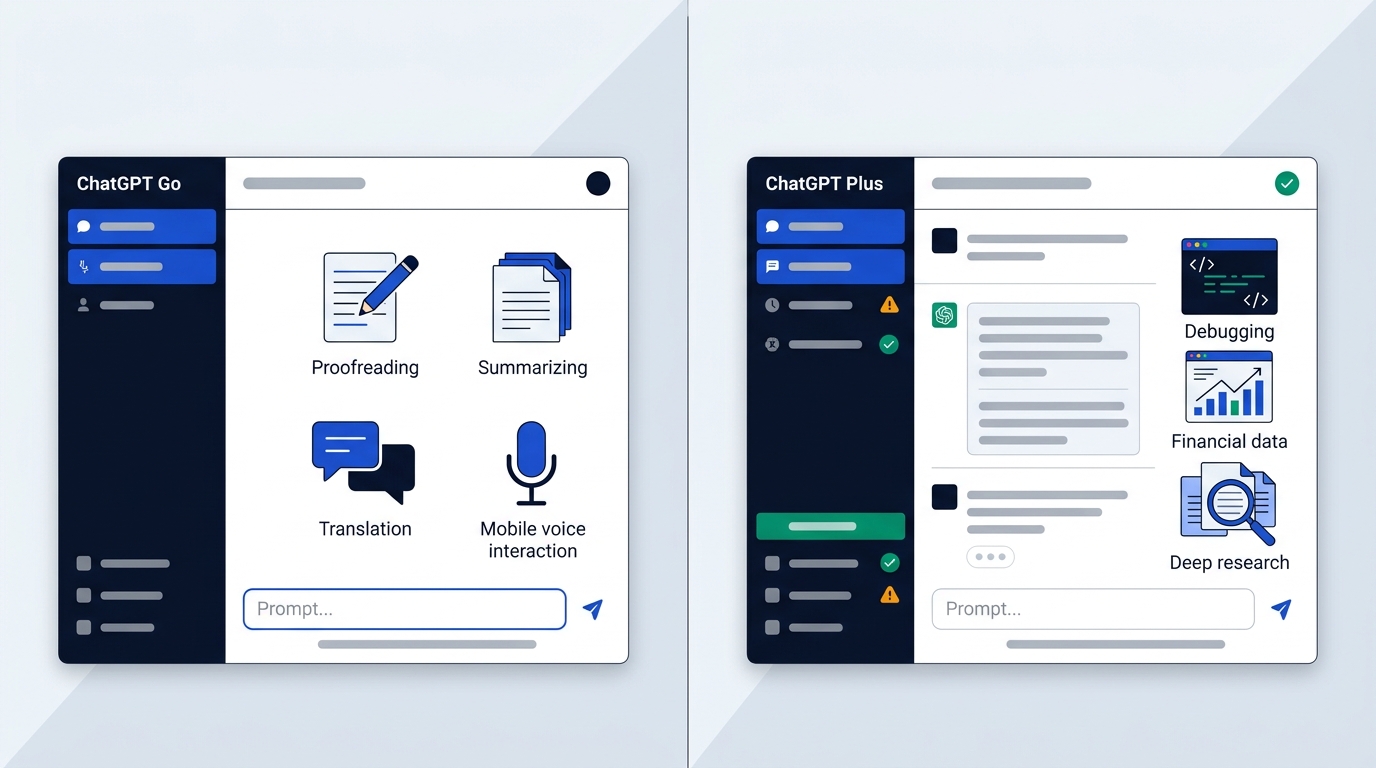
Selecting between these two options requires looking closely at your weekly AI interaction patterns. A creator writing brief social updates needs a vastly different setup than an engineer debugging software repositories. Identifying your primary user profile keeps you from paying for compute capacity you never use.
Everyday utility and casual drafting
ChatGPT Go suits users who send frequent, single-turn prompts throughout the week. If you rely on AI for rapid proofreading, text summarization, language translation, or occasional image generation, Go removes Free tier lockouts. It offers a smooth experience if you treat AI as an upgraded search engine or writing assistant.
Consider an e-commerce seller running an online store. She uses AI to polish product descriptions, correct customer emails, and draft basic captions. She does not need multi-step reasoning models or custom coding bots, Go delivers high message limits so her workflow never stalls mid-day.
Students and casual researchers also benefit from Go's expanded context memory. The system retains past conversation topics, letting you resume work without retyping background instructions. Because these tasks rely on fast text generation rather than complex logic, paying extra for reasoning models is unnecessary.
Voice interaction on mobile devices is another key benefit of Go. The tier includes Advanced Voice Mode with video support, allowing mobile users to speak with the assistant during daily commutes. If you prefer speaking to your assistant for quick summaries, Go provides fast responses at a reasonable price.
Pros and cons for utility users on Go
- Pros: Affordable US$8 monthly fee, zero message lockouts during routine chats, full conversation memory, standard DALL-E image generation, and Advanced Voice Mode with video. Go offers much higher message caps on GPT-5.3 compared to the free version, Ensuring you can finish projects without timing out.
- Cons: Display of sponsored links in select regions like the US market (ClickRank.ai), no access to GPT-5.5 Thinking reasoning models, inability to build custom GPTs, and lack of autonomous Deep Research or Agent Mode.AI.
Sustained professional project workflows
ChatGPT Plus fits professionals who spend hours inside the platform executing complex project work. Financial analysts summarizing earnings reports, management consultants mapping strategy, and project leads building internal tools need the analytical depth locked inside Plus. These tasks require the model to pause, cross-reference sources, and verify facts before returning output.
Software developers and data scientists should choose Plus over Go. Standard instant models are fine for basic code snippets, but they struggle when refactoring complex scripts or running deep debugging tasks. Plus unlocks advanced Codex capabilities and reasoning models that break down logic step by step, preventing broken code syntax.
A marketing manager building a repeatable lead intake system provides a clear example of Plus in action. He builds a custom GPT loaded with brand voice rules and buyer personas. Every week, he feeds meeting notes into the custom GPT, which automatically generates structured lead summaries. Go cannot create or run this custom workflow.
Researchers and consultants writing extensive reports rely on Plus for autonomous Deep Research. Instead of spending hours gathering web links, you input a research topic. Plus crawls multiple web sources, evaluates citations, and returns a structured report. That feature alone saves power users hours of manual research time every week.
Pros and cons for professional users on Plus
- Pros: Full access to GPT-5.5 Thinking and GPT-6.1 Terra reasoning models, 100% ad-free experience, custom GPT creation, autonomous Deep Research, interactive Canvas editor, and up to 5x higher message caps on flagship models (OpenAI pricing page). Plus includes early feature releases and specialized tools like Sora 2 video and Agent Mode.AI.
- Cons: Higher US$20 monthly price tag. Reasoning models take longer to generate output than fast instant models. Consumer plans opt data into model training by default unless manually turned off in account settings.
Real world usage scenarios compared
To see how these feature differences play out in daily operations, review three typical team setups and their plan matches:
Picture a five-person marketing team drafting short client email updates. If each member sends 15 short prompts daily, the team generates about 300 prompts per person each month. Because these requests involve simple text generation, Go's expanded message caps handle the volume comfortably without requiring reasoning models. Choosing Plus here would mean paying an extra US$12 per person each month for advanced tools the team rarely opens.
Compare that routine to a financial analyst evaluating a 20-page prospectus. The analyst might send only three prompts during an afternoon, but each prompt contains dense tables, complex math, and strategic synthesis. That workflow demands the 256K reasoning context window and step-by-step logic available on Plus. Attempting this task on Go leads to message limits and incomplete analysis.
Now consider a three-person support desk fielding 25 ticket drafts daily per agent. That equals 75 short drafting exchanges daily, totaling roughly 1,500 single-turn prompts per month. The agents rely on AI to draft quick support replies. Go handles this volume cleanly at US$8 per user, saving the team US$36 per month compared to equipping everyone with Plus. However, if one support lead spends an afternoon each week analyzing monthly ticket transcripts, feeding in long files and asking for structured breakdowns, that specific task requires Plus's reasoning and upload headroom, even if the agents remain fine on Go.
If your daily work involves connecting internal apps, creating custom workspace tools, or running continuous code scripts, skip Go entirely. Review full details on our ChatGPT plan limits and pricing details page, or compare alternative platforms using our Claude pricing guide to evaluate competing models for technical workloads.
Pricing comparison ($8 vs $20 per month)
The price gap between ChatGPT Go and ChatGPT Plus reflects two distinct product tiers. Understanding what each price point delivers helps you calculate whether upgrading makes sense for your budget.
Entry tier vs professional baseline
ChatGPT Go costs US$8 per month on a month-to-month basis. OpenAI built this tier as an accessible option for individual users who outgrew Free plan limits. It provides higher message allowances, full memory retention, and standard voice features without forcing individual buyers into a double-digit monthly commitment.
Go fills a wide gap in the AI software market. It is the most realistic plan for users who want to stop hitting Free tier limits. Millions of users found the Free tier too restrictive during peak hours, yet could not justify US$20 per month for heavy professional tools. At US$8, Go bridges that gap by offering consistent access to standard fast models. It started as a test in the India Market using UPI Payments, and its global launch in early 2026 at US$8.
ChatGPT Plus costs US$20 per month. This price point has served as the standard professional baseline for individual power users since paid ChatGPT subscriptions launched. It provides a full toolkit built for business productivity, including priority compute access, reasoning engines, and autonomous research features. Plus remains at the classic US$20 price point for professional workflows.
Understanding OpenAI's broader pricing structure helps place these options in context. The consumer lineup spans four levels: Free (US$0), Go (US$8), Plus (US$20), and Pro (starting from US$100 per month for power users needing unlimited compute and GPT-5.5 Pro). For business teams, Business ChatGPT + Codex costs US$20.
Evaluating the $12 monthly gap
The monthly price difference between Go and Plus is exactly US$12. Over a full year, selecting Go saves you US$144. However, that cost saving means giving up access to OpenAI's advanced reasoning models, custom workspace GPTs, deep research agents, and guaranteed ad-free usage.
If you use AI tools professionally, that US$12 monthly investment pays for itself quickly. A single hour saved during document analysis or code debugging easily covers the US$20 monthly price tag. Conversely, if you only rely on the platform for casual writing and quick searches, saving US$144 annually by choosing Go represents practical financial planning.
To decide if the US$12 gap is worth paying, ask yourself these four practical questions:
- Do you hit message limits on the Free plan more than twice a week? (If yes, Go solves this for US$8).
- Do you paste complex code, multi-page PDFs, or financial data that requires step-by-step logic? (If yes, Plus is required).
- Do you need to build custom GPTs or connect AI directly to Google Sheets and Excel? (If yes, pick Plus).
- Is your concentration disrupted by sponsored shopping links inside chat responses? (If yes, choose Plus for guaranteed ad-free access).
The US$12 difference unlocks critical tools like Sora 2 video generation, Agent Mode, and Deep Research, which are absent from the Go tier.4 Thinking model, which stops to think through complex problems before presenting strategic breakdowns, This US$12 represents a practical investment in personal productivity.
Subscription flexibility and billing rules
Neither ChatGPT Go nor ChatGPT Plus requires a long-term annual contract. Both options operate on a flexible monthly subscription cycle, allowing you to upgrade, downgrade, or cancel your plan at any time inside your account settings. If your workload surges during a busy quarter, you can upgrade from Go to Plus mid-month and return to Go later.
When you upgrade from Go to Plus mid-cycle, OpenAI automatically prorates your billing. The unused portion of your US$8 Go subscription is applied as a balance credit toward the US$20 Plus fee, so you never double-pay for the same billing period.
All prices listed by OpenAI are quoted in US Dollars before applicable national taxes. European individual buyers will see local VAT added to their invoice at checkout based on their country of residence. Business buyers holding valid European tax registrations can manage these charges using standard corporate tax procedures.
Model intelligence and reasoning capabilities
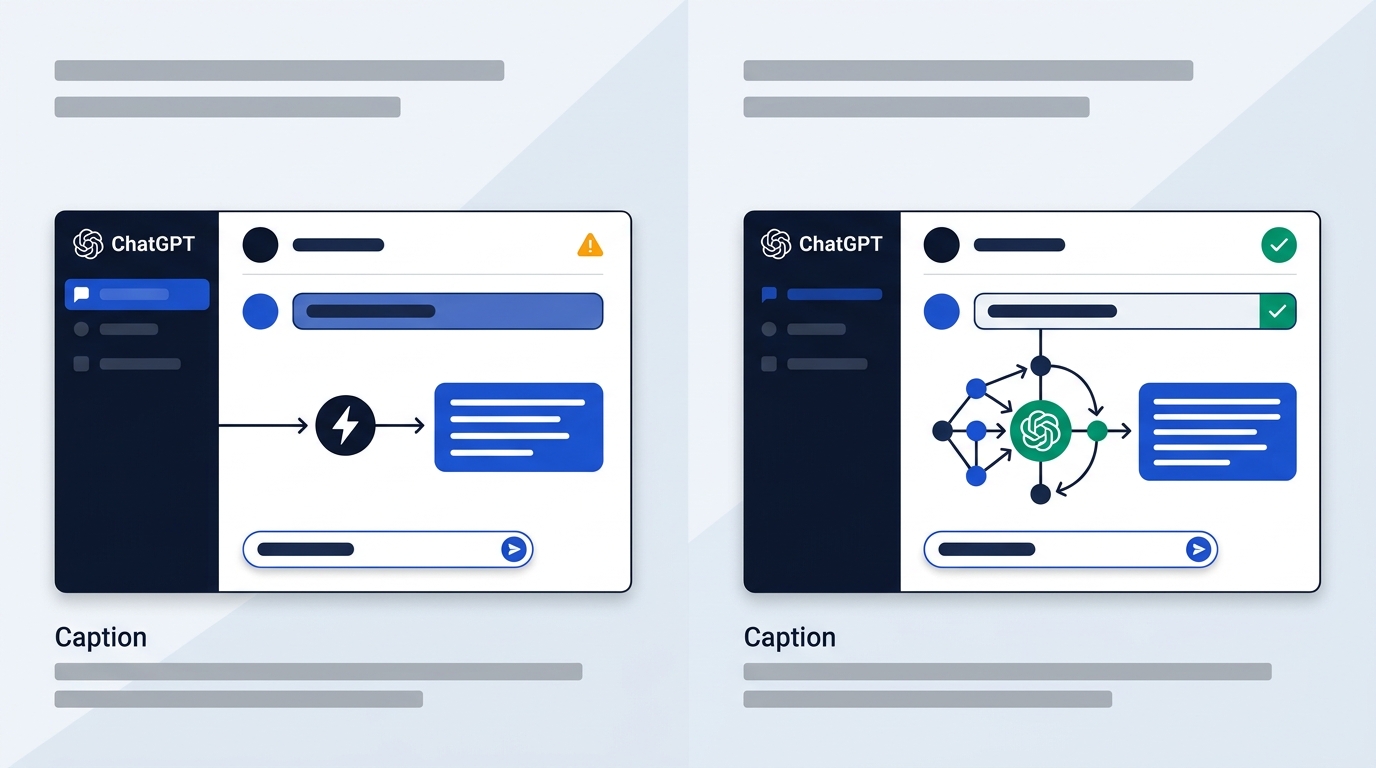
The core distinction between ChatGPT Go and ChatGPT Plus lies in the underlying AI model architecture. While both tiers operate on OpenAI's modern model platform, their prompt routing logic and cognitive abilities differ significantly.
Standard fast models for instant tasks
ChatGPT Go routes incoming user prompts to standard fast models, such as GPT-5.2 Instant or GPT-5.5 Instant.AI. These models are optimized for rapid execution speed, low latency, and efficient text processing. They generate short text replies almost instantly, making them effective for routine drafting, simple translations, and quick conversational exchanges.
Standard instant models perform well when speed matters more than deep analytical logic. If you need a blog post outline, a polite reply to a customer, or a rapid language translation, instant models produce output within seconds. You maintain natural conversational momentum without waiting for the engine to think. Go is built for speed and accessibility on a budget, making it the commuter version of OpenAI's ecosystem.
However, standard instant models trade deep logic for raw operational speed. When presented with multi-layered logic puzzles, complex financial datasets, or extensive legal contracts, instant models may return plausible-sounding answers that lack analytical accuracy. They answer immediately rather than taking time to evaluate variables. As one user noted, GPT-5.2 Instant gave a great outline in seconds but lacked necessary nuance.AI confirms that Go users do not get access to GPT-5.5 Thinking reasoning models.
Advanced reasoning models for deep logic
ChatGPT Plus unlocks OpenAI's advanced reasoning engine family, including GPT-5.4 Thinking, GPT-5.5 Thinking, and GPT-6.1 Terra within Work and Codex environments.AI. Unlike instant models, reasoning models are built to pause before answering. They generate internal chains of thought, testing assumptions, verifying intermediate conclusions, and correcting logical flaws before streaming a final answer.
When you submit a prompt to GPT-5.5 Thinking, the system can spend 5 to 15 seconds executing internal reasoning steps before generating text. This cognitive pause allows the model to map dependencies, verify syntax, and cross-check factual consistency. It transforms the assistant from a simple text generator into an analytical partner. As one user observed, switching to Plus provided strategic breakdowns that felt like consulting advice.AI notes that Plus is the first plan unlocking GPT-5.5 Thinking, which is essential for non-trivial tasks. Plus also includes expanded access to GPT-5 Thinking Mini.
This reasoning capability is essential for complex technical projects. When debugging software scripts, GPT-5.5 Thinking evaluates how variable changes affect your entire program structure. For strategic planning, market research, or mathematical modeling, this step-by-step processing prevents logical oversights that standard instant models miss.
Plus users also benefit from specialized model access in Codex environments. GPT-6.1 Terra in Codex handles automated code reviews, refactoring, and multi-file project execution. For software engineering workflows, having reasoning access built into your coding editor prevents subtle logic bugs that instant models introduce.
Speed versus reasoning architecture tradeoffs
Choosing between fast execution and deliberate reasoning creates a practical workflow tradeoff. Standard fast models respond in seconds, which keeps conversational momentum high during live brainstorming or voice chats. Advanced reasoning models pause while thinking through a problem, but their final output is far more accurate for complex requests.
Consider how this tradeoff impacts daily work. If you ask ten simple questions during a morning writing session, waiting 10 seconds per response on a reasoning model slows you down unnecessarily. Standard fast models on Go answer those ten questions in under two seconds each, keeping your drafting process fast.
Conversely, if you ask a single complex question about restructuring a software database, an instant model's rapid response may omit critical edge cases. Waiting 10 seconds for GPT-5.5 Thinking to evaluate database relations saves you hours of manual debugging later. Choosing between Go and Plus determines whether you have access to that reasoning pause when your projects demand it.
Message caps, context windows, and prompt density
Understanding message caps and context window sizes helps prevent unexpected work disruptions. Both plans offer higher limits than the Free tier, but their internal thresholds reflect their target audiences.
Message cap headroom explained
The Free plan places tight restrictions on model usage, often locking users out during peak traffic hours or after brief usage bursts. ChatGPT Go solves this bottleneck by granting significantly higher message headroom on standard instant models. As ClickRank.ai notes, Go offers much higher message caps on GPT-5.3 compared to the free version. This extra volume allows light users to run frequent chats throughout the workday without hitting mid-day lockouts.
Go's expanded headroom allows you to maintain continuous usage across an 8-hour workday, provided your prompts focus on standard fast models. You can send dozens of drafting requests, run voice conversations, and generate images without receiving Free tier usage warnings. However, message limits on Go are designed for casual bursts of work rather than 8-hour deep research dives.
ChatGPT Plus increases these thresholds further, granting up to 5x higher message caps on flagship models compared to standard Free tier allocations, according to OpenAI's pricing page. Plus users enjoy predictable access during high-traffic periods, ensuring intensive work sessions continue without sudden service interruptions.
If you reach message capacity on Plus during heavy reasoning sessions, the system dynamically adjusts allocations or allows fallback to high-speed models. On Go, reaching message limits falls back to base Free tier thresholds, which can disrupt heavy daily sessions.
Context window capacity differences
Context window capacity determines how much text the AI can read, retain, and analyze within a single continuous chat session. On ChatGPT Plus, the Instant model context window supports approximately 54K tokens (around 40 pages of text), while the GPT-5.5 Thinking reasoning context expands up to 256K tokens (roughly 320 pages of text).
ChatGPT Go provides expanded context retention compared to the Free plan with a documented 256K reasoning context window, Its standard instant processing handles smaller input volumes effectively. Plus, with its 256K reasoning context and 54K instant context window, is better equipped for continuous analysis of longer documents. Attempting to paste a 200-page manual into Go hits practical context limitations for detailed, multi-turn questions, whereas Plus processes long-form documents effectively without truncating critical data or losing context mid-conversation.
Understanding context limits is critical when working with long files. If your context window is too small, the AI forgets text from the beginning of your conversation as you paste new details. Plus ensures full document structures remain active in memory throughout multi-hour analysis sessions.
Prompt density math for teams and analysts
To choose the right tier, calculate your team's weekly prompt density and document length requirements:
- Customer Support Team Scenario: Three support reps handle 25 short customer ticket drafts daily (75 total prompts per day, or 1,500 monthly prompts). Because each prompt is a short, single-turn text request, Go's messaging headroom covers the workload efficiently. However, if one support lead spends an afternoon each week analyzing monthly ticket transcripts, feeding in long documents and asking for structured breakdowns, that specific task shifts the requirement toward Plus's deeper reasoning and upload capacity, even if the agents themselves are fine on Go.
- Financial Analyst Scenario: A single analyst evaluates two 150-page audit files each week. The analyst inputs long document sections, runs cross-source validation, and requests structured financial summaries. This low-frequency, high-density pattern requires the 256K reasoning context and document handling of Plus.
- Software Developer Scenario: A developer pastes 500 lines of script and requests continuous refactoring and unit tests over a four-hour session. The iterative debugging process requires high message caps and reasoning logic, making Plus the appropriate selection.
This prompt density calculation prevents overspending while ensuring your team has adequate tools. Reaching message limits on Go forces your account to fall back to base Free tier thresholds. Plus provides dynamic compute allocations that protect sustained project hours from sudden performance drops.
Custom GPTs, deep research, and advanced tools
Beyond raw intelligence and message caps, ChatGPT Plus grants access to a suite of advanced productivity tools, specialized editors, and research features that are omitted from ChatGPT Go.
Custom GPT creation and workspace tools
ChatGPT Plus includes full custom GPT creation capabilities. Users can build, configure, and deploy custom AI bots tailored to specific tasks or corporate guidelines. You can upload custom instructions, train the bot on internal style guides, and attach static references to streamline repetitive tasks. Plus users also get access to Projects, custom GPTs, ChatGPT record mode, develo.
Building a custom GPT requires zero coding knowledge. A Plus user describes the desired behavior in plain language, uploads reference files like brand guides or standard operating procedures, and saves the bot. The custom GPT appears in your sidebar, ready to execute repeatable tasks with identical context every time. Custom GPTs transform generic AI into a specialized assistant pre-loaded with your specific knowledge, tone, and operational rules.
In contrast, ChatGPT Go subscribers can browse and interact with publicly available GPTs in the OpenAI directory, but they cannot build or publish custom GPTs of their own. If your business relies on customized prompts or proprietary workspace bots, you must select Plus.
Deep research and autonomous agent mode
Deep Research and Agent Mode are exclusive to ChatGPT Plus and higher enterprise tiers. When activated, Deep Research allows the AI to autonomously crawl multiple web sources, synthesize complex information, check facts, and generate comprehensive research reports with embedded citations.AI.
This feature transforms the assistant from a simple text generator into an autonomous research partner. Instead of manually searching the web and compiling links, a Plus user can issue a broad research command and receive a structured, multi-page report in minutes. The AI navigates web pages, reads documents, synthesizes conflicting data, and footnotes its sources cleanly. This capability saves significant time for anyone involved in market analysis, writing, or competitive research.
Agent Mode expands this autonomy further by executing multi-step tasks across connected applications. If you need to compile market data, format it into a spreadsheet, and draft an executive summary, Agent Mode handles the full sequence without requiring step-by-step manual prompts. ChatGPT Go does not include autonomous deep research or agent features.
Excluded developer features on Go
ChatGPT Plus provides interactive software tools designed to improve content creation and data analysis. These include Canvas writing and coding editors, interactive tables, dynamic charting, and direct app connectors for external platforms like Google Sheets and Microsoft Excel, as mentioned by Stob.AI. Plus also unlocks Sora 2 for video generation, Agent Mode, scheduled Tasks, Codex access, ChatGPT record mode, develo.AI.
The Canvas editor provides a dedicated side-by-side workspace for drafting articles or refactoring code. Instead of generating long blocks of text inside the chat stream, Canvas opens a document window where you can edit specific lines, highlight text for inline AI revisions, and adjust length or reading level with single clicks.
ChatGPT Go excludes custom GPT creation, deep research modes, interactive Canvas editors, and workspace app connectors. Go users interact with AI purely through a standard chat window. While Go offers basic data analysis, Plus enhances this with interactive tables and charts, making data exploration far more dynamic. For teams seeking comprehensive workspace knowledge integration, explore our Notion AI feature breakdown alongside ChatGPT Plus options.
Ad experience, memory, and upload limits
Daily usability depends heavily on interface design, memory context retention, and file upload restrictions. Here is how the user experience differs between Go and Plus.
Ad supported versus ad free experiences
To maintain its low US$8 entry price, ChatGPT Go includes ad-supported elements in select regional markets, such as the United States. As ClickRank.ai points out, Go includes an ad-supported experience in the US market. Users on Go may encounter targeted sponsor links or shopping suggestions displayed below generated text responses.
For example, if you ask Go for a healthy dinner recipe, a small suggested shopping link for ingredients or kitchenware may appear at the bottom of your output, as described by ClickRank.ai. While the AI's answer remains objective and fast, the presence of commercial links may feel jarring if you expect a purely clean productivity tool. One user noted that seeing suggested shopping links was a bit jarring, though acceptable for the US$8 price point, This ad presence can detract from a professional workspace, making Plus a better fit.
ChatGPT Plus guarantees a strictly 100% ad-free experience across all global markets, mobile apps, and browser interfaces. Business professionals who require a clean workspace free from commercial distractions will appreciate Plus's ad-free environment.
Memory retention across active chats
Both Go and Plus offer expanded memory capabilities compared to the Free plan. The system automatically retains user preferences, past conversation context, and personal instructions across active chat sessions. You can state your writing style, target audience, or coding preferences once, and the model remembers those details in future chats.
While the Free plan features limited memory retention, Go provides full memory and past chat recall.AI notes that memory is no longer limited on Go. You can reference project context from three weeks ago without re-uploading background information. This persistent memory saves time and eliminates repetitive prompt setup, ensuring continuity across long-running projects.
Both paid tiers manage conversation memory smoothly, though Plus handles longer memory histories due to its larger context architecture. If memory capacity ever fills up, users on both tiers can manage, view, or delete specific stored memories inside account settings.
File uploads, voice, and image limits
File upload rules differ between the two tiers. Go supports basic image inspections and small data file uploads for simple calculations. Go offers more uploads and full data analysis and vision capabilities. However, if you regularly upload multi-page PDF documents, heavy spreadsheets, or full code directories, Go quickly hits upload caps. Plus supports sustained multi-file uploads across extensive project sessions.
Voice interaction and DALL-E image generation are enabled on both plans. Go includes Advanced Voice Mode with video capabilities, allowing interactive spoken chats and visual context parsing on mobile devices.
Plus elevates visual creation by providing Sora 2 video generation (ClickRank.ai), faster image render times, expanded image creation options, and deeper image editing controls integrated with reasoning models. Detailed visual tweaks and complex graphic instructions work more reliably on Plus. While Go allows basic data analysis and image input, Plus offers expanded document analysis and multi-file project support, crucial for handling large reports or extensive datasets without hitting limits.
EU GDPR compliance, DPA, and European VAT rules
European organizations must verify that AI vendor subscriptions comply with regional data privacy laws, cross-border transfer frameworks, and national tax rules before deployment.
Data hosting infrastructure and DPA terms
Customer data for OpenAI consumer tiers (Free, Go, and Plus) is processed and stored on US-based infrastructure, primarily within Microsoft Azure and OpenAI data centers located in the United States, as confirmed by OpenAI's enterprise privacy policy. OpenAI offers a standardized Data Processing Agreement (DPA) incorporating EU Standard Contractual Clauses (SCCs) to establish a legal framework for international data transfers under GDPR Article 28, per OpenAI's business terms.
Because processing occurs outside the European Economic Area, privacy officers must confirm that standard contractual protections meet internal risk policies. OpenAI's enterprise DPA incorporates standard transfer mechanisms, but data residency options inside Europe are reserved exclusively for Enterprise tier customers with dedicated regional hosting across 10 regions, While OpenAI provides contractual safeguards, the data still resides outside the EU, which may require additional due diligence or impact internal data governance policies.
European buyers requiring strict EU data residency should evaluate specialized enterprise plans or privacy-focused platforms. Review our GDPR data processing addendum guide to understand how US data transfers affect European privacy requirements.
Model training defaults and privacy options
By default, OpenAI uses customer interactions on consumer plans (Free, Go, and Plus) to train and refine its AI models. User prompts, uploaded text snippets, and generated outputs may be included in future training datasets unless you actively opt out.
Individual users on both Go and Plus can manually disable data training by navigating to Settings > Data Controls and toggling off "Improve the model for everyone." For organizations handling sensitive client records under non-disclosure agreements, opting out of model training is mandatory. Alternatively, consider business-tier plans that enforce zero data training by default.
Business plans such as Business ChatGPT + Codex (US$20 per user per month) or Enterprise automatically exclude customer data from AI model training without requiring manual configuration, as stated in OpenAI's business terms. They also provide administrative consoles, centralized billing, and shared team workspaces. Memory with past chats is coming soon on Business and Enterprise plans and is not live yet.
EU and UK reverse charge VAT mechanics
Value-added tax treatment depends on the buyer's tax registration status and physical location:
- European Union Individual Buyers: Consumers residing in EU member states pay national VAT added directly to their monthly US$8 or US$20 invoice at checkout.
- EU Business Buyers (B2B): VAT-registered European businesses can enter their valid EU VAT identification number during checkout. This applies the reverse charge mechanism, placing the responsibility on the buyer to account for VAT on their local tax return. Learn more in our EU VAT reverse charge rules guide.
- United Kingdom Business Buyers: UK VAT-registered businesses comply with cross-border B2B service regulations under HMRC VAT Notice 741A rather than European Union rules. UK buyers apply standard UK reverse charge handling on their domestic VAT returns.
Frequently asked questions
Is ChatGPT Go available worldwide?
ChatGPT Go is available globally at US$8 per month. OpenAI initially introduced the tier as a targeted test in the India Market using local UPI payments before rolling it out worldwide in early 2026 as the standard entry-level paid option for casual users.
Can I upgrade from Go to Plus mid-month?
You can upgrade your subscription from ChatGPT Go to ChatGPT Plus at any time through your account settings. OpenAI automatically prorates your remaining account balance, applying the unused portion of your US$8 Go subscription toward the US$20 Plus fee.
Does ChatGPT Go give access to GPT-5.5 Thinking?
ChatGPT Go does not include access to advanced reasoning models like GPT-5.5 Thinking or GPT-6.1 Terra. Reasoning engines are reserved exclusively for ChatGPT Plus, Pro, and business workspace plans, as confirmed by Stob.AI.
Are custom GPTs usable on ChatGPT Go?
Go subscribers can browse, search, and chat with public custom GPTs published in the official OpenAI directory. However, Go users cannot build, edit, or publish their own custom GPTs.
Do European business buyers pay VAT on ChatGPT subscriptions?
Individual consumer subscriptions include local national VAT at checkout. VAT-registered business buyers in Europe can enter their corporate VAT ID at checkout to apply zero-rated B2B reverse charge rules.
What happens if I hit message limits on ChatGPT Go?
When you reach your message caps on Go, your account temporarily falls back to base Free plan throughput levels. You can continue chatting, but responses will use restricted free-tier allocations until your limit resets.
Does ChatGPT Go support mobile voice and video chats?
ChatGPT Go includes full access to Advanced Voice Mode with video support, Making it practical for mobile usage.
Bottom line: Which ChatGPT tier should you pick?
Choose ChatGPT Go at US$8 per month if you are a casual user, student, realtor, or light content writer who routinely hits Free plan limits. It delivers higher message headroom, full conversation memory, standard DALL-E image generation, and Advanced Voice Mode with video for everyday tasks without forcing you to pay for complex reasoning models you do not need.
Choose ChatGPT Plus at US$20 per month if you are a professional, software developer, financial analyst, or researcher who depends on AI for daily project work. Plus provides access to advanced reasoning models (GPT-5.5 Thinking, GPT-6.1 Terra), custom GPT creation, autonomous Deep Research agents, Sora 2 video, Canvas editing, expanded document uploads, and a guaranteed 100% ad-free interface.
Evaluate your weekly prompt math carefully: high-frequency, single-turn drafting fits Go perfectly, while complex multi-step coding, document analysis, and custom workflows easily justify paying for Plus. Log into your OpenAI account settings today to select your subscription tier, or visit our ChatGPT plan limits and pricing details for complete breakdown details.