















Compare Printify vs Printful vs Gelato on base prices, print quality, shipping speeds, and EU compliance to choose the right POD partner for your store.
Printify vs Printful vs Gelato comes down to what would hurt your store most. Pick Gelato for fast local delivery in Europe, Printful for uniform in-house quality and branding, and Printify for the lowest unit costs and the widest catalog. No single platform wins on margin, speed and consistency together.
Printify vs Printful vs Gelato at a glance
TL;DR
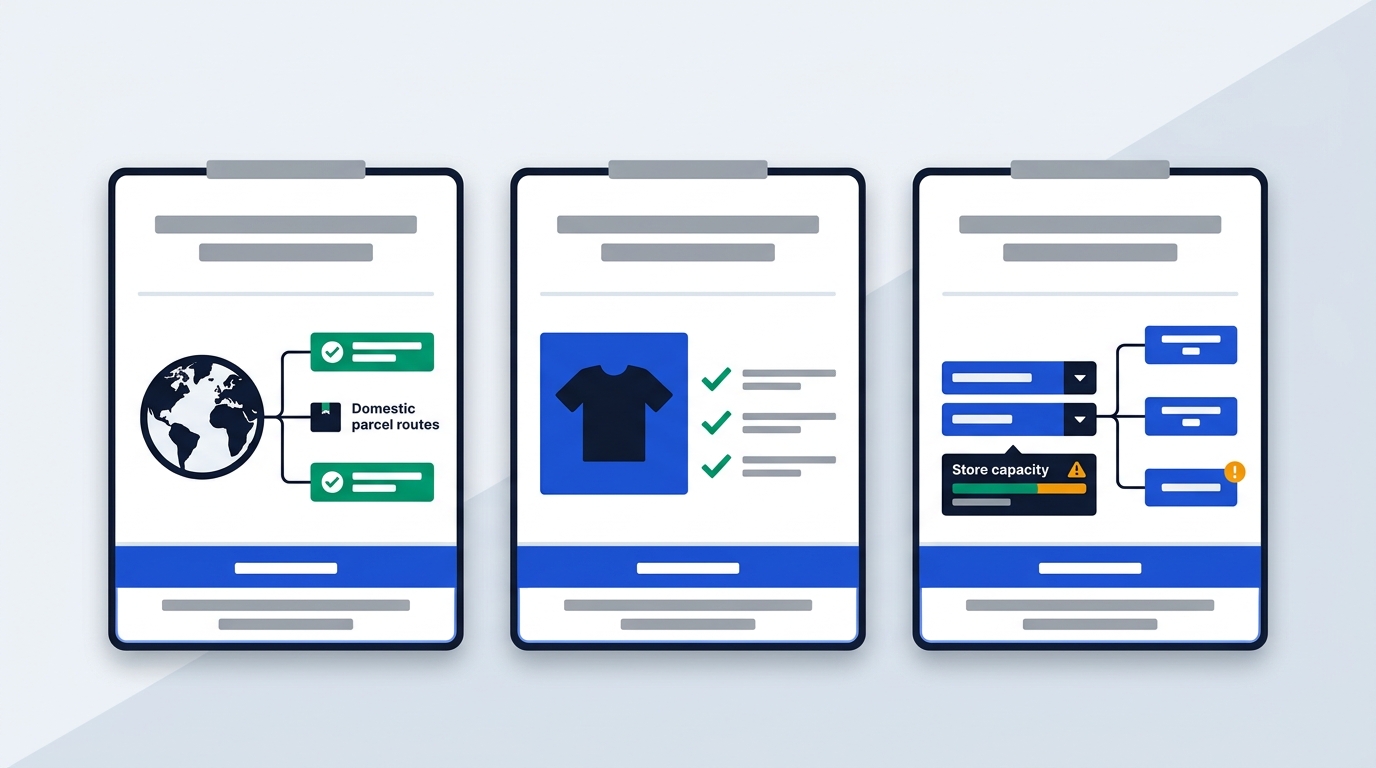
- Gelato suits EU and UK merchants who want fast regional delivery without cross-border customs delays. It suits you less if you need a very large catalog or many sales channels.
- Printful suits brand-focused sellers who want uniform in-house quality and custom packaging. It suits you less if the lowest unit cost is your main goal.
- Printify suits catalog expanders who want the lowest unit costs and a choice of suppliers. It suits you less if you want one identical look on every order, or if you dislike manual order handling.
The three platforms run on different models, and that shapes everything else. Printful prints in hubs it owns. Gelato sends each order to a local partner that follows shared print standards. Printify is a marketplace where you choose between independent print providers.
| Feature | Gelato | Printful | Printify |
|---|---|---|---|
| Catalog size | 250+ items | 370+ to 450+ items | 1,300+ to 2,000+ items |
| Fulfillment network | 140+ local partners in 32 countries | Owned hubs plus partners | 140+ third-party facilities |
| Stores on the free plan | 2 | Unlimited | 5 |
Source: the vendors' official pricing, documentation and legal pages, checked October 2026.
The Printify and Printful catalog ranges reflect the different totals each vendor publishes. Either way, Printify's catalog is several times larger than Gelato's.
The store quota bites earlier than you might expect. If you run a Shopify shop, an Etsy shop and a WooCommerce site, Gelato's free plan runs out of room at two. Gelato+ raises the cap to 10 stores, and Printify Premium does the same.
Some things do not separate the three at all. None of them sets a minimum order, and all of them let you start without an upfront fee. So the decision rarely hinges on the cost of entry. It hinges on how much operational work you want to carry once orders arrive.
A quick way to sort yourself is to ask which failure you could least afford. If late parcels would wreck your reviews, start with Gelato. If an inconsistent look between orders would hurt a brand you are building, start with Printful. If a thin catalog or high unit cost would cap your growth, start with Printify.
Support is similar on paper. Gelato offers 24/7 live chat and email, and Printify offers 24/7 chat and a contact form. Printful's free plan includes 24/7 support too. The difference you feel day to day comes less from the support desk than from who owns production when something goes wrong.
Which platform fits your specific store model

The right choice depends on what you sell and where your buyers live. Here are three typical setups.
Local wall art and paper goods: Gelato
Say you sell A3 posters and greeting cards on Etsy to buyers in Germany, France and Ireland. Gelato routes each order to the production partner nearest the customer, so the parcel rarely crosses a border. The platform started with paper products such as wall art and calendars, and it has since added apparel and mugs.
The catalog also covers photo books, phone cases and kids' clothing, so you can widen the range without leaving the platform. Gelato's own pricing page also points to new apparel styles from brands such as Lane Seven, Allmade and SOL'S. Ordering is hands-off, because you do not pick a provider for each order.
There are trade-offs. You have less control over who prints your order than on Printify, and many fonts in the design tool sit behind Gelato+. Branding extras such as neck labels and packaging inserts carry extra charges, and inserts are for paid subscribers only. If you want to judge paper stock and finish before launch, Gelato says it will send free samples as part of a tailored plan, which you arrange through its sales team.
A high-ticket apparel brand: Printful
If you are building a clothing label, consistency matters more than saving a few cents per shirt. Printful offers custom inside labels, branded packaging inserts and custom packaging. It also covers DTG, DTF, all-over print and embroidery, including 3D puff, from the same operator.
Its design tool lets you upload graphics or use free clipart, with paid images available from Getty. You can layer designs, create patterns and add text from a library of more than 791 fonts. That helps if you want to build every product mockup in one place.
Printful also has a path for larger brands. Its Business plan is published as having no monthly fee once you have made at least $60,000 in sales in the last 12 months, with up to 33% off products, 9% off branding options, 25% off sample orders and priority support. That figure comes from a December 2024 comparison, so check the current terms before you plan around it.
Scaling on Shopify or TikTok Shop: Printify
When margins and range drive your growth, Printify's catalog depth wins. Alongside standard apparel you find unusual items such as shower curtains and scented candles. The trade-off is that you pick providers yourself, so you carry more routing work than on the other two.
Printify's strength is price competition on everyday lines such as t-shirts, hoodies, phone cases and wall art. The final cost still depends on which provider you choose and which shipping speed applies. So compare the full landed cost per product, not just the blank.
Its Product Creator includes a free graphics library, fonts, Shutterstock access and an AI image generator. Premium adds order management tools through Printify Connect and early access to new features. If you want to run many products at speed, that extra tooling can matter as much as the discount.
Sales channels
- Printful: 22+ integrations plus its API. Its Quick Stores pop-up option is aimed at US merchants.
- Printify: 9+ integrations, its API and a Pop-Up Store builder.
- Gelato: six integrations plus its API, including Shopify, Etsy and WooCommerce.
If you sell on eBay or run PrestaShop, note that Printful and Printify list both, while Gelato lists neither.
Integration lists change often, and vendors count them differently. Before you commit, check that your exact channel appears on the vendor's current list, and ask what the connection syncs. If you run a custom storefront, all three offer an API, which is the safer route for a bespoke checkout.
Gelato adds a Personalization Studio for Etsy and Shopify sellers who offer customised products. A December 2024 comparison described its subscription plans as running from $0 to $749 a month, depending on order volume. Check the current tiers if personalization is central to your offer.
Production setups and real print quality compared
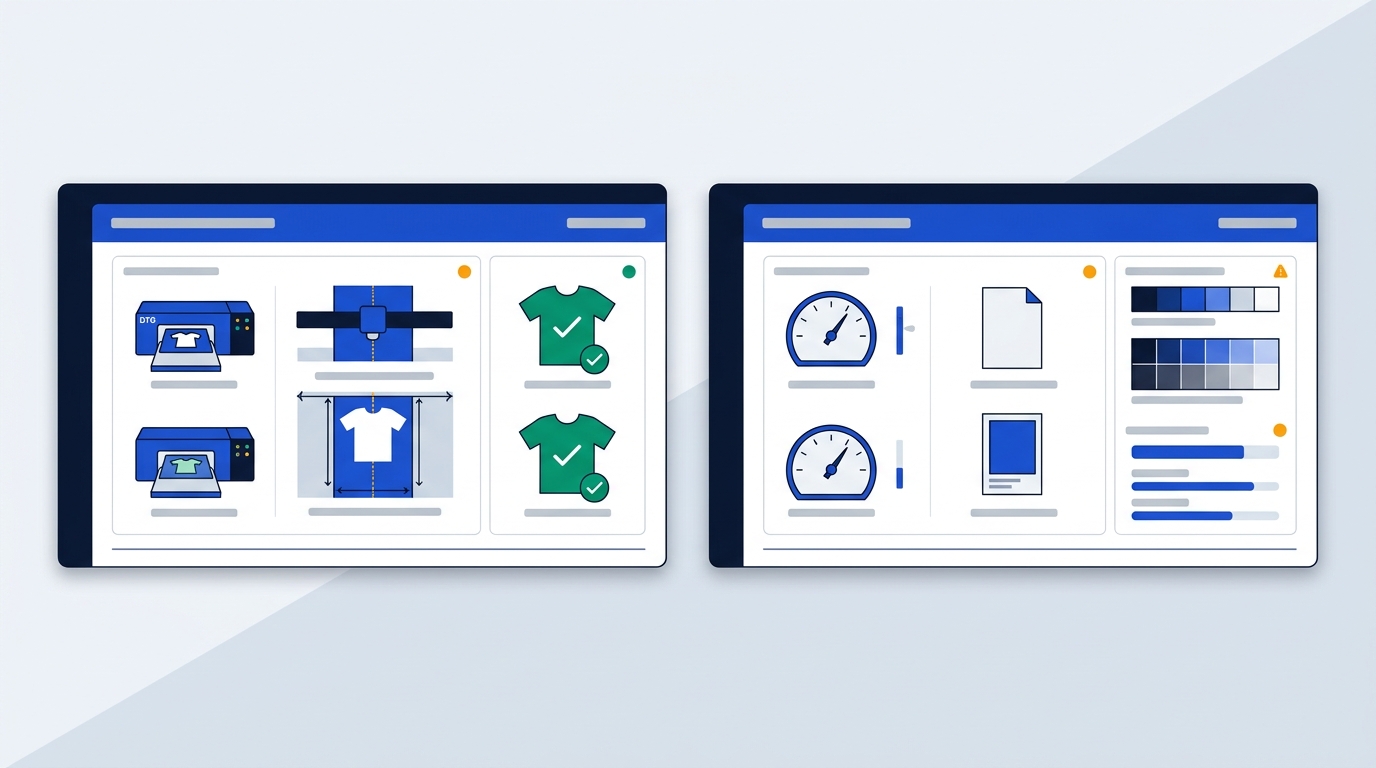
Print quality follows the production model more than the brand name. Each model has a predictable strength and a predictable weak spot.
Printful: owned facilities
Printful operates its own hubs in Riga, Barcelona and North America. Because it controls the machines, every item gets checked after printing and before shipping. A Bella+Canvas 3001 printed in North Carolina should look close to one printed in Latvia. The cost of that control is a higher base price.
Printful describes its in-house printing as a way to keep control over quality, using the same set of techniques across hubs. The downside is flexibility. If one hub is busy, you cannot simply hand the order to another vendor. That is the price of a single, accountable operator.
Gelato: distributed standards
Gelato contracts 140+ vetted commercial printers and requires each one to follow the Gelato Standard, a set of guidelines and machine profiles. It prints with DTG, DTF and flat embroidery. Paper products are its best-known strength, and posters are widely seen as a top choice on the platform.
The Standard aims for uniform output wherever an item is made, so a poster printed near Dublin and one printed near Berlin should match. Because the printers are independent businesses, you rely on the standard being applied well. A sample order from your own target region is the best check.
Printify: marketplace brokering
Printify owns no printers. It connects you to independent providers such as Monster Digital, SwiftPOD and Print Geek. That gives flexible routing, but print vibrancy and blank stock vary between providers. A hoodie from one provider can feel quite different from another's, so you should sample each provider you plan to rely on.
A practical routine helps here. Pick two or three providers for a product, order the same design from each, and compare fabric weight, colour accuracy and print sharpness side by side. Then lock in your favourite and keep the runner-up as a backup for stock problems. This turns Printify's variability into an advantage, since you can swap providers without changing platform.
Branding on demand
- Printful: inside neck labels, packaging inserts and custom packaging.
- Gelato: packaging inserts and branded labels, mainly through paid subscriptions.
- Printify: packaging inserts, branded labels and gift messages, with availability that varies by provider.
Branding is where the three differ most for a label that wants to look premium. Printful treats it as a core offer, with the widest set of options in one place. On Gelato, check what each add-on costs, because charges apply for items such as neck labels and inserts. On Printify, confirm that your chosen provider supports the branding you want before you build a product around it.
Base prices, subscriptions, and merchant profit margins
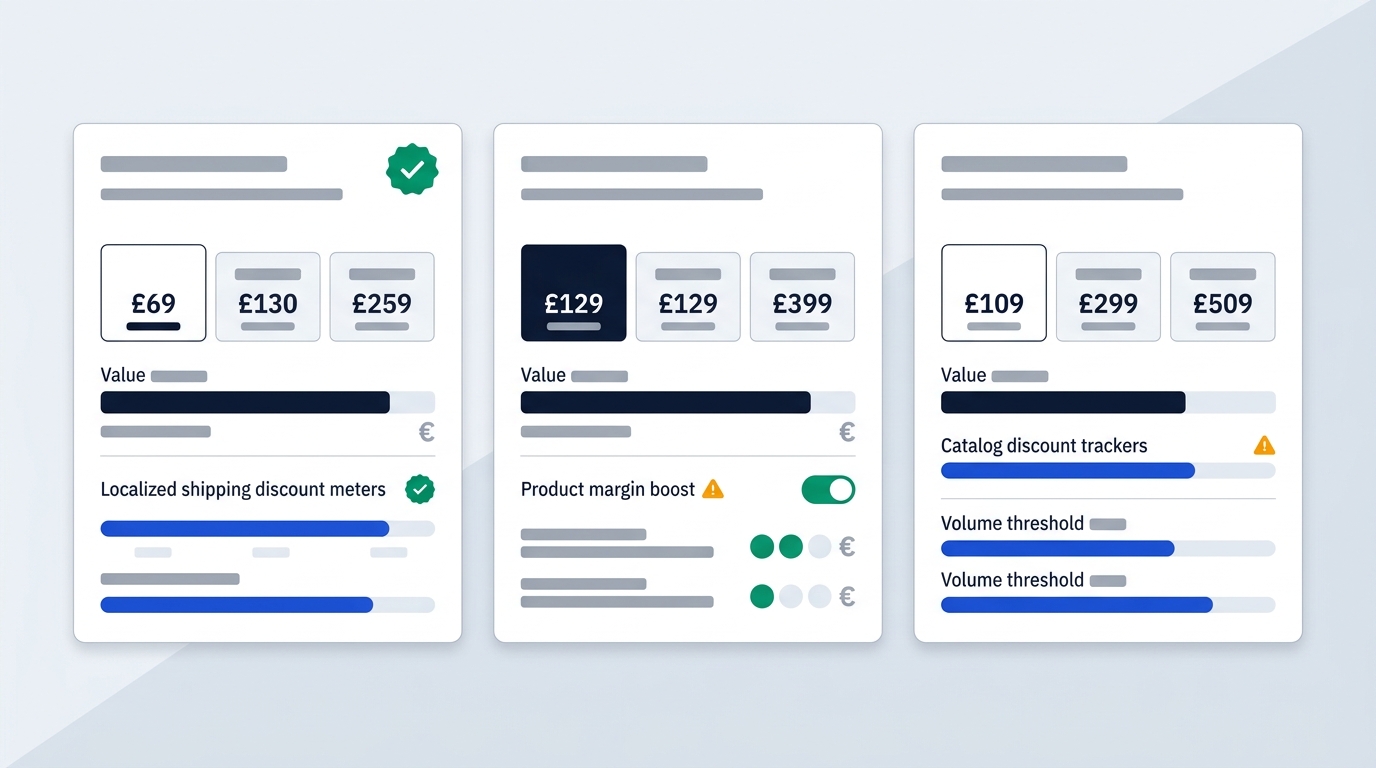
Printify usually posts the lowest base cost on everyday apparel, because providers compete for your orders. Printful charges a premium for in-house manufacturing. That said, Printful and Gelato have trimmed some base prices, so the gap depends on the product you sell.
Plans shift the maths once your volume grows. Prices are before VAT. Printify lists its plans in US$, while Gelato and Printful list theirs in €.
| Platform | Plan | Price | What you get |
|---|---|---|---|
| Gelato | Free | €0 | 2 stores, pay only when an item is ordered |
| Gelato | Gelato+ | €24/month, or €19/month billed annually | Up to 30% off standard shipping, 10 stores, premium mockups, personalization tool |
| Gelato | Gelato Gold | €99/month, or €79/month billed annually | Up to 50% off standard shipping, dedicated account manager, multi-user permissions, API support |
| Printful | Free Standard | €0 | Unlimited stores, mockup generator, 24/7 support |
| Printful | Growth | €24.99/month | Up to 33% off DTG apparel, up to 9% off embroidery, branding options |
| Printify | Free | US$0 | 5 stores, unlimited designs, 24/7 support |
| Printify | Premium | US$39/month, or US$24.99/month billed annually | 10 stores, up to 20% off most products, up to 33% off new products, Printify Connect |
Two details change how you read that table.
- Gelato's discounts apply to shipping, not products. That fits its model, since local production already shortens shipping routes.
- Gelato+ carries a holiday offer: free standard shipping on orders of 3+ items until 30 November, plus up to 33% off products. See our Black Friday deals page for more seasonal offers.
Gelato also states that it charges no commission, and it will match the rates you pay elsewhere on tailored plans, with free samples. Higher-volume sellers should factor that in.
The sensible way to judge a paid plan is to work from your own numbers. Take what you spend on products and shipping each month, apply the discount that plan offers to the part it covers, and compare the saving with the monthly fee. A plan that discounts shipping helps most if parcels are your biggest cost, while a plan that discounts products helps most if blanks are.
Paying Gelato works in a simple loop. A customer pays the price you set, you place the order with Gelato, and you pay for the product and shipping. It accepts major cards and PayPal, and it takes USD, EUR, GBP, JPY and more. The multi-currency wallet with auto top-up spares you from funding each order by hand.
Gelato also publishes that it will notify you of applicable VAT and tax at checkout before you complete an order. For a seller who is watching margin closely, that avoids a nasty surprise on an individual order.
Shipping speeds and localized fulfillment networks
Gelato has the clearest local-delivery advantage on paper. It reports that 90% of orders are produced in the recipient's own country, across 32 nations, and that 90% arrive within 5 days. Those are provider-reported figures. Producing near the buyer cuts international transit and the import paperwork that comes with it.
Printful's average production turnaround is 2 to 5 business days. Transit then depends on how far the buyer sits from its hubs in Latvia, Spain or the US. Its "Made in EU" collection helps European sellers steer toward items produced close to home.
Printify's speed depends entirely on the provider handling each product. Some ship within 48 hours, while others take a week. The real risk appears in Q4. If your chosen provider runs out of a colour or size, the order stalls until you cancel it and reroute it manually to another provider with stock.
Printful carries a different Q4 risk. Because it owns its production queue, it cannot easily pass excess orders to outside vendors, so bottlenecks can form at peak times.
For European buyers, the question is where the parcel starts. A shirt printed and shipped inside the EU is a domestic or intra-EU delivery. A parcel arriving from a non-EU facility adds customs declarations and waiting time. With Printify you control this by choosing providers close to your customers.
Speed matters beyond logistics. It affects conversion rates, review quality, support volume and refund risk. A slow parcel turns into a support email, and a support email can turn into a refund. So a platform that ships faster can protect margin even when its unit price is not the lowest.
The shipping tiers differ in how they are offered. Gelato offers Standard and Express, and a December 2024 comparison put its Standard or Economy delivery at two to four business days including production. Printful offers tiers from Standard to Express, and US deliveries were described as typically arriving in two to six business days. Printify lists Standard, Expedited and Express options. Treat all these times as published estimates, not promises.
Printful operates facilities across North America, South America, Europe, Japan and Australia. Gelato's network leans on more than 40 delivery services, picking one by production country, destination and shipping method. If your buyers sit outside Europe, check that the platform has a production site near them, not only in your home market.
European compliance, data hosting, and VAT rules
All three platforms handle your customers' names and addresses, so the data terms matter. Under GDPR Article 28, you act as the controller and the platform is your processor. You need a processing agreement in place.
- Gelato: a Norwegian company (Gelato ASA) headquartered in Oslo. It hosts data in EU data centers in Norway and Germany, and it publishes a standardized Data Processing Agreement.
- Printful: Latvian-founded, with primary EU customer data and manufacturing hosted in Latvia and Spain on AWS infrastructure. It publishes a DPA and uses Standard Contractual Clauses for global routing.
- Printify: Printify, Inc. is a Delaware company with a Latvian subsidiary, SIA Printify Development. Its privacy pages cite Standard Contractual Clauses for transfers, but no data processing agreement is mentioned on them.
If a signed DPA is a requirement for your business, that last point matters. Gelato and Printful give you a ready document, and Printify's pages describe only the SCC mechanism.
On tax, Gelato says it shows applicable VAT and tax at checkout before you complete an order. It also accepts payment in EUR, GBP, USD and other currencies, and it offers a multi-currency wallet with auto top-up.
Customs follows the production location. When Gelato or Printful produces inside the EU for an EU buyer, the parcel avoids customs clearance and surprise import charges. With Printify the outcome depends on the provider and route you select for each product.
If you are a regulated business, turn this into a short routine. Download the DPA each vendor publishes, file it with your records, and note where the data is hosted. For Printify, ask the vendor in writing whether it offers a DPA before you rely on it for customer data. Doing this once, before launch, is far easier than doing it after a customer complaint.
Where a parcel is made also shapes your customer's experience. A buyer in Spain who gets an item made in Spain sees no import charge at the door. That keeps your reviews clean, and it is one reason local production gets so much attention from European sellers.
Frequently asked questions about POD partners
Can I connect more than one print-on-demand service to a single store?
Yes. Shopify and Etsy let you add more than one fulfilment app. A common split is Gelato for posters and cards, and Printful for embroidered hoodies. Map each product to a single supplier, and watch the store caps: Gelato's free plan covers two stores, so a multi-channel setup may push you onto Gelato+.
Keep one rule in mind. Never let two suppliers fulfil the same listing, or you will not know whose print a customer is holding when they raise a complaint. Name each listing clearly in your store so your support team can see the supplier at a glance.
Which platform is cheapest for Bella+Canvas 3001 t-shirts?
Printify is usually cheapest, because several providers stock and print the same blank and compete on price. Printful's in-house costs sit higher. Plan discounts narrow the gap at volume: Printify Premium offers up to 20% off most products, and Printful Growth offers up to 33% off DTG apparel.
Look at the whole order, not only the blank. Shipping and the speed you choose change the final figure, and Printify's own total varies with the provider. Compare a basket of your real products on all three before you set retail prices.
Do any of these platforms charge upfront platform fees?
No. All three have free plans, and you pay only when a customer places an order. Gelato adds that it charges no commission. Paid plans are optional, so they only make sense once discounts outweigh the monthly fee.
Moving volume from another supplier is also possible without losing margin. Gelato says it will match the rates you get elsewhere on a tailored plan, so ask its sales team before you move a large product range across.
How do out-of-stock blank items get handled?
On Printify, the order sits until you cancel it and reroute it to another provider by hand. Gelato routes each order automatically to a production partner near the customer, so you do not pick a provider per order. Printful handles everything inside its own operation, which keeps you dealing with one team, though its queue can back up in Q4.
If you sell on Printify, prepare for this before the holiday rush. Keep a second provider already sampled for your best sellers, so a stock-out means a quick swap instead of a scramble.
Sources and how this was compiled
Compiled by the SaaSEuro team from the vendors' official documentation; we have not hands-on tested these products. Facts last checked in October 2026.
Source: official vendor pages, checked October 2026.
Which one should you pick
If you sell paper goods, posters or core apparel to European buyers, Gelato gives you fast local delivery without customs overhead. If you run an apparel-first label that depends on embroidery, inside labels and branded inserts, Printful fits better. If you are a volume seller who wants low costs and is happy to vet providers and reroute orders, Printify gives you the most room on margin.
Think about what you would have to change later. Switching platform means rebuilding products, mockups and listings, so it pays to pick the model that matches how you want to work from the start. A seller who dislikes manual rerouting will be unhappy on Printify however low the blanks cost.
If you already produce elsewhere and the move would eat your margin, ask Gelato about price matching before you decide. A seller on its way to Printful's Business plan should note its published sales threshold and check it is still current. Either way, run your real product list through each platform's costs, not an average.
Next, open a free account on your top pick and order a physical sample, so you can judge fabric weight and print accuracy yourself. You can read our Printify vs Printful comparison or our Gelato vs Printify guide for a closer look at two of the platforms, or visit the pages for Gelato, Printful and Printify.