











For UK and EU print-on-demand sellers weighing alternatives to Printify: plan fees and store limits side by side, plus EU production sites and DPA terms.
TL;DR: The strongest Alternatives to Printify for UK and EU stores are Printful for uniform branded quality, Gelato for local production across 32 countries, and SPOD for 48-hour production in Central Europe. Below you will find their prices, store limits, EU production sites and GDPR terms side by side, plus three other options.
- Printful suits brands that want uniform quality and custom labels. Skip it if base cost decides everything.
- Gelato suits cross-border sellers of wall art and core apparel. Skip it if your shop is built on shoes or pet items.
- SPOD suits Central European sellers who need speed. Skip it if your buyers sit outside the EU and US.
- Fourthwall and Sellfy suit sellers with no store yet. Skip them if you want a free hand over catalogue and checkout.
- Gooten suits mainly US shoppers. Skip it for European delivery, because shipping outside the US is costly.
- Printify still leads on range and base price. Leave it if every order must look identical.
Best Alternatives to Printify at a glance

The seven platforms differ on three things: how you pay, how many stores you can connect and where the printing happens. The table puts Printify next to the six alternatives.
| Tool | Price | Plan limits | Catalogue | Key difference |
|---|---|---|---|---|
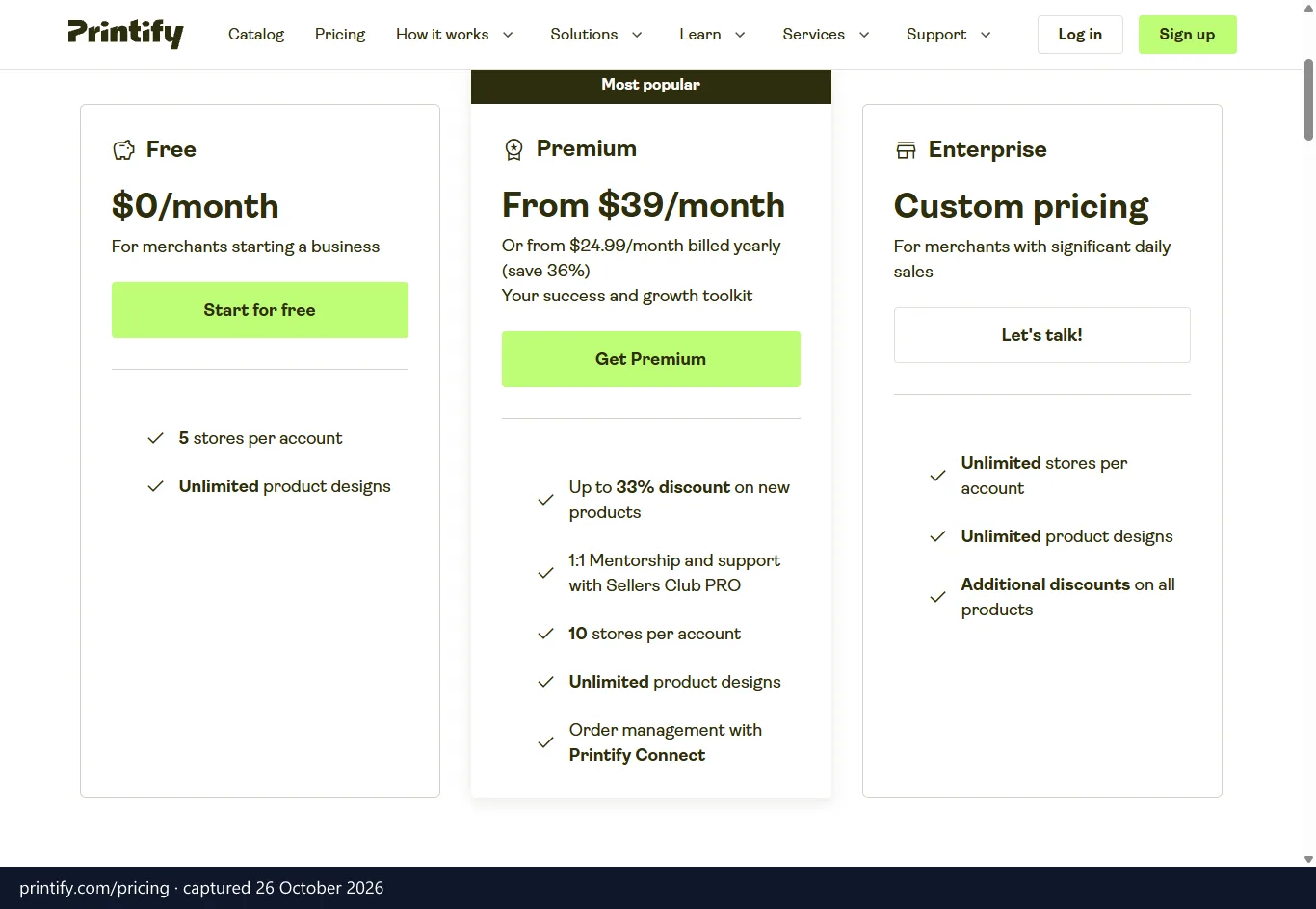
| Printify | Free; Premium US$39/month or US$24.99/month billed yearly | 5 stores on Free, 10 on Premium | 2,000+ items | 140+ third-party facilities; you pick the provider |
| Printful | Free; Growth €24.99/month, waived for stores reaching $12k+ annual sales | Unlimited stores | 450+ products | Own production in Riga, Latvia and Barcelona, Spain |
| Gelato | Free; Gelato+ €24/month or €19/month billed yearly; Gold €99/month or €79/month billed yearly | 2 stores on Free, 10 on Gelato+ | Around 250 products | 130+ partner facilities in 32 countries, routed automatically |
| SPOD | No subscription | Native integrations with Shopify, WooCommerce, Amazon, eBay | 200+ products | Own factories in Germany, Poland, the Czech Republic and Nevada |
| Fourthwall | Free; Pro US$19/month or US$180/year | Built-in storefront | Curated, smaller than Printify | Acts as Merchant of Record |
| Sellfy | Paid plans from US$19 to US$29/month, depending on billing term | Built-in store builder | Print-on-demand range, strong on clothing | Full ecommerce platform; PayPal and Stripe only |
| Gooten | No subscription | Shopify, BigCommerce, Etsy, WooCommerce, API | Around 400 products | 70 routing locations, US focus |
Source: vendor pricing pages, checked October 2026. Prices are before VAT and shown in the currency each vendor lists.
Store caps matter more than they look. If you run one shop for a UK brand and another for an EU brand, Gelato's free plan is already full, while a free Printful account never hits a limit. That cap can push you onto a paid plan sooner than any print setting would.
What do you give up by leaving Printify?
Quite a lot. Printify lists over 2,000 customisable items, from apparel and home decor to shoes and holiday products, and its base prices are among the lowest in the sector. It also offers 24/7 merchant support by email and live chat. Printify's own comparison page cites one seller whose 2021 earnings of $91,991.68 would have been $8,362.88 lower on Printful because of pricing differences.
The catch is the structure. Printify routes orders to its network of third-party print providers, so the result depends on who prints the job. Two customers ordering the same hoodie, one in Dublin and one in Madrid, can receive different blanks, print finish and packaging. Delivery times vary the same way.
Printify admits as much: its own pros and cons list says product quality varies by print provider. It shows merchant ratings for each provider's quality, production speed and shipping, which helps. Still, the choice and the risk stay with you.
Catalogue, mockups and store integrations
Range is where Printify pulls furthest ahead. Its catalogue is roughly eight times the size of Gelato's, and it covers shoes, tech accessories such as watch bands and speakers, and an eco-friendly section. Printify's comparison page puts Printful's catalogue at over 340 products and says its tech range is limited to mousepads, AirPods cases, laptop sleeves and phone cases, with three shoe options.
Design tools differ too. Printify includes free design tools and its Product Creator on every plan. Printful offers a Design Maker, a Logo Maker and a Mockup Generator. Gelato's Mockup Studio covers wall art only, and premium mockups and stock images need a paid plan. SPOD adds a library of premade graphics, covered in its section below.
Most of these tools reach the main shop builders. Printify connects to Etsy, eBay, Shopify, BigCommerce, TikTok Shop, Amazon, WooCommerce, Wix, Squarespace and PrestaShop, plus a custom API for your own site. Printful and Gelato both cover Shopify, Etsy and WooCommerce, and Gelato adds Amazon. If you sell on a less common platform, check its integration list before you move any products.
How to choose your fulfillment model
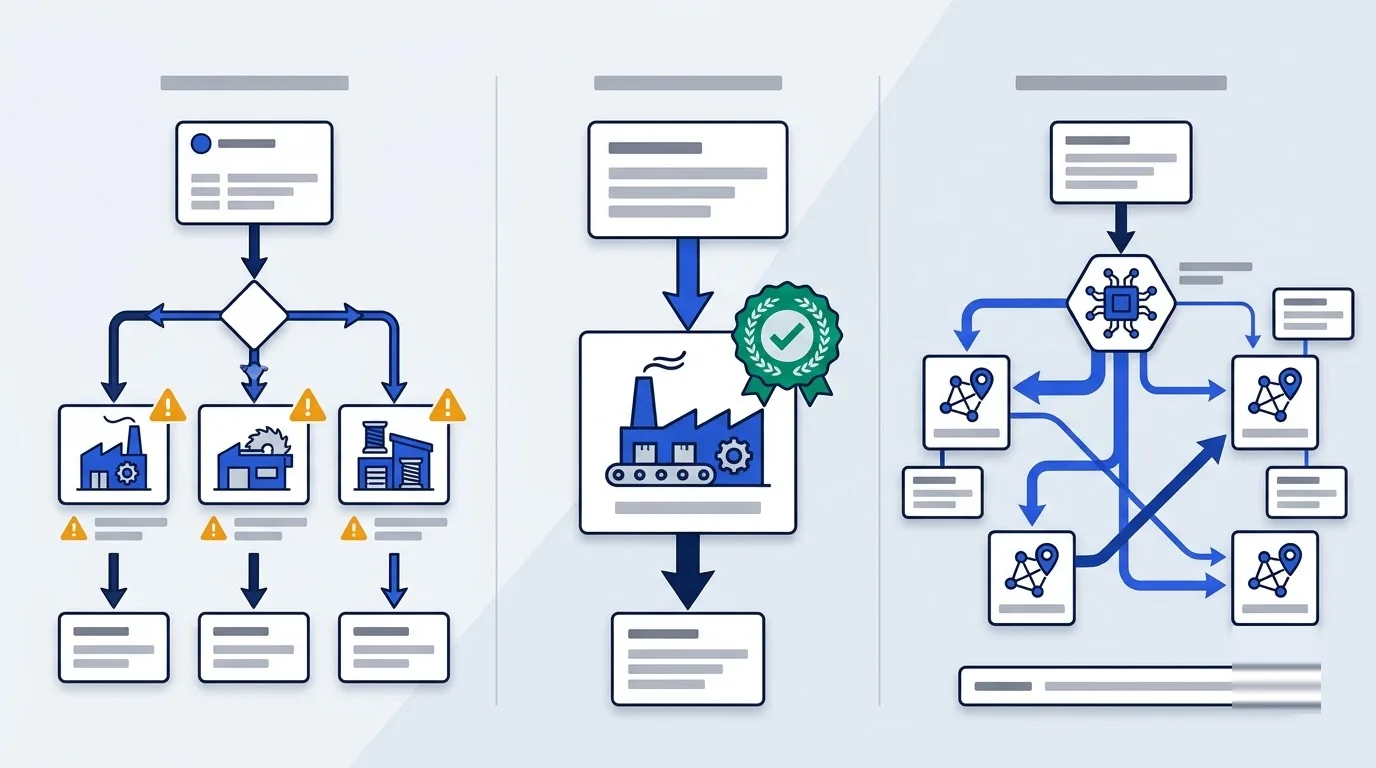
Choose the model before the brand, because it decides who controls quality, speed and stock. There are three: a marketplace of independent shops (Printify), owned factories (Printful) and automated routing across partner sites (Gelato).
How do the three models differ in practice?
With Printify, you act as buyer and quality inspector. You pick a provider per product, compare their ratings and accept that print results, blanks and packaging differ between providers, even for the same item. That freedom is also a form of control, because you can swap a weak provider for a better one.
Printful removes the variance. It runs its own sites, so every order passes the same quality checks. Gelato sits in the middle: its partners are third parties, but Gelato monitors production workflows at each one and routes jobs automatically. You cannot choose a provider by hand.
Stock problems show the difference clearly. When a Printify provider runs out of a blank, you fix it yourself or rely on Order Routing to move the job to another facility. Gelato replaces out-of-stock items with similar products, occasionally without telling you first. For a brand with a fixed colour palette, that surprise matters.
When does a paid plan pay for itself?
A paid plan pays off only when the discount on your monthly spend beats the fee. Take the fee from the first table and divide it by the discount rate to find your break-even spend. Every discount below is "up to" and covers selected products, so your real break-even sits higher.
| Plan | Discount | What else changes |
|---|---|---|
| Printify Premium | Up to 20% off most products | Higher store cap |
| Printful Growth | Up to 33% off DTG apparel, up to 9% off embroidery | Fee waived for stores reaching $12k+ annual sales; more branding options |
| Gelato+ | Up to 30% off standard shipping | Higher store cap, premium mockups, personalisation tool |
Two details stand out. Printful waives its fee once a store passes $12k+ in annual sales, so Growth costs a small shop real money but a busy one nothing. Gelato+ discounts shipping, not products, so it pays back mainly when you send many parcels. If you ship only a handful of orders a month, stay on the free plans.
You can see the full Printify and Printful plan structures in our Printify vs Printful pricing comparison for Europe.
Which model fits which product?
- Wall art, posters, calendars and photo books: Gelato.
- Branded streetwear, DTG apparel and embroidery: Printful.
- Standard apparel on a short deadline: SPOD.
- Creator merch with drops, memberships and digital items: Fourthwall.
- Home decor such as metal prints and woven blankets for US buyers: Gooten.
- Shoes, tech accessories and wide niche ranges: Printify.
Printful for centralized quality and branding
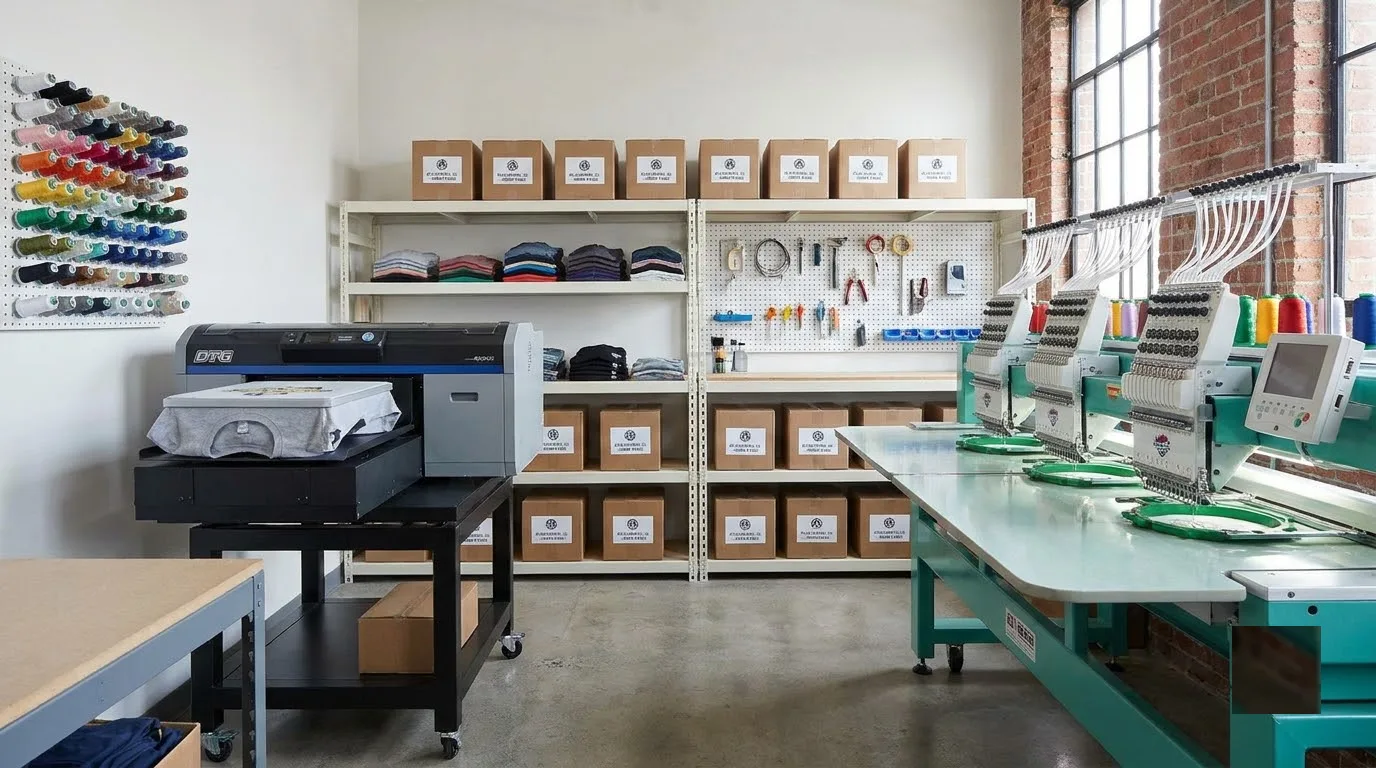
Printful suits fashion brands and established merchants who value uniform print quality, strong branding and owned European production over the lowest base cost.
It prints in its own facilities, with European sites in Riga and Barcelona. Because it does not hand jobs to independent shops, one set of quality checks covers the whole network. For a brand, that means the tenth hoodie looks like the first.
- Custom labels, branded packaging and pack-in inserts such as packing slips and thank-you cards.
- Warehousing services, including storage for custom promotional materials.
- A catalogue centred on DTG apparel, all-over printing and embroidery.
- Integrations with Shopify, Etsy and WooCommerce, plus 24/7 support.
Picture a streetwear label selling to Berlin, Lyon and Milan. You want the same neck label and the same packing slip in every parcel. Printful is built for that; a marketplace of providers is not.
Where does Printful fall short?
The Free Standard tier has no monthly fee. You pay per order only, with unlimited store connections. Growth adds the product discounts listed above and further branding options. Printify's comparison page says it also includes 25% off sample orders and free design digitisation for samples.
The downsides are real. Base prices run higher than Printify's, discounts sit behind the paid plan and there are fewer budget products. Margins on low-ticket items are therefore thin. Shipping can also run past the estimate, and the shoe and tech ranges are slim.
That makes Printful a poor match for beginners with low sales volume. It also fits badly with stores that need the lowest base price, or with sellers chasing margin on cheap items.
Against Printify, the trade is simple: you pay more per unit, but you remove supplier variance and connect unlimited stores for free. If your typical order is a premium garment with custom branding, the extra cost buys something customers can see. If you sell low-ticket items in volume, it does not. The current Printful plans and European prices show what each tier includes.
Gelato for local print routing worldwide
Gelato suits cross-border sellers in Europe and beyond who want production close to the buyer, which shortens transit and avoids many customs delays.
Its network spans 130+ partner facilities in 32 countries. You sell globally, but each order prints in or near the customer's country and travels by local postal service. Partners offer 72-hour fulfilment, and Gelato monitors production at each site.
- Strong coverage of wall art, posters, calendars, photo books, stationery, drinkware and core apparel, plus kids' and baby clothes.
- Tax and VAT handling, multi-currency selling and custom packaging among its listed features.
- Integrations with Shopify, Etsy, WooCommerce and Amazon.
The catalogue does have gaps. Shoes and pet products are missing, so a shop built around them needs a second supplier.
What do the paid tiers add?
The free plan works on a pay-per-order basis. You pay only when an item is ordered and fulfilled, and you get standard production access in all 32 countries. Gelato+ adds premium product mockups and a customer personalisation tool on top of its shipping discount.
Gelato Gold is built for higher volume. It raises the discount to up to 50% off standard shipping and adds a dedicated account manager, early access to new catalogue items, multi-user permissions and API support. The Gelato plan and pricing page tracks each tier in euros.
Gelato's weak points are control and branding. Automated routing means you cannot pick a provider, and out-of-stock blanks can be swapped without notice. Mockups are limited on the free plan, as noted above, and branding features are less advanced than Printful's.
Against Printify, Gelato handles multi-country fulfilment more smoothly, because jobs print near the buyer. Printify gives you more control over which shop makes each product, and more stores on its free plan. The choice comes down to automation versus control, and our head-to-head of Gelato and Printify for European sellers goes deeper on that split.
Storefront options with Fourthwall and Sellfy
Fourthwall and Sellfy suit sellers who have no store yet, because each bundles a storefront with print-on-demand. Unlike the other options here, they replace your shop as well as your printer.
Is Fourthwall right for creators?
Fourthwall suits creators, musicians and community builders who want a branded shop, retail-grade merch and digital sales in one place.
- The storefront is part of the plan, with a drag-and-drop builder and integrations for YouTube Product Shelf and TikTok Shop.
- Fourthwall acts as Merchant of Record, so it handles tax issues and manages customer service for catalogue products.
- You can sell digital products and memberships beside merch, run limited-time drops and pre-orders, accept donations and order custom items such as plushies and enamel pins.
- Catalogue products are paid per order, with the base cost deducted from your sale.
The trade-off is choice. The catalogue is curated and far smaller than Printify's, premium product prices can run higher, and shipping times and prices vary. You also get less say over suppliers and checkout.
Fees beyond the plan depend on what you sell. Digital products carry a 5% fee on Free and 0% on Pro. Memberships carry a 5% platform fee on either plan.
Is Sellfy right if you have no website?
Sellfy suits entrepreneurs who want a standalone store builder with print-on-demand apparel, digital downloads and subscriptions, without Shopify or WooCommerce.
- A drag-and-drop site builder, order and inventory management, integrated checkout, email marketing, upselling and discount codes.
- A print-on-demand catalogue opened from the dashboard, with a particularly good range of shirts and hoodies.
- Physical, digital and subscription products in one store.
- Sellfy prints and ships each order, then bills you afterwards for the product and shipping.
Sellfy needs a monthly subscription once you go past the free trial. Its price depends on whether you bill monthly, yearly or every two years. Regular sales carry no additional transaction fees, but checkout accepts only PayPal and Stripe.
Printify works strictly as a back-end fulfilment service, so you still need a store somewhere else. Fourthwall and Sellfy cover both jobs, which cuts the number of tools you manage. The cost is flexibility: you accept their catalogues, their checkout and, with Sellfy, their payment options.
Regional fulfillment with SPOD and Gooten
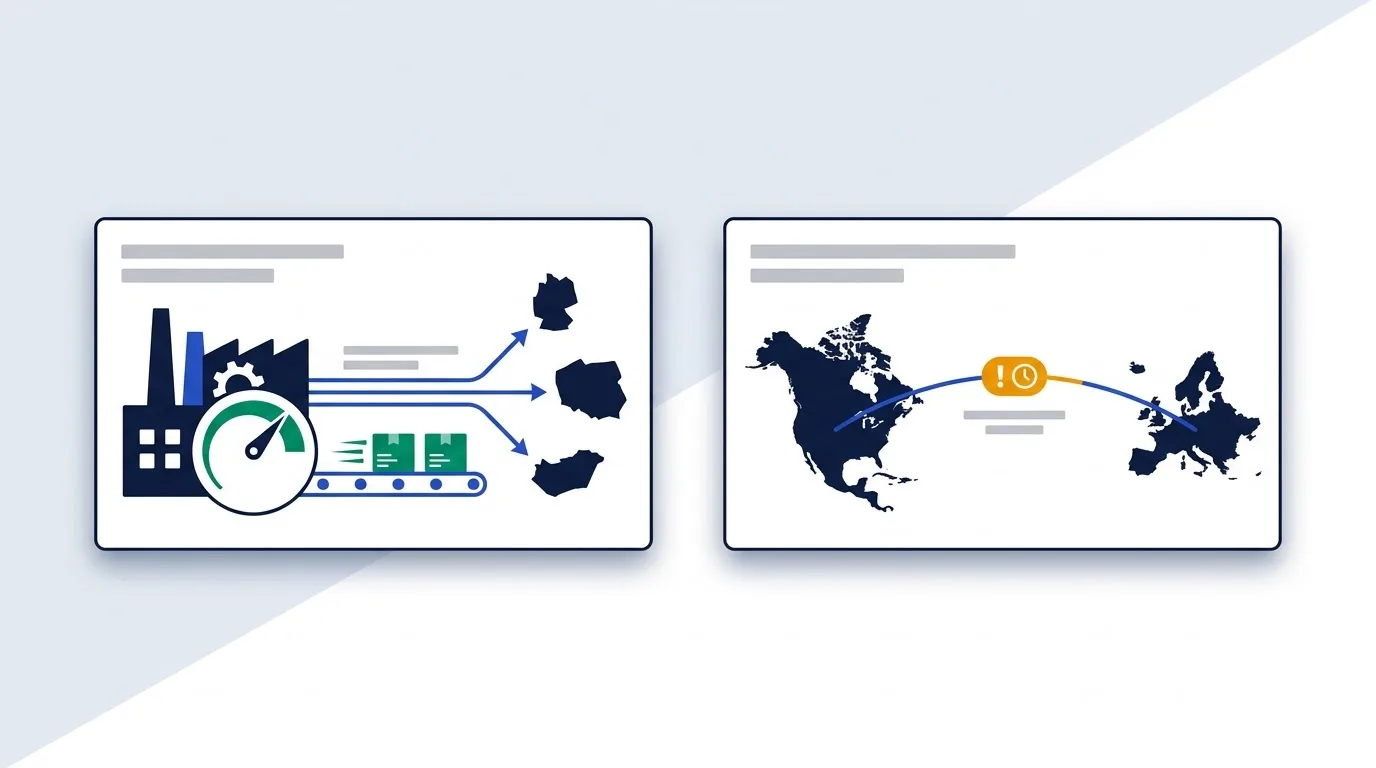
SPOD fits European merchants who need fast production, while Gooten fits US-focused sellers who want automated routing for apparel and home decor.
Why would a European seller pick SPOD?
SPOD suits merchants who put production speed first and sell mostly in the EU and US. It runs four of its own factories and works with no third-party providers. At signup, you choose whether your orders are produced in the US or the EU.
- 48-hour production, so orders ship quickly.
- Organic apparel collections within its catalogue.
- More than 50,000 premade graphics you can use in designs.
- Native integrations with most other popular platforms beyond the four in the table.
There is no subscription tier, and test samples come with up to 20% off. The downsides are a smaller catalogue than Printify's and no production outside the EU and US. Ship elsewhere and transit times will likely be a lot longer.
Is Gooten a good fit for Europe?
Gooten is the weakest fit of the six for European delivery. It prints some items in-house and also uses third-party manufacturers. An automated system sends each order to whichever provider it judges best.
- Free to use, with no subscription fees.
- Home decor such as metal prints and woven blankets alongside apparel.
- Its custom API reaches Amazon, eBay or a stand-alone site.
Two downsides matter if you ship in Europe. Shipping costs are high outside the US, and you cannot choose the print provider.
Where does CustomCat fit?
CustomCat is another US-focused option, though not one built for European buyers. According to Printify's comparison page, it ships in the US in typically two to three days, but its fulfilment centres are US-only and international shipping is slow. It lists 375+ products, with a solid range of athletic apparel and t-shirts.
The same page lists three tiers: CustomCat Lite is free, CustomCat Pro costs US$30/month with discounted prices, and Enterprise has custom pricing. It integrates with Shopify, WooCommerce, Etsy, BigCommerce and an API. It offers no branding options, and shipping costs split into four weight-based tiers that can be confusing.
Compared with Printify, SPOD is the clearest speed play. Its 48-hour production comes from its own German, Polish and Czech sites, whereas Printify's speed depends on whichever provider takes the job. Gooten routes automatically, much like Printify's Order Routing, but it gives you no say over the provider.
European tax rules and data privacy standards
Printful and Gelato publish Article 28 GDPR terms, while Printify's pages mention only Standard Contractual Clauses. That gap, plus the VAT treatment of vendor invoices, is the part of the choice most UK and EU merchants overlook.
Which vendors publish a data processing agreement?
When a customer's name and address pass to a print vendor, that vendor processes personal data on your behalf. Article 28 of the GDPR requires a written agreement covering that processing, which is what a data processing agreement (DPA) provides.
| Vendor | Company | GDPR terms and hosting |
|---|---|---|
| Printful | AS Printful Latvia (also trading as Printful Inc.) | Published Article 28 DPA, Standard Contractual Clauses for global routing; AWS servers in Latvia and Spain |
| Gelato | Gelato ASA, Oslo | Standard Article 28 DPA; hosting in Norway and Germany |
| Printify | Printify, Inc. (Delaware), with Latvian subsidiary SIA Printify Development | Standard Contractual Clauses for transfers; no DPA mentioned |
If a DPA is a hard requirement in your compliance file, Printful and Gelato are the easier route. SPOD, Gooten, Fourthwall and Sellfy do not publish DPA or hosting terms we could verify, so they are not ranked on GDPR here.
How does the VAT reverse charge work in the EU?
If you are VAT-registered in one EU member state and buy a service from a supplier in another, the supplier generally invoices without VAT. You then account for the VAT yourself. That is the reverse charge under Council Directive 2006/112/EC, and you usually need to give the supplier a valid VAT number, which can be checked in the VIES system.
It applies most clearly to subscription fees such as Printful Growth, Gelato+ or Printify Premium. Whether an order invoice counts as services or goods depends on how the vendor bills you, so have your accountant confirm. Our guide to the VAT reverse charge for European businesses walks through the bookkeeping.
What changes for UK sellers?
The UK is not part of the EU VAT territory, so the EU mechanism above does not apply to you. If you are VAT-registered in the UK, you account for the UK reverse charge on imported business services. The rules sit in HMRC VAT Notice 741A, and a VIES check does not replace them.
Customs follow the same border. Printing in the customer's country sidesteps cross-border customs, which is where Gelato's network helps when a facility exists in the buyer's country. Printful's Riga and Barcelona sites serve EU shoppers inside the EU, but a parcel to a UK customer still crosses a customs border, so plan for import steps.
Consent is the last trap. If you collect marketing opt-ins at checkout and sync them to an email platform, use an unticked box and record the consent. Pre-ticked boxes do not meet the GDPR opt-in standard.
Which print-on-demand platform suits your business
The right platform follows from three questions about your buyer, your product and your store, not from the longest feature list.
First, do you already have a store? If not, the storefront tools save you a separate ecommerce subscription and setup. If you do, the back-end services plug into it, so check that your platform appears on their integration lists.
Second, where do your buyers live? A customer base spread across many countries favours local routing. Owned factories nearby are favoured when your base is concentrated in Germany, Poland or the Czech Republic. A mainly US base opens the door to Gooten or CustomCat, which suit few European sellers.
Third, does your compliance file need a published DPA? If your customers' data must sit under an Article 28 agreement, that alone narrows the field to two vendors in this comparison.
Here is a quick test. If you sell posters to Germany, France and Italy, Gelato fits. Printful fits if you sell embroidered hoodies with your own neck label. If your complaint is that Printify parcels arrive late, try SPOD first.
What should you do before going live?
Order a sample from your top two platforms before you publish a single listing. Judge print vibrancy, fabric weight and packaging side by side, because photos and mockups hide all three. SPOD's sample discount makes it cheap to include in the test. If two platforms come out equal, pick the one with a published DPA.
Bottom line
Choose Printful if consistent branded quality matters most, Gelato if your orders cross borders, and SPOD if your buyers are in Central Europe and speed counts. Pick Fourthwall or Sellfy if you have no store yet, and stay with Printify if range and base price outweigh consistency. These picks rest on price, plan limits, EU production sites, DPA terms and integrations from vendor data, not on testing.
Your next step is small. Open a free account with your top pick, build one product and order the sample this week.