


Compare Printify vs Printful for European ecommerce. Analyze base pricing, EU fulfillment centers, VAT reverse charge rules, and margins. Find your POD setup.
TL;DR: Executive Summary for European & UK Retailers
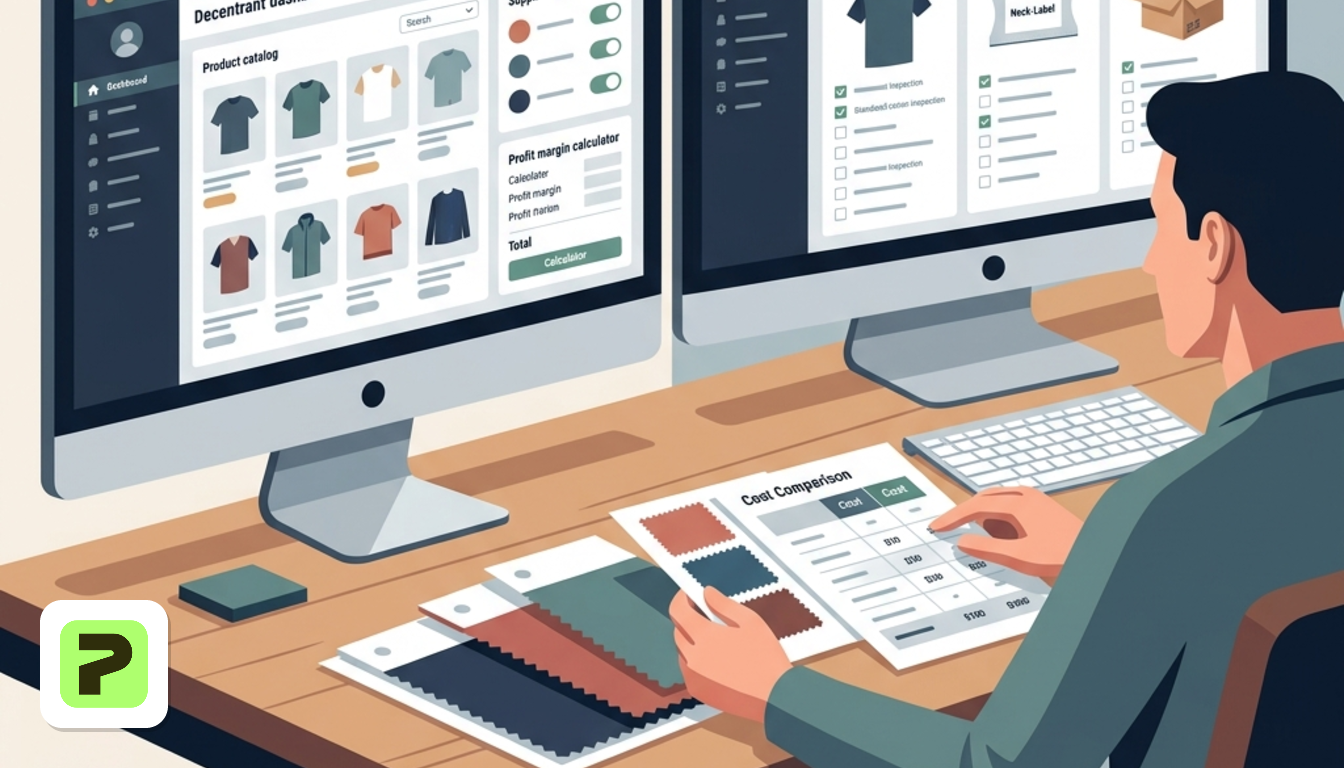
In any direct printify vs printful evaluation for European and UK merchants, the primary distinction lies in operational architecture. Printify acts as an open print-broker marketplace, connecting online stores with third-party manufacturing facilities. Printful operates as a vertically integrated manufacturer, controlling proprietary fulfillment plants across the European Union and the United Kingdom.
| Evaluation Criteria | Printify | Printful |
|---|---|---|
| Core Operating Model | Decentralized print aggregator & marketplace | Vertically integrated in-house manufacturer |
| Account Pricing | Free (US$0/mo) or Premium (US$39/mo or US$24.99/mo annual) | Free standard access (no mandatory recurring fee) |
| Billing Currencies | US Dollars (US$) only | Multi-currency billing (EUR €, GBP £, US$) |
| Catalog Volume | 1,300+ items across global partner network | 450+ curated items printed in-house |
| European Fulfillment | Independent partners in UK, DE, PL, CZ, LV, NL | Owned facilities in Riga (LV), Barcelona (ES), Wolverhampton (UK) |
| Custom Branding | Basic packing slips; neck labels provider-dependent | Inside/outside labels, pack-in inserts, branded packaging tape |
| B2B VAT Reverse Charge | Supported via VIES VAT ID verification | Supported via EU VIES or UK HMRC VAT numbers |
Who Printify is For
- European retailers prioritizing unit profit margins and seeking the most competitive pricing for standard apparel.
- Businesses desiring an extensive product catalog, featuring an extensive catalog, and a wide array of customization options.
- Merchants who are prepared to navigate and manage variable fulfillment partners, which can lead to differing production times and quality across orders.
Who Printful is For
- European brands that demand centralized quality consistency and a unified production standard across all their products.
- Those requiring built-in warehousing services for inventory management alongside their print-on-demand operations.
- Businesses focused on comprehensive white-label branding, including options for inside/outside labels and custom pack-ins, to ensure a cohesive brand experience.
From a European commercial perspective, neither side of the printify vs printful choice provides an automated single European tax setup. Merchants utilizing either service must independently understand and manage complexities such as cross-border invoicing, multi-currency handling, and specific regional VAT regulations.
Core Operational Models: Printify Aggregator vs Printful In-House Manufacturer
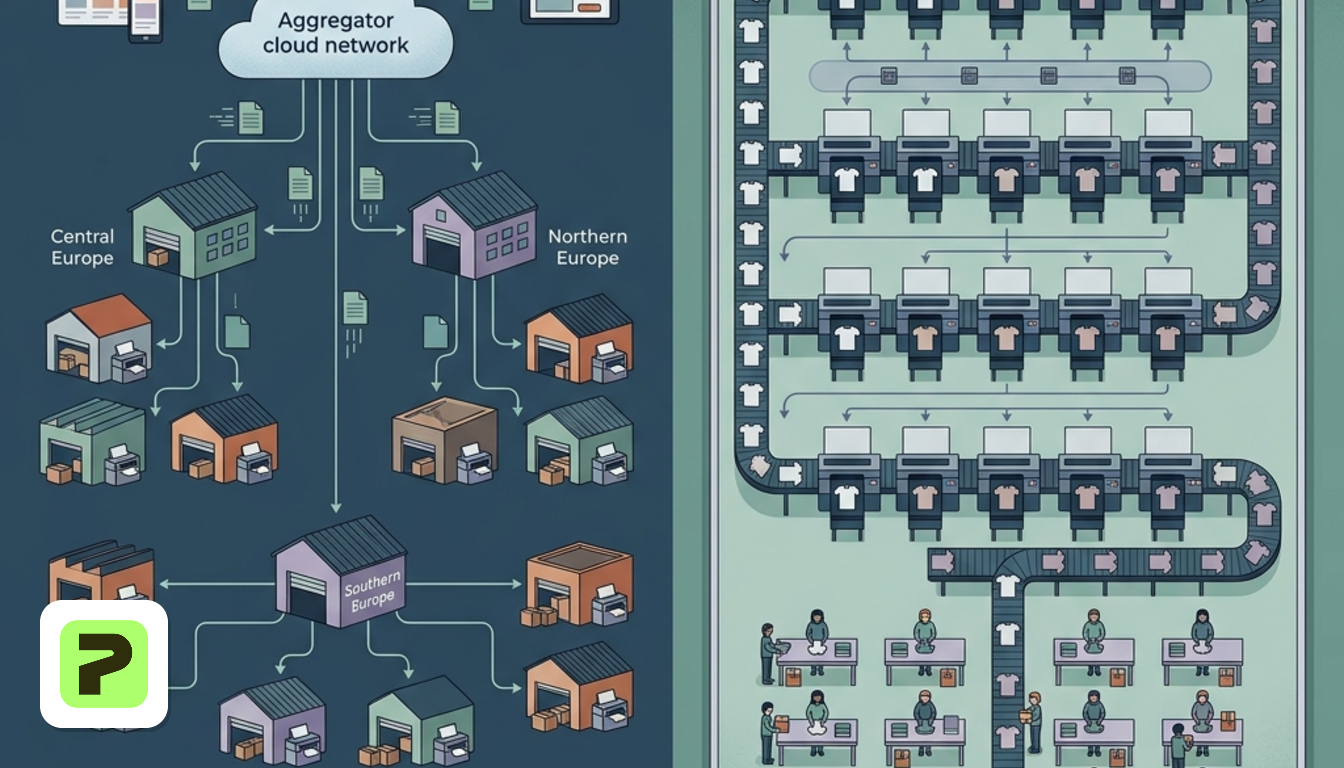
Understanding the operational divide in the printify vs printful comparison requires evaluating how each platform handles order routing, manufacturing, and fulfillment across Europe and global markets.
Printify's Global Print Provider Network
Printify operates as a technology intermediary rather than a direct manufacturer. The platform routes merchant orders to a decentralized network of independent third-party print providers located across Europe, the UK, and North America. According to Printify's pricing page (checked October 2026), the platform offers a Free plan for up to 5 stores and a Premium plan (US$39/month, or US$24.99/month billed yearly). This aggregator infrastructure enables dynamic routing and localized provider selection, allowing merchants to assign orders to specific facilities based on delivery destination, stock, or price.
Printful's Vertically Integrated Production Infrastructure
In contrast, Printful functions as a vertically integrated manufacturer. Printful owns or directly leases and operates its fulfillment centers worldwide, including facilities within the EU. By maintaining full internal control over its operational footprint, Printful standardizes its machinery—utilizing industrial Kornit Digital Direct-to-Garment (DTG) systems—and enforces unified quality assurance, ink management, and packaging procedures across every facility. In the operational assessment of printify vs printful, this vertical integration removes the third-party middleman layer from day-to-day manufacturing.
Operational Trade-offs: Cost Efficiency vs Product Consistency
The choice between an aggregator network and an in-house production model creates clear operational trade-offs for e-commerce merchants balancing printify vs printful:
- Printify (Aggregator Model): Delivers lower, highly competitive base prices driven by market competition among independent print providers. The trade-off is variance: using different third-party vendors for different catalog items can lead to slight discrepancies in print technique, color rendition, or unboxing packaging on multi-item orders.
- Printful (In-House Model): Provides strict uniformity, color matching, and consistent packaging across repeat orders regardless of where the item is printed. The trade-off is cost: Printful charges higher baseline manufacturing fees, which can result in tighter merchant profit margins compared to Printify's supplier network.
Printful vs Printify Pricing: Base Product Costs and Fee Structures

Pricing remains a central consideration when assessing printify vs printful for store owners managing localized margins across European consumer segments.
Printify Account Tiers and Pricing
Printify operates a tiered subscription model that influences both the features available and the base product costs for merchants, according to Printify's official pricing page, checked October 2026. This structure allows businesses to choose a plan that aligns with their operational scale and desired level of savings. * **Free:** This tier is available at US$0 per month. It supports up to 5 stores per account and allows for an unlimited number of product designs, making it suitable for new businesses or those testing the print-on-demand model. * **Premium:** Priced at US$39 per month when billed monthly, or US$24.99 per month with annual billing, the Premium tier significantly expands capabilities. It provides access to discounted base product pricing; refer to Printify's brand page for specific plan limits and catalog discounts. Additional features include AI mockups, Printify Connect for streamlined order management, and access to the Sellers Club PRO mentoring program. * **Enterprise:** This tier is available via custom pricing, designed for high-volume merchants with significant daily sales. It provides unlimited stores, custom API access, and additional discounts on all products, tailored to large-scale operations. For more in-depth information on Printify's pricing and features, refer to their dedicated page at /deals/printify/.Printful Pricing Architecture
Printful employs a different pricing philosophy compared to Printify's subscription-based model. In the broader printify vs printful comparison, Printful operates without a mandatory monthly membership fee for standard access to its product catalog. Instead, the core of its pricing structure revolves around production fees, which are charged per unit for each item ordered. This pay-as-you-go approach means businesses primarily incur costs directly proportional to their sales volume. While Printful previously offered optional paid tiers, such as "Printful Growth," which were tied to specific annual sales thresholds or required a monthly membership fee for additional benefits, the absence of a compulsory recurring fee for basic access remains a distinguishing factor in its current architecture.Currency Transparency for European Merchants
For businesses operating in Europe and the UK, the approach to currency billing presents a notable difference between the two platforms. Printify processes its software subscription fees and the base costs for products in US Dollars (US$). Consequently, European and UK merchants making payments in EUR (€) or GBP (£) may be subject to foreign exchange conversion fees imposed by their credit card issuer or payment gateway. In contrast, Printful offers multi-currency billing. This allows European sellers to conduct transactions and be billed directly in EUR or GBP, based on their geographical location settings, thereby potentially helping them avoid additional currency conversion charges—a key financial detail in printify vs printful bookkeeping.Mathematical Breakeven Analysis: When Does Printify Premium Justify the Overhead?
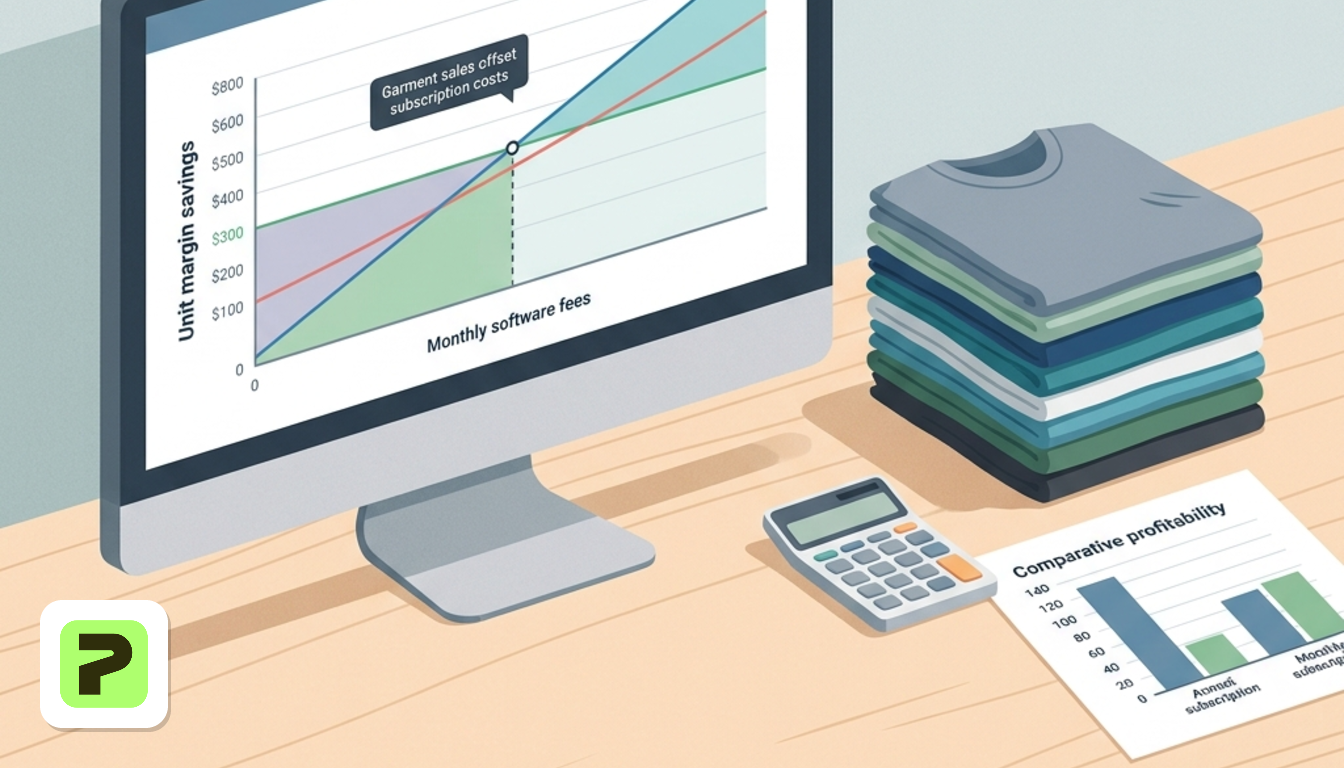
The Unit Breakeven Formula for Monthly (US$39) vs Annual (US$24.99) Billing
Let's use an average saving of US$3.50 per standard t-shirt as a representative figure to calculate the monthly unit threshold required to offset the subscription fee for Printify Premium. * **Annual Billing Calculation:** When billed annually, Printify Premium costs US$24.99 per month (source: Printify's pricing page, checked October 2026). To breakeven with an average saving of US$3.50 per unit, a store must sell: US$24.99 / US$3.50 savings per unit ≈ 7.14 units. Therefore, saving an average of US$3.50 per standard t-shirt requires selling exactly 8 units per month: 8 units × US$3.50 savings = US$28.00 gross margin savings, offsetting the US$24.99 cost. * **Monthly Billing Calculation:** Opting for monthly billing incurs a higher cost of US$39.00 per month (source: Printify's pricing page, checked October 2026). Using the same average saving of US$3.50 per unit, the breakeven point is: US$39.00 / US$3.50 savings per unit ≈ 11.14 units. Consequently, saving an average of US$3.50 per unit requires selling at least 12 units per month: 12 units × US$3.50 = US$42.00 savings.Financial Scenarios for Low-Volume vs Scaling Stores
These calculations highlight the critical sales volume needed to justify Printify Premium when assessing printify vs printful economics. * **Low-Volume Stores:** For businesses shipping fewer than 8 units per month (on an annual plan) or fewer than 12 units per month (on a monthly plan), the subscription fee will erode their profit margins. In such scenarios, operating on Printify's free plan, which supports up to 5 stores and unlimited product designs (according to Printify's pricing page, checked October 2026), would preserve more margin. * **Scaling Stores:** Conversely, stores with higher sales volumes benefit significantly. A store shipping 50 units per month, for example, would save 50 units × US$3.50 = US$175.00. After deducting the US$24.99 annual-billed Premium fee, this results in a net saving of US$150.01 per month. This substantial margin preservation becomes even more pronounced compared to Printful's baseline unit costs, which do not offer an equivalent subscription-based product discount model. The savings are verifiable against Printify's official published catalog pricing for various products.Print on Demand Europe: EU Fulfillment Centers and Regional Delivery
For businesses selling print-on-demand products in Europe, the location of fulfillment centers and the efficiency of regional delivery are critical factors in the printify vs printful operational matrix. They impact shipping costs, delivery times, and the overall customer experience, particularly concerning customs and cross-border logistics within the EU and to the UK.Printful Fulfillment Centers in the EU and UK
Printful operates its own dedicated fulfillment facilities within Europe. These include locations in Riga, Latvia, and Barcelona, Spain, serving the European Union market. Additionally, Printful maintains a UK facility in Wolverhampton. This strategy of owning and operating its print facilities allows Printful to manage quality control directly and streamline logistics. Orders processed through these domestic centers benefit from localized postal routing and domestic customs clearance, which can contribute to faster delivery times and a smoother experience for customers in the respective regions.Printify European Print Providers and Regional Routing
In contrast to Printful's owned facilities, Printify utilizes a network of independent third-party print providers across Europe. This network includes partners located in the UK, Germany, Poland, the Czech Republic, Latvia, and the Netherlands. This distributed model allows merchants using Printify to select specific regional print providers directly from the product catalog. The ability to choose a provider closer to the end customer can optimize transit times and potentially reduce shipping costs. Printify does not publish verified EU corporate entity or local data residency details in the supplied specifications.Cross-Border Delivery Latency and Multi-Item Shipping Discrepancies
The operational models of printify vs printful lead to different customer experiences for multi-item orders. For Printify, if an order contains products fulfilled by different print partners, each item may be produced and shipped separately. This means that customers might receive multiple packages for a single order, and separate shipping fees may be incurred for each package, potentially increasing the overall cost and complexity for the customer. Printful, with its owned and consolidated facilities, can often provide a more unified shipping experience. When a multi-category order can be produced within the same Printful facility, it is typically consolidated into a single delivery. This approach helps reduce customer confusion, simplifies tracking, and can result in a more predictable and potentially more cost-effective shipping outcome for the end consumer.Print on Demand VAT Reverse Charge and Cross-Border EU Invoicing
Navigating VAT regulations is crucial for European print-on-demand (POD) merchants, particularly when comparing printify vs printful across multiple jurisdictions. The correct application of VAT reverse charge, VIES validation, and Import One-Stop Shop (IOSS) schemes can significantly impact your profitability and customer experience.
B2B Invoicing Rules: Cross-Border Supply and VIES Validation
For businesses registered for VAT within the European Union, the reverse charge mechanism is a key component of cross-border B2B transactions. When an EU VAT-registered merchant purchases services or goods from another EU VAT-registered supplier in a different Member State, the VAT liability shifts from the supplier to the recipient.
To qualify for zero-rated intra-Community supplies under this mechanism, businesses must input a verified VAT ID. This ID is validated via the EU VIES (VAT Information Exchange System) database. This process ensures that the transaction is correctly accounted for VAT purposes in the recipient's country, as stipulated by Article 196 of the EU VAT Directive. According to Printify's Terms of Service and official vendor tax documentation, merchants are required to provide a valid VAT ID for such transactions.
Intra-EU vs Post-Brexit UK VAT Rules
The VAT landscape for UK businesses has diverged significantly from intra-EU rules since Brexit. UK businesses trading with Printful's UK entity will generally be subject to domestic UK VAT rules on manufacturing costs. To avoid these charges, businesses must supply a valid UK HMRC VAT number directly to Printful's UK entity, allowing for correct VAT treatment.
When UK businesses interact with Printify's European or US entities, or Printful's non-UK entities, the situation becomes more complex. Such transactions may be treated as imports into the UK, potentially incurring import VAT and customs duties. For sales within the EU, the EU One-Stop Shop (OSS) scheme applies to distance selling, with a pan-EU threshold of €10,000. Once this threshold is exceeded, sellers must register for OSS and charge the VAT rate of the customer's country.
Import VAT, IOSS Schemes, and End-Customer Invoicing Responsibilities
A critical operational consideration for any dropshipping model, including POD, is the handling of import VAT for orders shipped from outside the customer's customs territory. For instance, if a US-based Printify or Printful print provider ships an order directly to an end-customer in France, without proper integration of the Import One-Stop Shop (IOSS) scheme, the retail buyer will face unexpected carrier import clearance fees and domestic import VAT upon delivery.
The IOSS scheme allows businesses to collect VAT at the point of sale for goods imported into the EU with a value of up to €150, and then declare and remit this VAT via a single monthly IOSS return in one EU Member State. This prevents the end customer from being hit with unforeseen charges, which can lead to a poor customer experience and abandoned parcels. Merchants comparing printify vs printful should verify whether their chosen platform and its print providers support IOSS for shipments into the EU to mitigate these risks and ensure a smooth delivery process for their European customers.
For more detailed information on Printify's offerings, you can visit the Printify pricing in Europe (October 2026): plans, free plan & deals page.
Legal Entity Governance and GDPR Compliance (Article 28 DPA)
Understanding corporate governance and data handling practices is crucial when contrasting printify vs printful for compliance under European data protection laws. This involves examining the legal domiciles of the entities and their approach to data processing agreements.Corporate Entity Domiciles: Printify Delaware/Latvia vs Printful Corporate Structure
Both Printify and Printful operate with a dual corporate structure, combining a US registration with significant European operations. Printify is legally registered in the United States as Printify, Inc. (Delaware). Its primary European engineering and operations are managed through its subsidiary, SIA Printify Development, registered in Riga, Latvia, according to Printify's Terms of Service, checked October 2026. Similarly, Printful operates via Printful, Inc. (Delaware) with its primary European operations handled by AS Printful Latvia. This European presence is a key factor for businesses operating within the EU/EEA.
Article 28 GDPR Data Processing Agreements (DPA)
Under Regulation (EU) 2016/679, known as GDPR, online merchants act as Data Controllers. When a customer places an order, the merchant transfers personal data—such as consumer names, physical shipping addresses, and phone numbers—to the fulfillment platform. In this scenario, platforms like Printify and Printful act as Data Processors. Article 28 of the GDPR mandates that a Data Processing Agreement (DPA) must be in place between the Controller and the Processor to govern the handling of this personal data, ensuring adequate safeguards and compliance.
Third-Party Sub-Processor Data Exposure
A key distinction between the two platforms lies in their use of sub-processors. Printify, with its decentralized network of external print partners, transfers shipping data to these third-party entities for production and fulfillment. This requires merchants using Printify to review Printify's sub-processor list and understand the extended data flow. This model means data may pass through several hands, necessitating careful due diligence from the merchant's side regarding each sub-processor's compliance.
In contrast, Printful handles production data predominantly internally within its corporate group. This centralized approach standardizes data security under unified European Standard Contractual Clauses (SCCs), which are designed to ensure data transfers outside the EU meet GDPR requirements. In the printify vs printful comparison, Printful's internal handling of production data offers a more centralized compliance pathway for merchants, as there are fewer external third parties involved in the core manufacturing workflow.
Product Catalog Breadth, Sourcing Variety, and Print Techniques
When assessing printify vs printful, the range of products and available printing methods directly impacts a business's creative freedom and market reach. Both platforms support substantial catalogs and diverse techniques, but their underlying operational models create clear structural differences.
Catalog Scope: 1,300+ Printify SKUs vs Printful's Curated 450+ Range
Printify operates on a marketplace model, aggregating print providers from various manufacturers. This approach, according to Printify's documentation, enables a catalog exceeding 1,300 products. This extensive range covers diverse categories such as apparel, phone cases, home goods, and stationery, offering businesses broad options for product diversification. In contrast, Printful maintains a more curated catalog, listing over 450 products. Printful states that its selection is verified for compatibility with its proprietary machinery, aiming for consistent quality control across its offerings.
Manufacturing Techniques: DTG, All-Over Print (AOP), Sublimation, and Embroidery
Both platforms support core print-on-demand manufacturing techniques. Businesses can utilize Direct-to-Garment (DTG) printing for detailed designs on fabrics, all-over print (AOP) for seamless designs across entire garments, and dye-sublimation for vibrant, permanent prints on suitable materials. Both also offer direct embroidery services. Printful, however, maintains strict standardization across its embroidery files, often requiring digitization fees to ensure consistency. For Printify, embroidery options and their specific requirements, including potential digitization, vary significantly by the chosen print provider within its network.
Eco-friendly Apparel Availability
For European buyers prioritizing sustainability, both Printify and Printful offer eco-friendly apparel options. This includes certified organic garments from brands like Stanley/Stella and Continental Clothing. These products typically comply with standards such as OEKO-TEX or GOTS, catering to demand for ethically and environmentally produced goods. Printify further assists European businesses by allowing them to filter specifically for European eco-providers, streamlining the sourcing process for locally certified sustainable products.
Custom Branding Capabilities: Labels, Packaging, and Inserts
Effective branding extends beyond the product design itself, encompassing elements like custom labels and packaging. The branding feature set is a substantial differentiator in the printify vs printful decision for direct-to-consumer businesses.Label Customization (Inside and Outside Neck Labels)
Printful offers direct printing for both inside and outside neck labels on compatible apparel SKUs. This allows merchants to replace the manufacturer's tag with their own branding, including custom sizing and care instructions. This service is available for an added per-unit fee, according to Printful's documentation. This provides a consistent brand experience directly on the garment. In contrast, Printify's neck label customization is more restrictive. Its availability is limited to specific print providers and particular garments within their extensive network. This means that merchants using Printify may find it challenging to apply consistent custom neck labels across their entire product catalog or if they switch print providers.Custom Packaging, Inserts, and Packing Slips
Printful provides more extensive options for custom packaging and inserts. It offers dedicated warehousing services where merchants can store custom pack-ins, such as branded flyers, stickers, or business cards. Printful also supports custom branded packaging tape. These services are billed on a storage plus pick-and-pack fee schedule, as stated on Printful's official website. This comprehensive approach allows for a highly branded unboxing experience. For Printify, custom packaging options are more limited. While Printify generally provides customized black-and-white packing slips across most of its third-party print providers, physical pack-ins like custom flyers or stickers are largely unsupported across its network. Merchants using Printify for their products may need to manage custom inserts and branded packaging separately, which can add complexity to their fulfillment process. For more details on Printify's offerings, you can visit their page at /deals/printify/.Multi-Store Limits, Platform Integrations, and Management Overhead
Another pragmatic operational axis of the printify vs printful comparison involves store connectivity limits and software integrations.
Store Allocation Constraints: Printify's 5 vs 10 Store Cap vs Printful Architecture
When managing multiple online stores, the platform's allocation limits become a key consideration. According to Printify's official pricing page (checked October 2026), the Free tier permits up to 5 stores per account, while the Premium tier expands this to 10 stores. For merchants with significant daily sales requiring more extensive operations, Printify's Enterprise tier offers custom pricing and allows for an unlimited number of stores. In contrast, Printful allows merchants to connect multiple storefronts without an explicit hard tier limit across its plans, offering more flexibility for extensive multi-store operations from the outset.Native Integrations and Order Automation
Both Printify and Printful provide robust native integration capabilities with leading e-commerce platforms, facilitating streamlined order automation. Merchants can directly connect their storefronts on platforms such as Shopify, WooCommerce, Etsy, eBay, Wix, and Squarespace via direct API integrations. This ensures that orders placed on these platforms are automatically pushed to the print-on-demand service for fulfillment, reducing manual input and potential errors.Operational Switching Costs and Regional Management
While both platforms support multi-store operations, their approaches to managing inventory and fulfillment across different regions can introduce varying levels of management overhead and potential "switching costs" in terms of provider choice. On Printify, managing multiple regional storefronts often requires merchants to manually assign specific print providers per SKU. Alternatively, users can utilize automated order routing rules, which may dynamically select a different provider if the primary one runs out of stock. This automation, however, can potentially alter the base product costs, as different providers may have different pricing structures for the same item. In the printify vs printful workflow, Printful's integrated fulfillment network aims to simplify this by routing orders to the most suitable facility based on product availability and destination, potentially reducing the need for granular manual intervention, though specific regional pricing can still vary.The Good vs The Bad: Verifiable Realities for European Retailers
Weighing the balance of printify vs printful requires confronting the verifiable strengths and tangible limitations inherent in each provider's business model.
Printify — The Verifiable Upsides and Concrete Drawbacks
Printify offers a broad range of products, boasting a catalog of over 1,300 items, which allows for significant flexibility in product offerings for European retailers. For businesses looking to scale, the Printify Premium plan provides aggressive pricing discounts, offering up to 20% off most products, according to Printify's pricing page, checked October 2026. Furthermore, the Free plan supports up to 5 stores per account, which is beneficial for merchants managing multiple niches or brands without an upfront subscription cost.
However, Printify presents specific drawbacks for European users. Subscription billing for its Premium plan is USD-only, potentially incurring foreign exchange (FX) fees for businesses operating in EUR or GBP. Orders containing multiple items sourced from different print providers can lead to duplicate shipping fees, as each provider ships separately. From a data handling perspective, Printify's approach involves disparate sub-processors, which may require careful review for European businesses adhering to GDPR compliance.
Printful — The Verifiable Upsides and Concrete Drawbacks
Printful distinguishes itself with vertically integrated quality control, particularly across its EU and UK facilities, which can ensure consistent product quality. For European retailers, the ability to receive multi-currency billing in EUR or GBP helps avoid FX fees on subscription costs. Printful also provides comprehensive support for custom neck labeling and physical pack-ins, offering greater branding opportunities. Its data processing architecture is structured around a single DPA data processor, which can simplify compliance considerations for GDPR-conscious businesses.
On the downside, Printful typically features higher base manufacturing prices compared to Printify, which can cut into profit margins, especially for low-volume orders. Its catalog selection is also smaller, with over 450 items, offering less variety than Printify for retailers seeking a very broad product range.