











Comparing Majestic SEO vs Semrush? Discover differences in backlink indexes, Trust Flow, AI search tracking, multi-user pricing, and EU data compliance.
TL;DR: In the Majestic SEO vs Semrush choice, Majestic suits you if backlink forensics is most of your job. Semrush suits you if you also need rank tracking, audits, PPC and AI search tracking. Majestic is a poor sole platform. Semrush is overkill if you only vet links.
Quick verdict on Majestic SEO vs Semrush
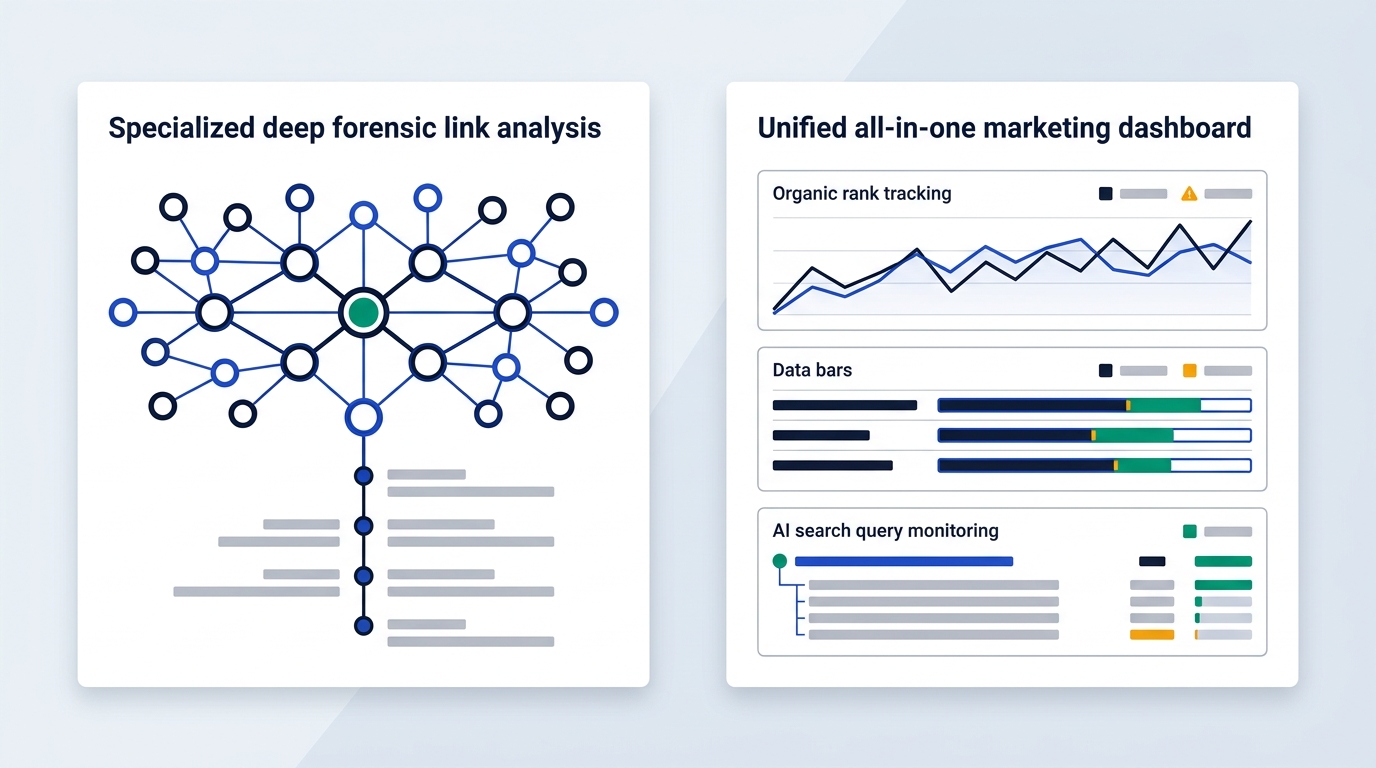
Pay for Majestic only if link analysis is your core work. That means expired domain screening, vetting link networks, or auditing profiles that go back years. If links are one input among many, Semrush already gives you a big backlink index plus everything around it.
The two tools are built for different people. Majestic targets dedicated link builders, affiliate webmasters and forensic link auditors. Semrush targets marketing teams, SEO managers and agencies who want one organic search workflow. That gap explains most of the differences below.
The database scope differs too. Semrush reports over 43 trillion backlinks. Majestic splits its data into a Fresh Index covering the last 120 days and a Historic Index of 21+ trillion URLs.
| Point | Majestic | Semrush |
|---|---|---|
| Main job | Backlink intelligence | Search and AI visibility platform |
| Backlink data | Fresh Index (120 days) plus Historic Index (21+ trillion URLs) | Over 43 trillion backlinks |
| Link history from | 2006 | 2012 |
| Keyword and rank tracking | None | 500 to 5,000 keywords tracked daily |
| AI prompt monitoring | None | Yes, 50 daily prompts on Starter |
| Entry paid price | Lite: UK £39.99 / €46.99 / US$49.99 per month | SEO plan: US$139 monthly, US$117.33 per month billed annually |
Source: vendors' pricing and product pages, checked October 2026.
So the answer to your question is conditional. If you buy and sell domains, or you clean up toxic links for clients, Majestic earns its fee. If you run campaigns and report on them, start with Semrush and see whether its link reports cover you.
Choosing between link depth and search breadth
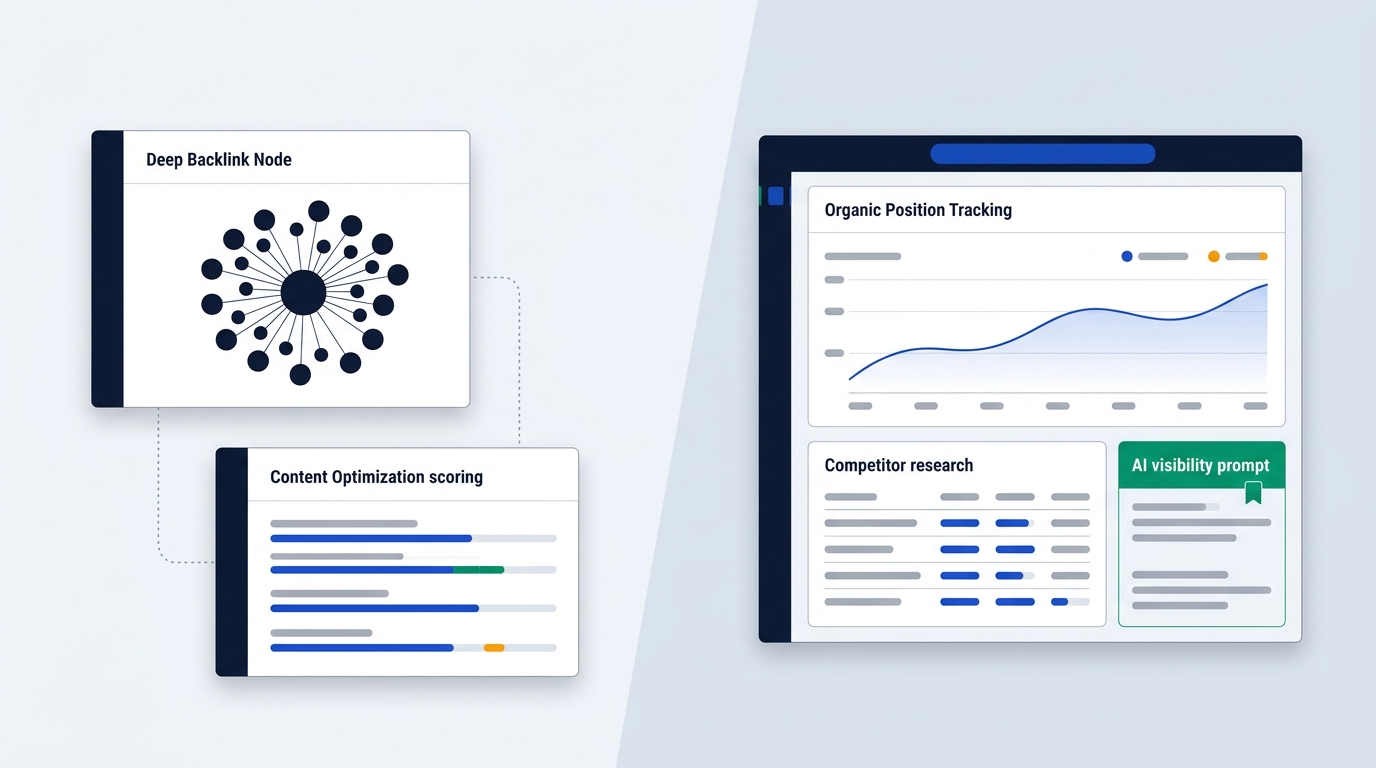
Your daily tasks decide this, not the feature count. Four situations come up most often, and each points one way.
Do you audit links or buy expired domains?
Majestic wins here. Its Historic Index runs back to 2006, and Topical Trust Flow sorts referring domains by subject. Its link context data shows where each link sits on the page.
Say you are checking a ten-year-old domain before buying it. You want to know who linked to it in 2014 and whether those sites were about the same topic. That is the job Majestic was built for.
Do you serve clients across several channels?
Semrush wins. It puts position tracking, scheduled PDF reports and competitor research in one workspace, and over 55 tools sit behind the same login. A client who asks "how are we doing on Google and in AI answers?" gets one report instead of three exports.
Can Majestic run a campaign on its own?
No. It has no keyword research, no rank tracking and no PPC data. Teams that use it usually bolt on other tools. DataForSEO supplies pay-as-you-go API data, and Surfer SEO handles content optimisation.
That stack can work. However, you now manage several logins and bills to replace one platform.
Do you need to track AI search?
Semrush has it and Majestic does not. Semrush monitors AI visibility, AI sentiment and custom prompts. Majestic stays a link-only product, so nothing in it touches generative search.
Trust Flow metrics versus Authority Score
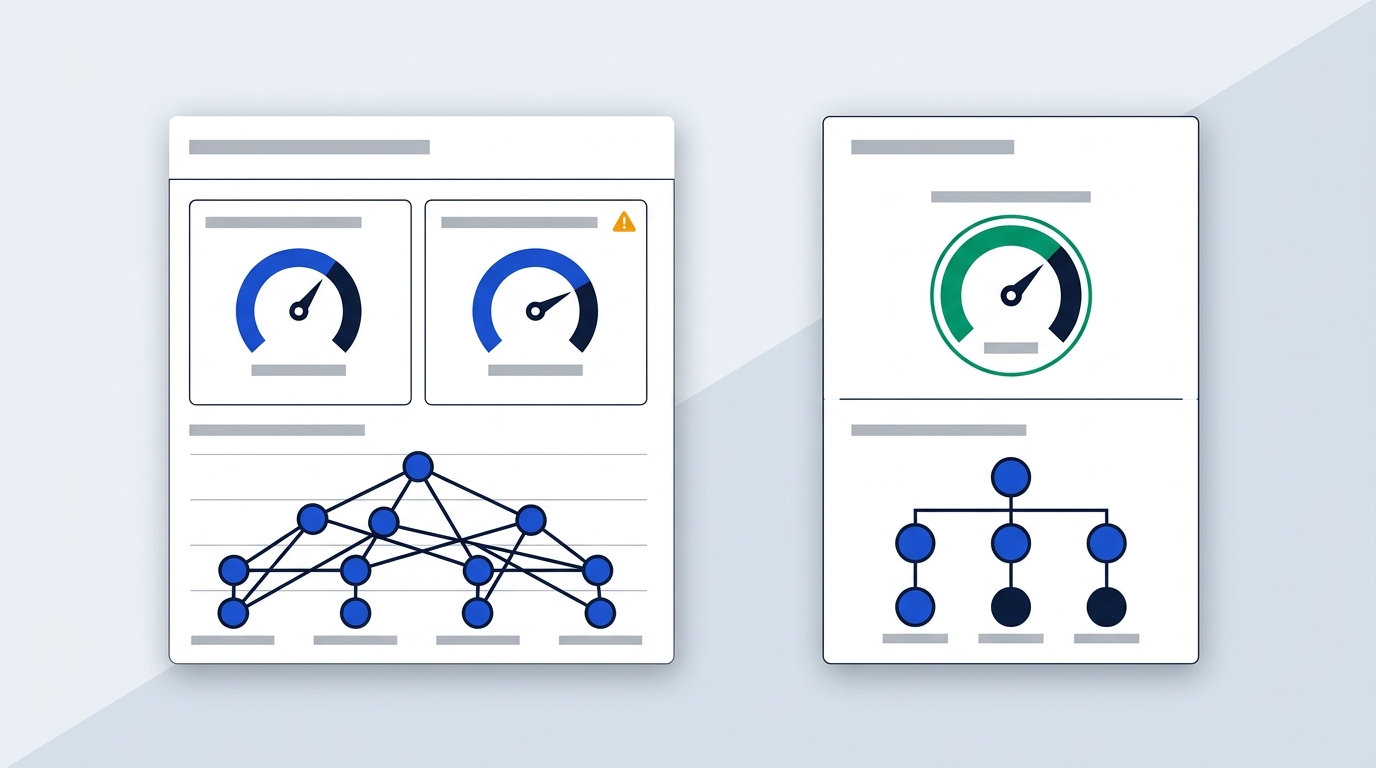
Majestic gives you two scores per domain, while Semrush gives you one. Which is better depends on whether you want to see the split or just a quick number.
How Majestic splits Trust Flow and Citation Flow
Trust Flow measures how closely a site's backlinks connect to a curated set of trusted seed sites. Citation Flow counts raw link volume. Read together, they show two things: how trustworthy a domain looks, and how many links point at it.
The gap between them is the useful part. When Citation Flow far exceeds Trust Flow, the site has plenty of links but few from trusted neighbourhoods. That pattern often points to bought or automated links, so link builders use it as a fast filter on outreach lists and expired domains.
What Semrush Authority Score blends
Authority Score folds backlink quality, backlink quantity, organic performance and spam signals into one number. It is easy to read and fine for general workflows. The downside is that you cannot see whether a high score comes from trust or from volume.
For a content team ranking prospects for guest posts, one number is often enough. For someone vetting a link network, it hides the detail that matters.
Where does the link sit on the page?
Majestic's Context Report shows whether a backlink sits in the main body, a footer, a sidebar or a block of other outbound links. It also shows the surrounding text and nearby links. A link density graph plots internal links in blue and external links in gold.
This matters because a link inside relevant body copy generally carries more weight than one buried in a template. Semrush shows linking domains, anchor text and link attributes, but no placement-level view.
How deep do the network maps go?
Both tools draw backlink networks. Semrush maps three tiers: up to 12 first-tier, 10 second-tier and 8 third-tier referring domains. It helps you spot clusters, authority hubs and suspicious networks, and it sits inside Semrush's wider analytics.
Majestic's Link Graph goes four tiers deep and brings in Trust Flow and Citation Flow on the map itself. If you chase private blog networks, the extra tier and the built-in metrics give you more to work with.
Comparing index history and competitive link gaps
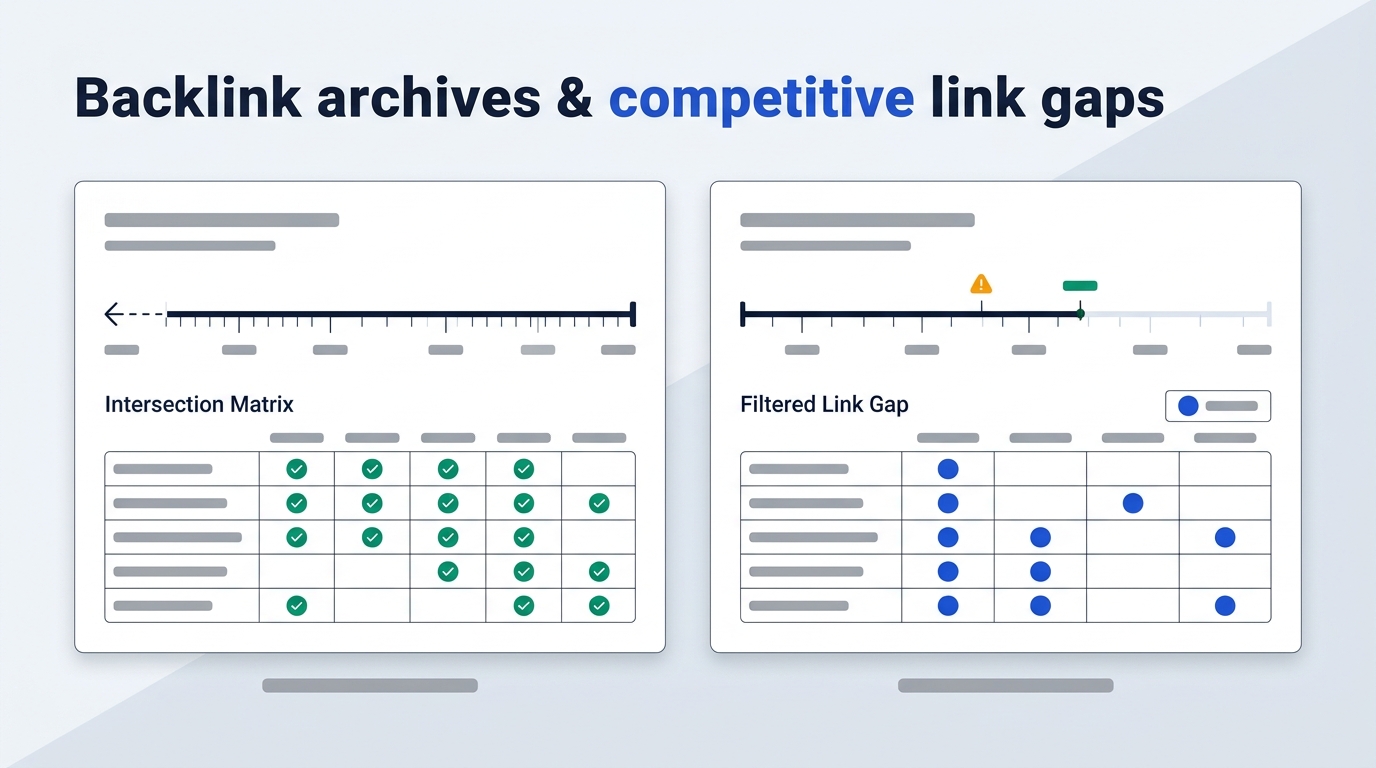
Majestic goes further back and costs less to reach that history. Semrush has the larger headline index and the broader toolset around it.
Which index goes back further?
Majestic has link records from 2006. Semrush's backlink history extends to 2012. Semrush does not keep a standalone historic index either, so older links appear in general reports with fewer tools for digging through them.
That six-year gap matters for older sites. If you are reviewing a legacy campaign or checking what a domain looked like before a penalty, those extra years are your evidence.
What does historical access cost?
Majestic includes its complete Historic Index on the Pro tier at US$99 a month. Semrush locks historical SEO data behind Pro+ at US$299 a month, or US$248.17 a month billed annually, or higher. Pro+ also brings you 15 websites and 1,500 daily keywords, so you are paying for more than history. Still, if history is all you want, you are paying for features you won't touch.
Who finds more competitor link gaps?
Majestic's Clique Hunter compares up to 10 domains at once and surfaces sites that link to your competitors but not to you. Semrush's Backlink Gap handles up to five domains. It adds filters for authority score, link type and follow status, which is handy for narrowing a list quickly.
Here is a typical case. You run a niche affiliate site and want sites linking to eight rivals but not to you. Clique Hunter takes all eight in one pass, while Semrush would need you to split the set.
Can you judge topical fit?
Topical Trust Flow classifies referring domains by subject matter. A link from a high-trust site in an unrelated field looks different from one in your own niche, and this metric makes that visible. Semrush has no equivalent topic-based classification in its gap tool.
AI search tracking and modern keyword workflows
Semrush covers this ground and Majestic does not touch it. If your reporting now includes AI answers, that settles part of the question.
What does Semrush track in AI search?
The SEO plan includes tracking performance in AI search, AI sentiment, AI visibility reports for any domain and custom prompts. Starter monitors 50 prompts daily for one domain and allows 300 AI visibility reports a day. Pro+ doubles the prompt count to 100.
For a brand manager, this answers a new question: when someone asks an AI assistant about your category, does your name come up, and in what tone?
How far do audits and rank tracking go?
Site Audit comes with the plans, and Starter adds an AI-ready version. Rank tracking covers 500 keywords daily on the SEO and Starter plans and 1,500 on Pro+. Advanced reaches 5,000. Pro+ also adds multi-location and multi-device tracking, which matters if you serve several markets.
What does Majestic lack?
Majestic has no keyword tracking, no rank tracking module, no SERP position history and no AI prompt monitoring. You can still use it for what it does well. You just cannot check positions in it.
What else sits around the core tools?
Semrush covers content optimisation and keyword cannibalisation analysis from Pro+. Starter includes MCP (Model Context Protocol) access, useful if your developers want to pull data into their own workflows. That puts it in direct competition with platforms like Ahrefs, and our Semrush vs Ahrefs pricing comparison breaks down that matchup.
Total software pricing and European compliance costs
Majestic is cheaper to start, but Semrush replaces more tools. What you pay depends on how many people use it and how you report.
What do the plans cost?
Majestic Lite starts at UK £39.99 / €46.99 / US$49.99 per month. Pro costs UK £99.99 / US$99 per month. An API plan is also available.
Semrush lists a free plan at US$0 with one demo project and 10 reports a day, no credit card needed. It also offers a 7-day free trial. Paid plans are in US dollars:
| Plan | Monthly | Per month, billed annually | Websites | Keywords daily |
|---|---|---|---|---|
| SEO | US$139 | US$117.33 | 5 | 500 |
| Starter | US$199 | US$165.17 | 5 | 500 |
| Pro+ | US$299 | US$248.17 | 15 | 1,500 |
| Advanced | US$549 | US$455.67 | 40 | 5,000 |
What do extra users and reports add?
Additional users start at US$45 a month each. A Base Report add-on costs US$10 a month and gives you scheduling, PDF export and Google Analytics and Search Console integrations. The Pro Report at US$20 a month adds white-labelling, AI-generated summaries and sharing by link.
Picture a three-person agency that needs separate logins and branded client reports. Those add-ons stack on the plan price, so the real bill sits well above the headline number. Majestic lists only Lite, Pro and API tiers, so there are fewer lines to add up.
What about GDPR and data transfers?
Semrush Inc. is a Delaware corporation based in Boston, so US jurisdiction applies. It offers a data processing agreement in which it acts as processor. That agreement incorporates the EU Standard Contractual Clauses (Decision 2021/914) and the UK transfer mechanism, and the Clauses are governed by Czech law.
This comparison has no DPA or data-location details for Majestic, so it cannot separate the two on compliance. If US jurisdiction is a dealbreaker for your legal team, our guide to Semrush alternatives for European marketing teams covers other routes.
How does VAT work for European buyers?
Semrush prices are in US dollars before VAT. A VAT-registered business in Ireland, France, Spain or Italy can generally apply B2B reverse charge on services bought from a non-EU supplier. You supply a valid VAT ID and account for VAT in your own return.
The bottom line on both tools
Choose Majestic if you vet domains, audit link profiles or build links all day. Choose Semrush if you run campaigns, report to clients or need to track AI answers. If you do both, expect to run Semrush as your base and Majestic as the specialist add-on.
Your next step: open a free Semrush account or start its 7-day trial on one live site. Then run the domains you care about through its backlink reports. If they leave gaps on historical or forensic checks, add Majestic Lite on top.