

















European teams, compare Base44 vs Lovable. Find out which AI app builder offers better EU data options, code ownership, and transparent pricing.
Your choice between Base44 vs Lovable for AI app building depends on whether you prioritize quick setup or long-term code control. Base44 offers a fully managed platform with zero-setup speed. Lovable, conversely, delivers exportable React code with two-way GitHub version control and open data ownership.
Base44 builds your frontend, database, authentication, and backend functions inside a single managed ecosystem. This allows you to launch applications instantly without configuring cloud infrastructure. Lovable generates standard React and TypeScript code synced directly to your GitHub repository, letting you own your application codebase and decide exactly where your database resides.
TL;DR: Base44 vs Lovable
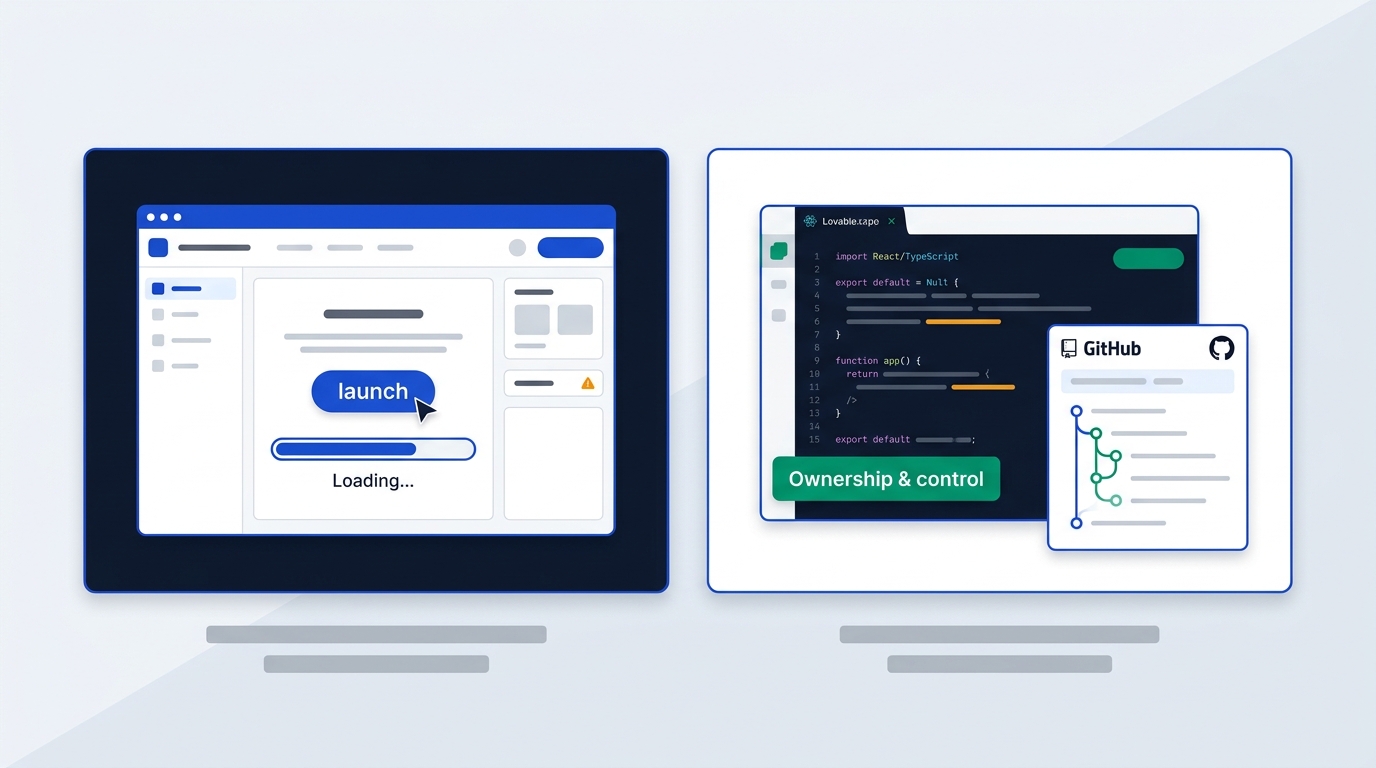
Base44 suits non-technical creators, solo builders, and product managers who need to launch a fully managed web application fast. The platform abstracts hosting, serverless functions, database scaffolding, and authentication rules into one environment.
Lovable is built for founders, agencies, and development teams requiring production-ready React and TypeScript code, GitHub repository synchronization, and full control over their open-source Supabase database. You keep total control over your intellectual property and tech stack from your very first prompt.
Choose Base44 if speed to market and an all-in-one managed environment are your primary goals. You can generate a functional web prototype from a single prompt without creating third-party developer accounts or setting up external database schemas.
Opt for Lovable if code ownership, clean developer handoff, and avoiding vendor lock-in are essential for your commercial SaaS product or client deliverables. Your team can export the full-stack repository, run it locally, and host it anywhere without platform dependencies.
Who Should Pick Which?
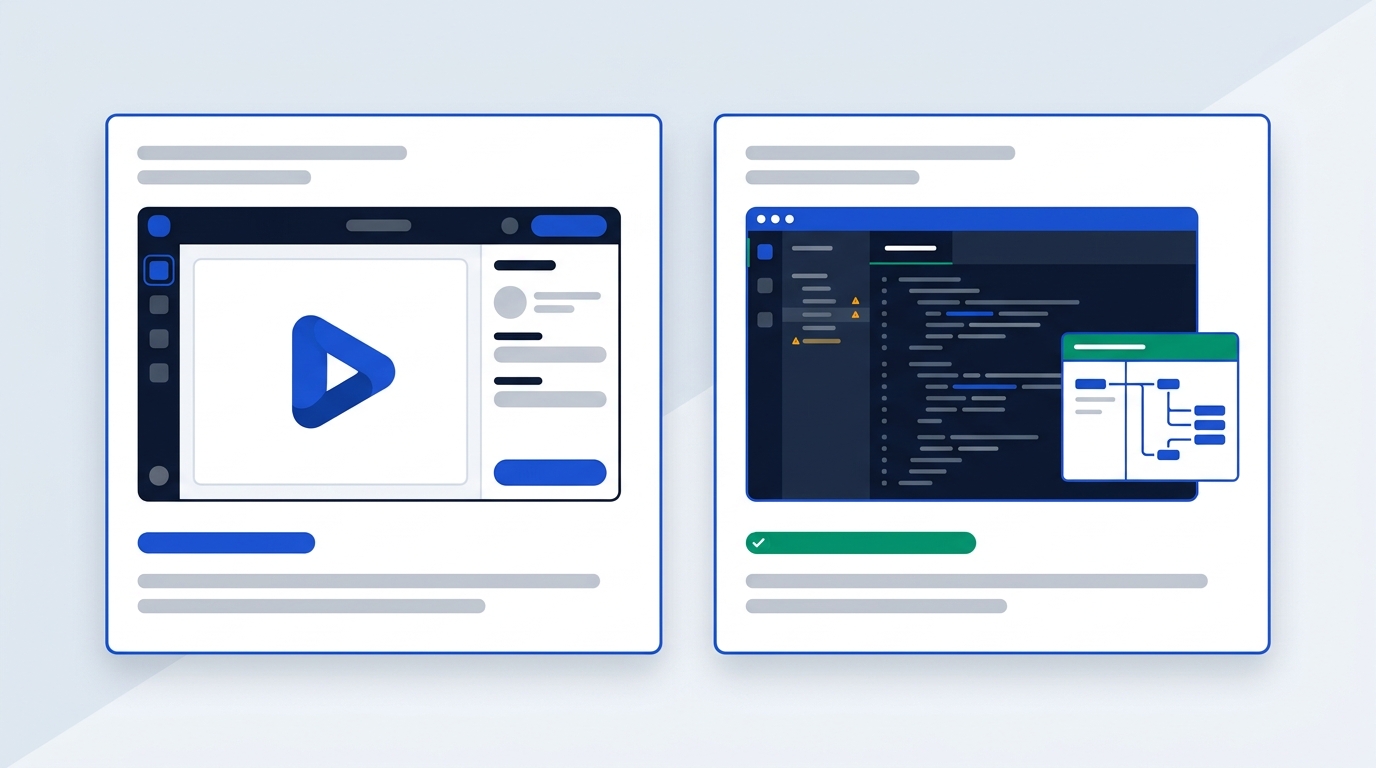
Select Base44 when building a quick MVP, an internal tool, or a validation prototype over days or weeks. If you feel comfortable operating within the Wix ecosystem, Base44 delivers a completely frictionless setup. Non-technical creators building back-office task trackers, student portals, or simple marketing apps gain significant value because the platform abstracts API keys, server configurations, and database hosting. A Base44 case study shows a founder building an application that reached $1M ARR in three months, demonstrating what happens when speed to market takes priority over backend export rights.
Choose Lovable when your prototype needs to become a production application. It fits projects requiring clean developer handoff, verified API integrations, or custom backend extensions. If vendor lock-in represents a business risk for your SaaS app or client deliverables, Lovable protects your project by outputting standard web code. For example, if you build a client portal for a consulting practice or a subscription SaaS platform, any web developer can pick up the codebase without learning proprietary platform rules.
Base44 works best for solopreneurs and non-technical managers who want to eliminate technical setup entirely. You never have to deal with API keys, row-level security settings, or cloud server configurations.
Lovable works best for technical founders, agency owners, and product teams who need an MVP they truly own. Any React developer can inspect, refactor, or extend your project locally using standard tools like VS Code or Cursor.
Managed Stack vs. Open Code
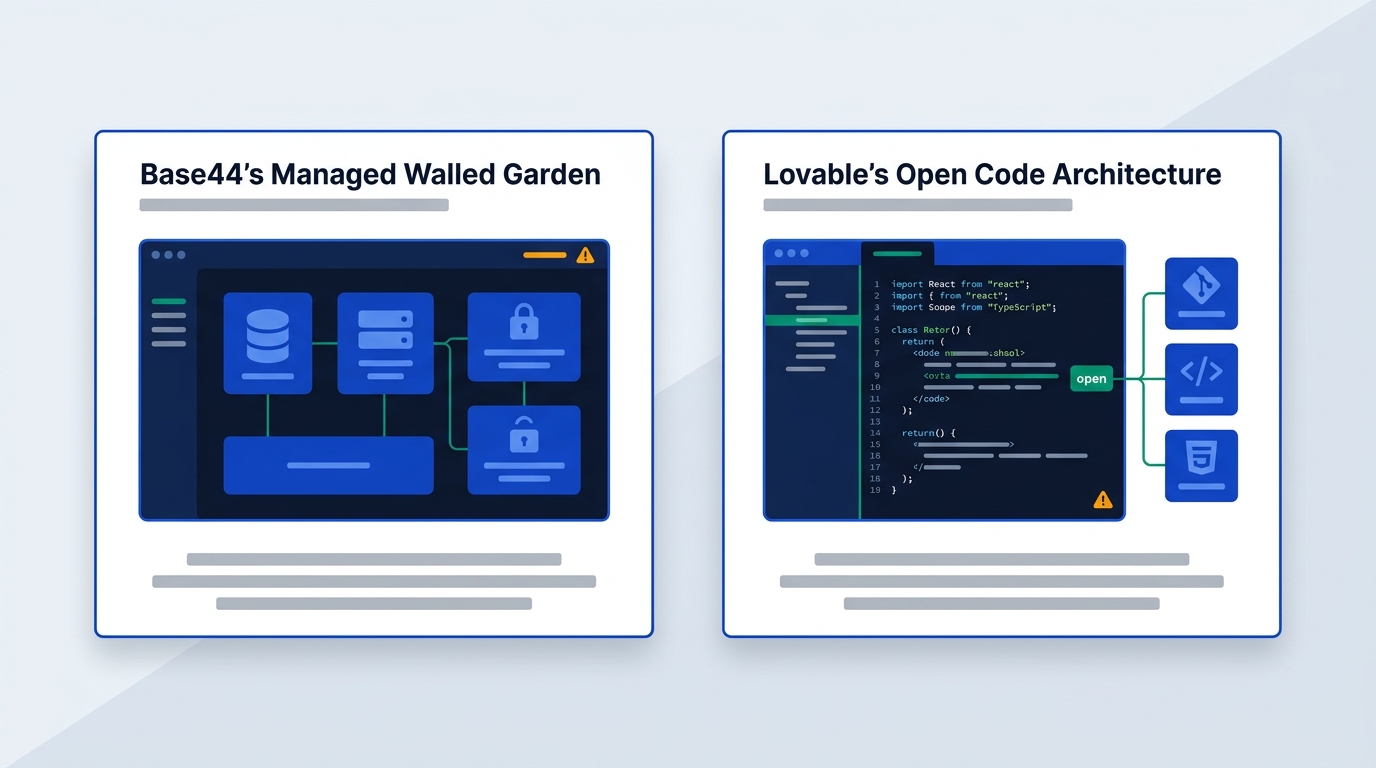
The fundamental difference between these two platforms lies in their technical philosophy. One abstracts infrastructure into a managed service, while the other gives you standard open-source tools.
Base44's Managed Walled Garden
Base44 operates as a fully managed AI app builder. Your backend logic, database, hosting servers, authentication flows, and analytics reside inside a single proprietary environment.
Before its acquisition by Wix in June 2025 for a reported $80 million plus retention incentives, Base44 grew to roughly 250,000 users and was generating $189,000 in monthly profits as of May 2025, according to post-deal analyses. The platform was created by a solo founder, Meir, who built the tool in six months with an eight-person team before selling to Wix. When you submit a prompt inside Base44, the platform automatically scaffolds frontend UI components, database tables, security settings, and serverless logic behind the scenes.
This managed approach eliminates setup friction. You do not need to configure external database tables, manage API endpoints, or write deployment scripts. The trade-off is backend lock-in: your application's logic and data layer remain bound to Base44's infrastructure.
Lovable's Open Code Architecture
Lovable generates standard React, TypeScript, Vite, and Tailwind CSS code. It builds applications using industry-standard libraries like shadcn/ui, TanStack Query, and Zod validation, matching the stack experienced developers use daily.
Lovable was founded in Stockholm by Anton Osika and Fabian Hedin, emerging from the open-source GPT Engineer project. The platform raised a $200 million Series A at a $1.8 billion valuation in July 2025 led by Accel, followed by a $330 million Series B at a $6.6 billion valuation in December 2025 led by CapitalG and Menlo Ventures, with participation from Klarna founder Sebastian Siemiatkowski and Slack co-founder Stewart Butterfield, according to TechCrunch.
Instead of locking code inside proprietary servers, Lovable builds a standard full-stack repository. For backend functions, authentication, and file storage, it connects natively to Lovable Cloud or your own self-managed Supabase PostgreSQL database.
This architectural choice separates Base44's managed simplicity from Lovable's open-stack ownership. Base44 keeps all development inside one interface, whereas Lovable gives you direct control over your project's underlying code and infrastructure.
Code Ownership and Portability
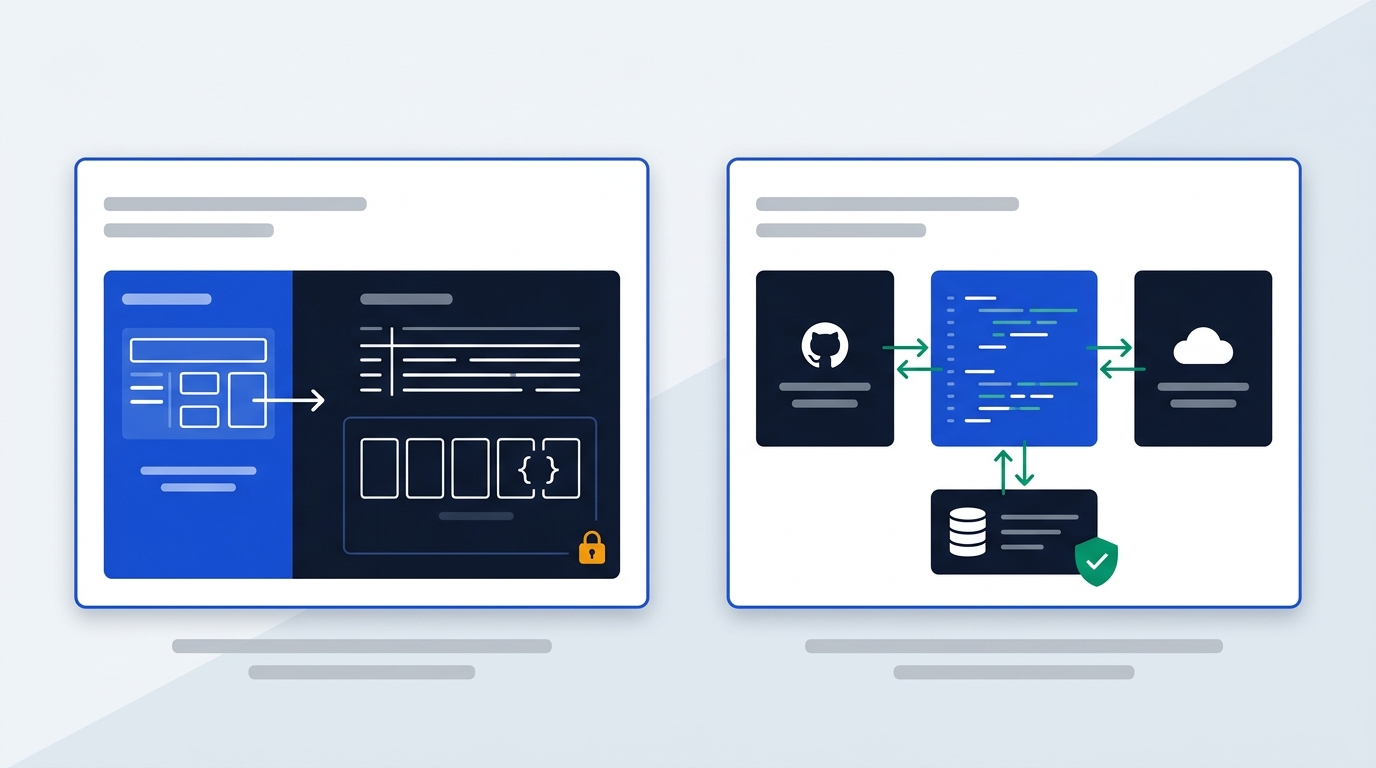
Code portability determines what happens when your application outgrows its initial prototype phase. Moving to a custom stack works differently across these tools.
Base44's Backend Dependency
Base44 permits frontend code export via GitHub synchronization or ZIP file download on its Builder plan ($40 per month) and higher tiers. However, this export only covers the client-side user interface code.
The application's backend services—including its database, serverless backend functions, real-time data handlers, and authentication system—stay on Base44's infrastructure. The exported frontend code communicates back to Base44 using a proprietary SDK. If you ever decide to leave Base44 completely, you must rebuild the database schemas, API connections, and serverless logic from scratch on another cloud provider.
Lovable's Complete Code Freedom
Lovable offers full-stack code export across all subscription tiers. Every line of generated React and TypeScript code syncs to your personal GitHub repository through native two-way synchronization.
Changes made inside the Lovable interface push directly to your repository, while local code changes pushed to GitHub automatically pull back into the platform interface.
Lovable Editor <---> GitHub Repository <---> Custom Cloud Host (Vercel / Netlify / AWS)
|
Supabase PostgreSQL Database (Owned and Managed by You)
You can clone your repository locally, run it inside any code editor, and deploy it to any cloud host without platform restrictions. Because your data resides in a standard Supabase instance, your database tables, edge functions, and identity records remain under your control.
Lovable ensures your application remains fully portable. If you stop using the platform, your development team can continue building on top of the exact same codebase without writing platform migration scripts.
Backend, Data, and EU Residency
Data control and hosting locations are critical considerations for European businesses handling sensitive customer records under strict privacy frameworks.
Proprietary NoSQL vs. Open PostgreSQL
Base44 generates a managed NoSQL-style database with internal serverless functions and a built-in admin panel. Data models generate directly from your conversational prompts. For example, describing a course platform automatically creates backend structures for users, course modules, video lessons, quizzes, and certificates.
Lovable uses an open-source PostgreSQL foundation via Lovable Cloud or self-managed Supabase projects. This setup gives you access to real relational database features, including typed columns, foreign keys, SQL queries, and row-level security policies.
GDPR and European Data Protection
For European companies, Lovable's native Supabase integration provides strong compliance advantages. Supabase allows organizations to select specific data center locations, including regions within the European Union like Frankfurt or Dublin. This setup simplifies compliance with GDPR requirements regarding data localization and cross-border transfer restrictions.
Base44 operates on cloud servers managed within the broader Wix ecosystem. While secure, proprietary SaaS platforms may not always offer explicit EU-only data residency guarantees on standard self-serve plans without custom enterprise agreements.
European buyers subject to value-added tax must handle cross-border digital service transactions correctly. For EU-based businesses purchasing software subscriptions across borders, standard reverse-charge mechanisms apply under national implementations of the EU VAT Directive. UK VAT-registered buyers must account for cross-border software purchases using the UK reverse charge rules defined in HMRC VAT Notice 741A. You can review our guide on the VAT reverse charge mechanism for further compliance details.
Ease of Use, Integrations, and Scaling
Both builders turn text prompts into working user interfaces quickly. However, their editing environments and third-party integrations cater to different operational workflows.
Workflow and Editing Capabilities
Base44 and Lovable both start with natural language prompts, displaying live previews of your application alongside conversational AI chat interfaces.
Post-generation editing in Base44 relies on a visual drag-and-drop editor paired with follow-up prompts. It also offers a Discuss mode for planning at lower credit costs (0.3 credits per request), an Activity Monitor, and a Code tab for inspecting underlying files. For non-technical users, keeping visual adjustments inside one editor offers a simple build process.
Lovable provides four distinct interaction modes:
- Visual Edits: Direct interface editing where you click UI elements to modify text, colors, and layout spacing without writing prompts or spending AI credits.
- Agent Mode: Autonomous AI development that navigates multi-file codebases, searches the web, and fixes bugs independently using a queued task model.
- Chat Mode: An interactive collaborative interface designed for architectural planning, debugging, and iterative reasoning.
- Code Mode: Direct code editing inside the browser editor, allowing developers on paid plans to inspect and edit raw React code directly.
Third-Party Ecosystems
Base44 bundles essential capabilities directly into its interface. It features simplified integrations for Stripe payments, platform-managed authentication, transactional email, and quick connectors for external apps like WhatsApp, Google Calendar, Notion, and Slack directly through chat commands.
Lovable connects directly to specialized third-party services using full production APIs:
- Stripe: Direct API access for custom billing and subscription flows.
- Clerk: Advanced identity management supporting enterprise SSO and role permissions.
- OpenAI & Anthropic: Direct LLM API connections using your own provider keys.
- Resend: Transactional email delivery with full header control.
- Data Visualization: Native integration with charting libraries like D3.js and Highcharts.
When scaling beyond Base44's initial environment, moving away requires rewriting proprietary SDK connections. Lovable applications scale naturally because they rely on standard npm packages and industry-standard web frameworks.
Pricing, Credits, and Limits
Understanding subscription tiers and credit consumption models helps prevent unexpected bills during heavy development cycles.
Base44 Pricing Structure
Base44 uses a dual-credit system divided into message credits (for AI interactions when building or modifying apps) and integration credits (for external service calls like emails or AI requests).
Base44 subscription tiers include:
- Free Plan: $0 per month with 25 message credits and 100 integration credits total (or 5 messages per day).
- Starter Plan: $16 per month (billed annually) or $20 per month (billed monthly) for basic personal projects.
- Builder Plan: $40 per month (billed annually) or $50 per month (billed monthly), providing 250 message credits, 10,000 integration credits, custom domains, and frontend GitHub export.
- Pro Plan: $80 per month (billed annually) for complex app development.
- Elite Plan: $160 per month (billed annually) offering 1,200 message credits and 50,000 integration credits.
Base44 does not document pay-as-you-go credit top-ups. If you exhaust your monthly allocation, you must upgrade your plan or wait for the next billing cycle.
Lovable Pricing Tiers
Lovable prices plans primarily by user seats and workspace projects, relying on interaction credits tiered by task complexity. For example, Lovable notes that a simple style change costs roughly 0.5 credits, while adding authentication runs about 1.2 credits, based on user testing.
Lovable subscription tiers include:
- Free Plan: $0 per month featuring 5 daily credits and 5 custom subdomains.
- Pro Plan: $21 per month (billed annually) or $25 per month (billed monthly), providing 100 monthly credits plus 5 daily credits. Unused monthly credits roll over to subsequent billing cycles.
- Business Plan: $42 per month (billed annually) with advanced team workspace controls.
- Enterprise Plan: Custom pricing tailored for enterprise governance and scale.
On-demand credit top-ups are supported on Lovable Pro plans, with some 2025–26 reviews referencing packs around $15 for 50 credits, though the official pricing page does not publish a fixed rate. Additionally, UI tweaks performed via Visual Edits do not consume credit allowances.
| Feature / Tier | Base44 | Lovable |
|---|---|---|
| Starting Paid Price | $16 / month (annual billing) | $21 / month (annual billing) |
| Free Tier Available | Yes (25 monthly message credits) | Yes (5 daily credits) |
| Code Export Type | Frontend code only (Builder plan+) | Full-stack React & TypeScript (All plans) |
| Database Architecture | Managed proprietary NoSQL | Open-source PostgreSQL / Supabase |
| Version Control | Internal history & GitHub push | Two-way native GitHub sync |
| Credit Rollover | No | Yes (Pro tier) |
Source: vendor pricing pages, checked October 2026.
Comparing tool prices and plans helps teams pick the subscription structure that fits their monthly workload.
Frequently Asked Questions about Base44 vs Lovable
Do both Base44 and Lovable offer free plans?
Yes, both platforms offer free tiers so you can test their interface and building workflows. However, free accounts come with strict daily or monthly credit caps and restricted export capabilities.
Which platform is better for complete beginners?
Base44 is generally simpler for non-technical beginners. It handles databases, backend logic, and hosting automatically within its proprietary environment, preventing technical friction like API key setup or database management.
Can developers take over a Lovable project later?
Yes. Lovable exports standard React, TypeScript, and Tailwind CSS code synced directly to GitHub. Any web developer can clone your repository and continue building locally using standard tools like VS Code or Cursor.
Can I host my Base44 database on my own server?
No. Base44's backend database and serverless functions reside exclusively on its cloud infrastructure. Exporting a project provides only client-side frontend code that connects back to Base44 via SDK.
Which tool is better for building custom AI-powered applications?
Base44 provides fast built-in AI tools for simple automation. Lovable offers greater custom flexibility by letting you connect your own OpenAI, Anthropic, or custom LLM API keys directly inside your codebase.
Bottom Line: Which AI App Builder Should You Pick?
For non-technical founders, product managers, and solopreneurs prioritizing rapid validation and a managed zero-setup environment, Base44 offers exceptional speed. You can turn conversational prompts into working web applications without touching backend infrastructure or cloud servers.
However, if your project demands complete code ownership, clean developer handoff, open database control, and European regional data residency options, Lovable's open-stack architecture is the superior choice.
Consider your long-term roadmap carefully. If your prototype must evolve into a commercial SaaS product with custom logic and developer access, starting on Lovable's exportable React and Supabase stack saves substantial time and migration expenses. Explore current platform features on the official Lovable page to start building your application repository today.