


Compare the top Apollo io alternatives for UK and European sales teams. Review verified B2B data accuracy, GDPR compliance, credit rollover, and pricing.
TL;DR: Among Apollo io alternatives, Cognism suits teams phoning European decision-makers. Saleshandy suits outbound teams that want unlimited seats and partial credit rollover. Clay suits RevOps builders. Stay on Apollo if you are an early-stage, US-focused team that needs a cheap all-in-one tool.
Which Apollo alternative fits your European sales
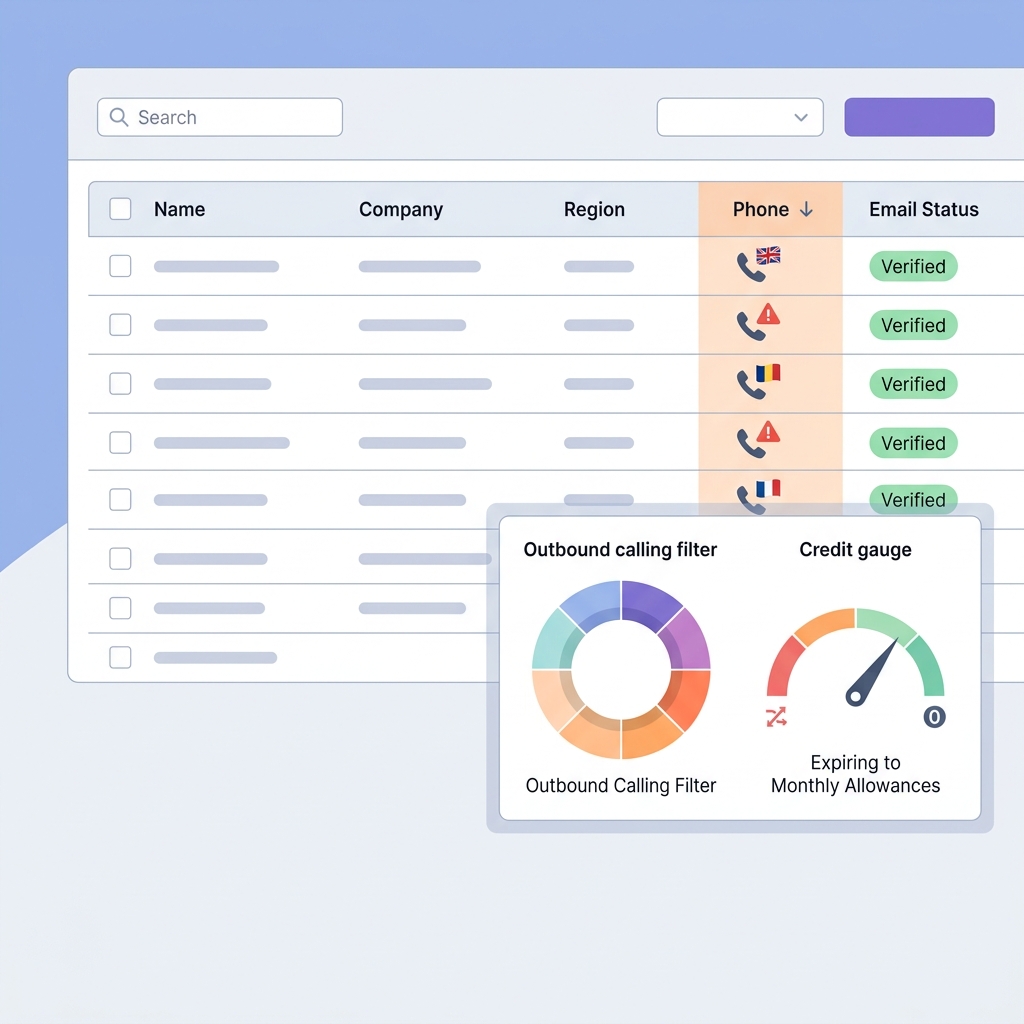
Pick Cognism if your reps call European decision-makers and need Do Not Call (DNC) screening. Pick Saleshandy if you run multi-channel outreach with credit rollover. Pick Clay if revenue operations (RevOps) teams want custom waterfall data routing. For tighter budgets, Hunter and Saleshandy provide cheaper entry points.
Here is the baseline. Apollo.io is run by ZenLeads Inc., a US company, and publishes 240M+ contacts across 30M+ companies, according to Saleshandy's review. Its credits reset with the billing cycle. Cognism provides broader European coverage across national lists.
Who should stay? An early-stage startup selling mainly into the US, with one or two reps, gets a lot for the money. Apollo's free plan grants 900 credits a year per seat, and paid plans start at US$49 per seat per month on yearly billing.
Who should switch? Scaling EMEA teams whose reps keep dialling dead mobiles, or who watch monthly credits lapse unused. If that sounds like you, the rest of this page is for you.
Choosing the right sales intelligence tool
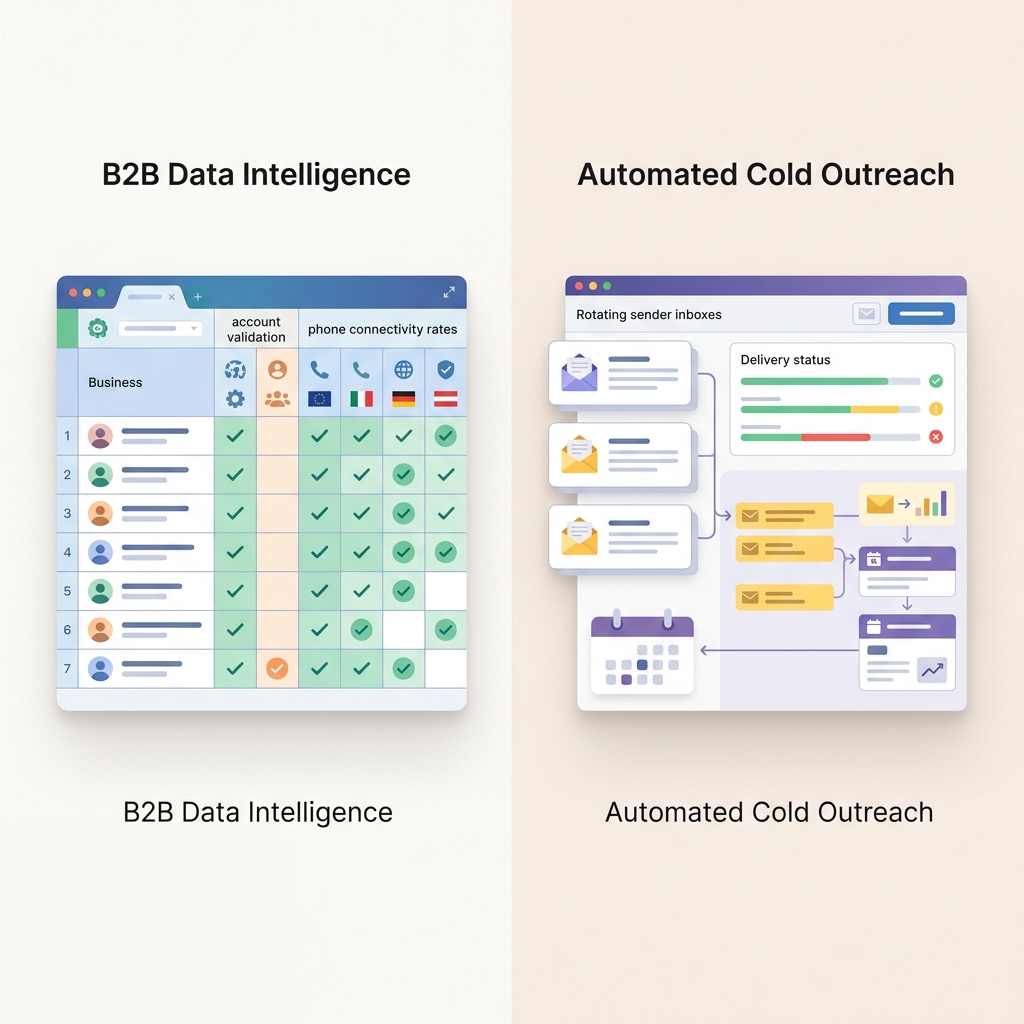
Start with where your buyers sit, because coverage is the one thing you cannot fix after buying. Reviews note Apollo's data is less consistent outside the US. Because European data is scattered across distinct national registers, a US index can easily miss local accounts.
The practical test is simple. First, run 200 named accounts from your territory through each shortlisted tool. Then, count how many return a valid email and phone you can legally call.
Credits, outreach and compliance
Credit rules change your real cost. Some platforms reset allowances monthly, while others allow unused credits to carry forward.
Next, decide whether you want data alone or data plus sending. Cognism and UpLead feed an existing CRM. Saleshandy bundles native sequences, inbox warm-up to build domain reputation, and sender rotation across accounts. If you only need a sender, see our Instantly alternatives guide.
UK teams must check the Telephone Preference Service (TPS) and Corporate TPS (CTPS). However, relying only on UK and US checks leaves continental European numbers unscreened.
European data compliance and VAT billing rules
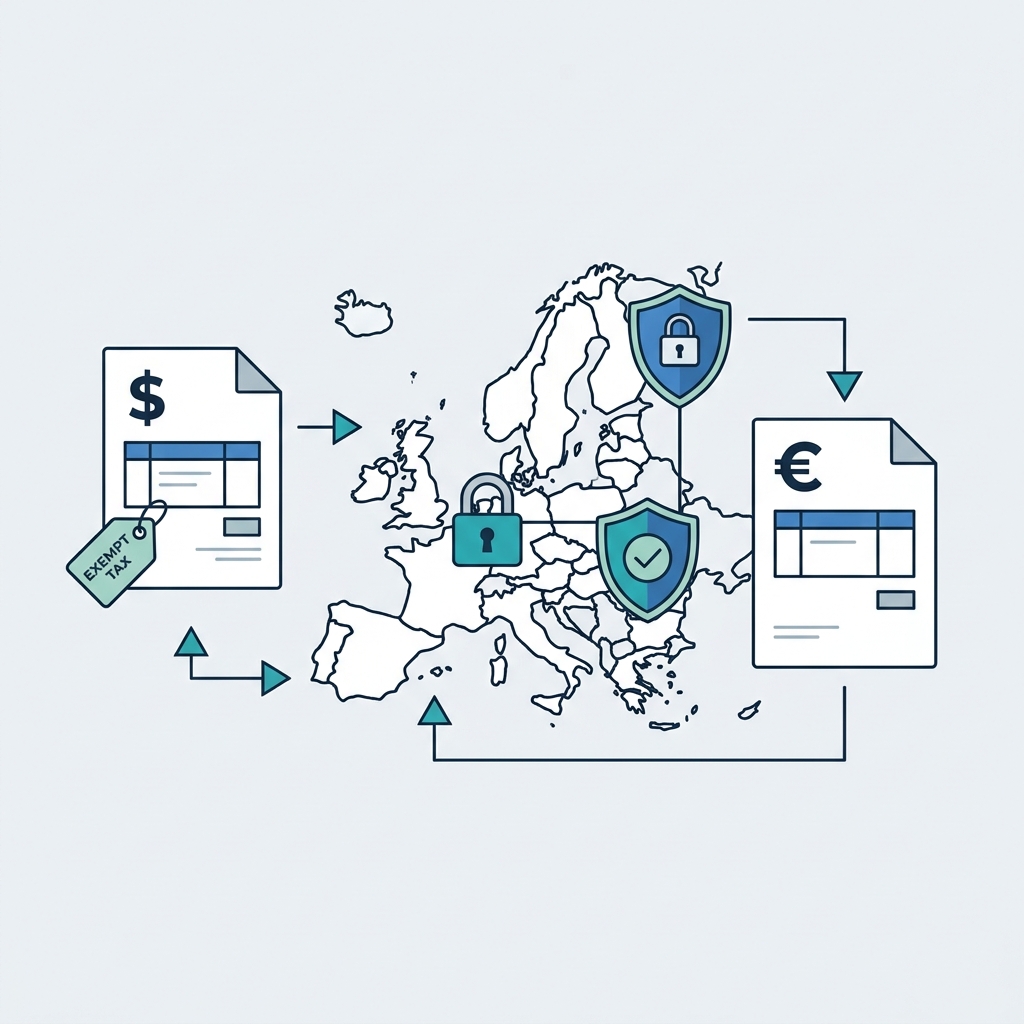
VAT reverse charge on a US supplier
According to Apollo's terms (checked October 2026), your contracting party is ZenLeads Inc., a US company. For an EU VAT-registered business, that triggers the reverse charge mechanism: you account for VAT yourself under Article 196 of the EU VAT Directive (2006/112/EC). Apollo's invoice shows the price without VAT, and your bookkeeping adds the entry. UK buyers follow HMRC's own rules for imported services rather than the EU directive.
Conversely, buying from European suppliers means standard domestic or intra-EU invoicing. For example, Paris-based Brevo illustrates this local model. Our Brevo page shows its current prices.
DPA and transfer mechanisms
According to Apollo's privacy policy (checked October 2026), its Data Privacy Framework certification covers ZenLeads, Inc., ZenLeads Holdings LLC and Varsovia Holdings LLC, and customers are pointed to its Data Processing Addendum. While this provides a valid transfer route, you must still sign the DPA and log the transfer.
On the alternatives side, Cognism lists ISO 27701 and SOC 2 Type II certification, and Saleshandy lists SOC 2 and GDPR compliance.
Outbound calling risk
The UK, Germany and France each treat unsolicited business calls differently, so one national check is not enough. Screen every mobile against the destination registry, and keep your opt-out records outside your enrichment vendor's database.
Top Apollo io competitors compared at glance

| Tool | Database size | Starting price | Outreach and integrations |
|---|---|---|---|
| Apollo.io (baseline) | 240M+ contacts, 30M+ companies | US$49 per seat/mo, billed yearly | Email and US dialer, LinkedIn as manual tasks |
| Cognism | 90% of Director+ contacts in Europe and US | Custom pricing | No built-in outreach; Salesforce, HubSpot, Bullhorn, Outreach, Salesloft |
| Saleshandy | 852M+ contacts, 42M+ companies | US$34/mo | Email, dialer, LinkedIn, WhatsApp; Salesforce, HubSpot, Pipedrive |
| ZoomInfo | 122.8M companies, 158.5M locations | Custom pricing | Built-in outreach; Salesforce, Snowflake, Salesloft |
| Clay | No owned database, 100+ providers | US$167/mo | Built-in outreach; Snowflake, BigQuery, Smartlead |
| UpLead | 208.5M contacts, 20.9M companies | US$74/mo | No built-in outreach; Salesforce, HubSpot, Pipedrive, Zapier |
| Lusha | 290M+ contacts, 26M+ companies | US$49.90/mo | Built-in outreach; Salesforce, HubSpot, Pipedrive, Clay, Zapier |
| Hunter.io | 150M email addresses | US$34/mo | Built-in outreach; HubSpot, Salesforce, Sheets, Zapier, API on all plans |
| Seamless.AI | 2.2B+ contacts, 121M+ companies | Custom pricing | Built-in outreach; Salesforce, HubSpot, n8n, free API on every plan |
Source: the vendors' published pricing and product information, 2026 editions; Apollo's price from its pricing page, checked October 2026. Prices are in US$ as listed, before VAT.
The biggest workflow trade-off is the licence model. Apollo charges per seat, and Cognism's own summary describes seat-based pricing. Saleshandy, Hunter.io and Clay give you unlimited team members, which Clay extends to its free plan too. For a growing SDR team, that difference compounds every time you hire.
Cognism for verified European mobile numbers
Cognism suits mid-market and enterprise teams prospecting into Europe and the UK by phone, where a verified mobile decides whether a call connects.
- Mobile numbers are verified by live callers before being added to the database.
- Email goes through a 16-step verification, against Apollo's 7-step process, according to Cognism's comparison.
- DNC screening covers 15 countries, against the narrower Apollo check described earlier.
- Bombora intent data sits in the Pro package.
- Coverage reaches 90% of Director-level and above contacts across Europe and the US.
Downsides. Pricing is by quote, so you cannot sign up with a card and start. Moreover, lacking built-in sending, you must connect a sequencer such as Outreach or Salesloft.
Price. According to Cognism's pricing page, there are two packages, Standard and Pro, each with a data allowance. Pro adds intent data, verification on demand and premium data access.
Against Apollo, the gap is phone quality and registry depth. If your reps spend their day on the phone in EMEA, that gap matters more than a lower seat price.
Saleshandy for cold outreach and credit rollover
Saleshandy suits outbound agencies and SDR teams that want a database and a multi-channel sequencer in one place, without paying per seat.
- The database holds 852M+ contacts across 42M+ companies.
- Each contact is verified in real time through a waterfall of providers when you unlock it.
- The credit is not spent if the record does not come back verified.
- 50% of unused credits roll over to the next month.
- Sequences cover email, dialer, LinkedIn and WhatsApp, with built-in warm-up and unlimited sending accounts.
Downsides. There is no free forever plan. Because its focus is outbound outreach, teams needing inbound enrichment gain less value.
Price. According to Saleshandy's pricing page, Starter is US$34/mo, Pro US$76/mo and Scale US$149/mo, with Enterprise on custom pricing.
Compared with Apollo, you lose the per-seat bill and the monthly credit wipe. Its own comparison also lists unlimited clients on Scale, which suits agencies that otherwise buy a seat per client.
ZoomInfo for enterprise US and global firmographics
ZoomInfo suits enterprise teams targeting deep US accounts that need firmographics (company size, revenue, and structure) alongside intent signals.
- The database holds 122.8M companies and 158.5M locations.
- WebSights identifies which companies visit your own website.
- Scoops surface hiring and project signals.
Downsides. Contracts run annually, with seat minimums and no self-serve route. Furthermore, Cognism notes regional price variances that make multi-region licensing costly. Therefore, European teams should evaluate these costs before committing.
Price. ZoomInfo sells by custom annual quote only. Vendr, a third party, tracks a median contract around US$33,500 a year.
Next to Apollo's self-serve tiers, that is a far higher commitment. It buys US depth, so it rarely fits a team whose pipeline is mostly European.
Clay for flexible multi provider waterfall enrichment
Clay suits RevOps engineers and growth teams that want to decide the fallback order across many data vendors instead of trusting one.
- Waterfall enrichment queries 100+ data providers in sequential order until a valid match is found.
- Claygent, Clay's AI agent, researches custom data points across the web.
- Every plan includes unlimited seats, the free one too.
- You can bring your own API keys and pay providers at your own rates.
Downsides. Two meters run at once, Data Credits and Actions, and your bill adds them together. However, setup demands technical effort to build and maintain tables.
Price. According to Saleshandy's comparison and Salesforge's review of Clay's pricing, plans start at US$167/mo. Clay repriced in March 2026 into Launch and Growth tiers, so older articles quoting Starter, Explorer and Pro are out of date.
Clay owns no data, so accuracy depends on the providers you chain. That fixes Apollo's single-source gaps, provided someone on your team will maintain the logic.
UpLead for high accuracy verified B2B data
UpLead suits small teams that care more about bounce rate than about list size.
- The index holds 208.5M contacts across 20.9M companies.
- Emails are verified in real time before you download them.
- Salesforce, HubSpot and Pipedrive connect natively, and Zapier opens 1,500+ more apps.
Downsides. However, the database is smaller than Apollo's index. Additionally, the trial lasts only seven days, and outreach requires a third-party sender.
Price. According to UpLead's pricing page, paid tiers start at US$74/mo.
UpLead focuses strictly on verified accuracy across its database. Against Apollo's wider but less consistent coverage, that is the trade: fewer records, with more of them usable on first send.
Lusha for fast LinkedIn prospecting extension
Lusha suits individual SDRs and recruiters who want to grab a contact straight from a LinkedIn profile.
- A light Chrome extension needs almost no learning curve.
- The directory holds 290M+ contacts and 26M+ companies.
- Exports go to Salesforce, HubSpot, Pipedrive, Clay and Zapier.
Downsides. Because phone numbers cost roughly ten times more than emails, dialling workflows deplete allowances quickly. Furthermore, prospecting focuses on single contacts rather than sequences.
Price. According to Lusha's pricing page, paid plans start at US$49.90/mo.
Apollo asks you to learn a prospecting suite. Lusha asks you to open a profile and click. If you only prospect a few dozen accounts a week, that simplicity can be worth more than a bigger database.
Hunter io for domain search and email verification
Hunter.io suits inbound marketing and PR teams that start from a company domain and need the right email, with flat team seats.
- The directory holds 150M email addresses.
- Domain search finds the email pattern for a company.
- Deliverability scoring flags risky addresses before you send.
- Unlimited team members come on every plan, and the API is open on all of them.
Downsides. However, Hunter lacks phone numbers entirely, making it unsuitable for dialling teams. Consequently, it focuses strictly on email discovery.
Price. According to Hunter.io's pricing page, plans start at US$34/mo.
That flat-seat model contrasts with Apollo's per-seat licence once you add reps. For a side-by-side of the two, read our Apollo.io vs Hunter.io page, or see current plans on the Hunter.io page.
Seamless AI for real time contact list building
This tool suits aggressive, high-volume outbound teams that want fresh contacts, including recently appointed decision-makers.
- The index spans 2.2B+ contacts and 121M+ companies.
- A real-time search engine crawls public profiles instead of serving a static database.
- A free API comes with every plan.
- Salesforce, HubSpot and n8n connect, and automation add-ons are available.
Downsides. Contracts require a 60-day cancellation notice before auto-renewal. In addition, mixed accuracy reviews make upfront sample testing essential.
Price. Pricing is by custom quote.
Its raw volume is far above Apollo's 240M+ contacts, and new hires surface faster. The cost is a contract you must negotiate carefully, with the renewal clause first on the list.
Why expiring credits increase your true costs
Expiring credits raise your cost per usable contact, because you pay for the full allowance and use only part of it. According to Apollo's pricing page (checked October 2026), Basic gives 30,000 credits a year at US$49 per seat per month on yearly billing, and Professional gives 48,000 at US$79. Organization needs at least three seats and gives 72,000 at US$119. Credits are granted in monthly portions, and per Saleshandy's review they do not roll over.
Picture a rep who works through only 60% of their allocation during a slow month. The unused remainder vanishes at renewal, while the monthly fee stays the same.
The real formula
Divide what you pay by the contacts that actually connected: verified email delivered or mobile answered. Expiry, invalid reveals and extra seats all push that number up.
The seat effect is easy to miss. Five reps on Professional means five seats at US$79 each, every month, before any add-ons. In contrast, vendors with flat pricing models avoid compounding seat fees entirely.
Refunds matter too. Saleshandy spends a credit only on a verified result. Its comparison lists no invalid-data refund for Apollo, so a bad reveal still costs you.
Frequently Asked Questions about Apollo io alternatives
Who has the best European phone data?
Cognism is the strongest fit on the evidence here. Specifically, it phone-verifies mobiles and provides broader European registry screening.
Is Apollo.io GDPR compliant?
Cognism's comparison describes Apollo as GDPR and CCPA compliant, with DNC checks in the UK and US, plus ISO 27001 and SOC II certification. Apollo operates under ZenLeads Inc. and holds Data Privacy Framework certification, covering three group entities. You still sign its Data Processing Addendum as the customer.
Do Apollo credits roll over?
No. Monthly Apollo credits expire when the billing cycle resets and do not roll over.
How do EU buyers handle Apollo VAT?
As detailed above, EU VAT-registered buyers account for VAT locally via the reverse charge. Current plans and deals are on our Apollo.io page, and more outreach tools are listed in the sales outreach category.