


This Brevo vs Mailchimp comparison is written for European businesses. It explains how the two pricing models differ and what each platform offers for automation, transactional email and SMS. It also sets out what each vendor's own legal pages say about GDPR and data location.
TL;DR: Brevo vs Mailchimp
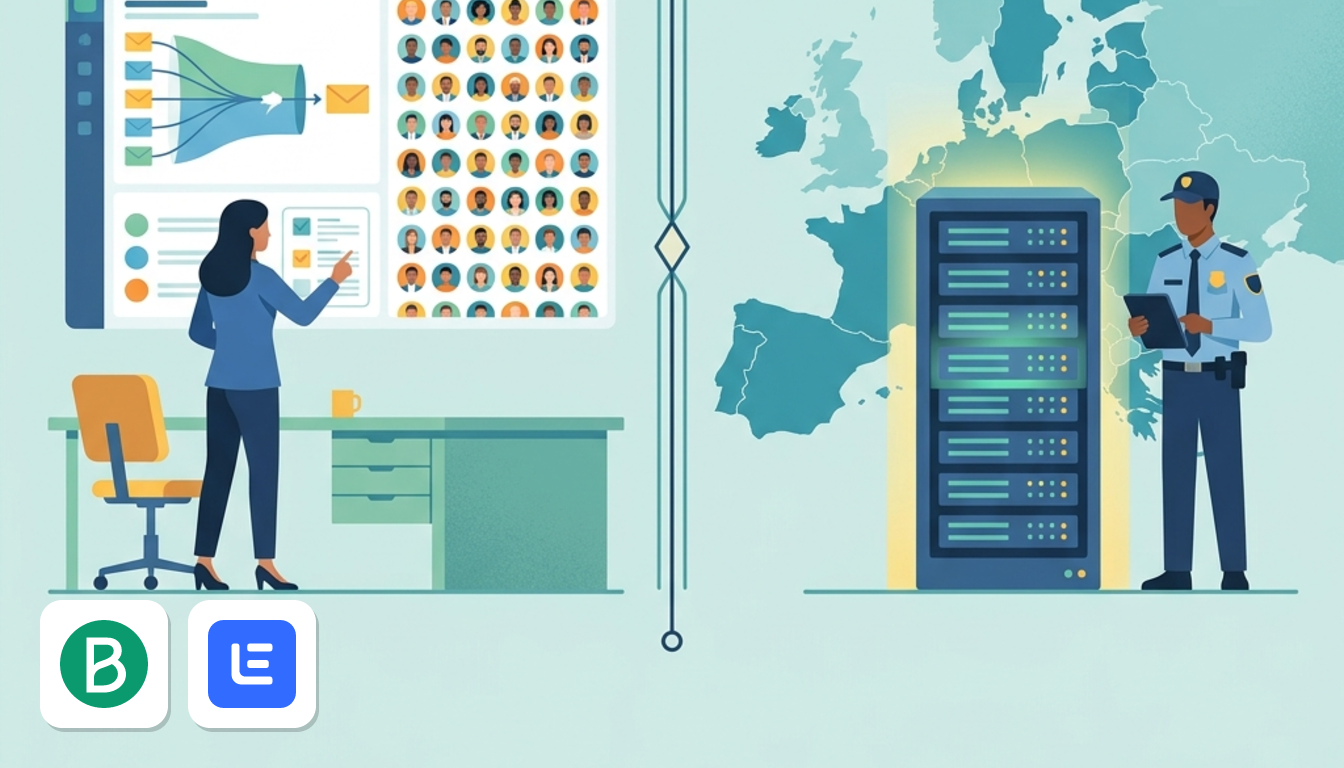
Brevo suits businesses with large contact lists that want volume-based pricing and built-in transactional email rather than paying per-subscriber fees that scale sharply with list size. It also suits anyone who wants a usable free tier before committing: according to Brevo's pricing page, checked October 2026, the free plan allows 300 emails a day regardless of how many contacts you store.
Mailchimp suits ecommerce managers who depend on deep native integrations (Shopify, WooCommerce) and advanced customer journey mapping. Its exact current pricing and free plan limits aren't repeated here — check them directly at saaseuro.com/deals/mailchimp/ before you buy.
- Large lists, transactional needs: Brevo.
- Ecommerce automation and journeys: Mailchimp.
- Strict EU-only data residency: neither vendor guarantees exclusive EU storage across all entities, so consider lemlist instead.
- Simple creator newsletters: Kit, discussed later as a Mailchimp alternative.
- Sales-focused outreach automation: ActiveCampaign.
Neither Brevo nor Mailchimp is a fit if exclusive EU data hosting is a hard requirement — that's where lemlist's EU-only data location stands apart.
The Good vs The Bad

Brevo: the good
Brevo publishes a free plan allowing 300 emails a day, according to Brevo's pricing page (checked October 2026), with no credit card required to get started. Pricing is shown openly in EUR and GBP on the live pricing page rather than buried behind a "contact sales" form, which makes budgeting easier for teams billing in either currency.
Brevo: the bad
The free plan's 300-emails-per-day cap is a real constraint for anyone sending larger daily campaigns, pushing growing lists onto a paid tier sooner than list-size-only competitors. Data is not EU-only either: according to Brevo's privacy policy, checked October 2026, the data controller can be Brevo Inc., which relies on the EU–US Data Privacy Framework, depending on where the customer is based.
Mailchimp: the good
Mailchimp maintains an extensive official integration ecosystem and long-established marketing automation tooling, built up over years as one of the category's incumbents. For teams already relying on a wide stack of e-commerce, CRM and analytics tools, this breadth of native connections is a practical advantage.
Mailchimp: the bad
Mailchimp's pricing is subscriber-based, so costs scale with total list size even for contacts who are rarely or never emailed. This structure can penalise teams with large but mostly dormant lists. Because exact subscriber thresholds and tier pricing change, readers should check Mailchimp's own page for current figures rather than relying on a fixed number here.
In short: Brevo's model favours senders who email often but keep lists lean; Mailchimp's model favours teams with smaller, highly engaged lists who lean on its integrations.
Pricing Models: Volume-Based vs Subscriber-Based
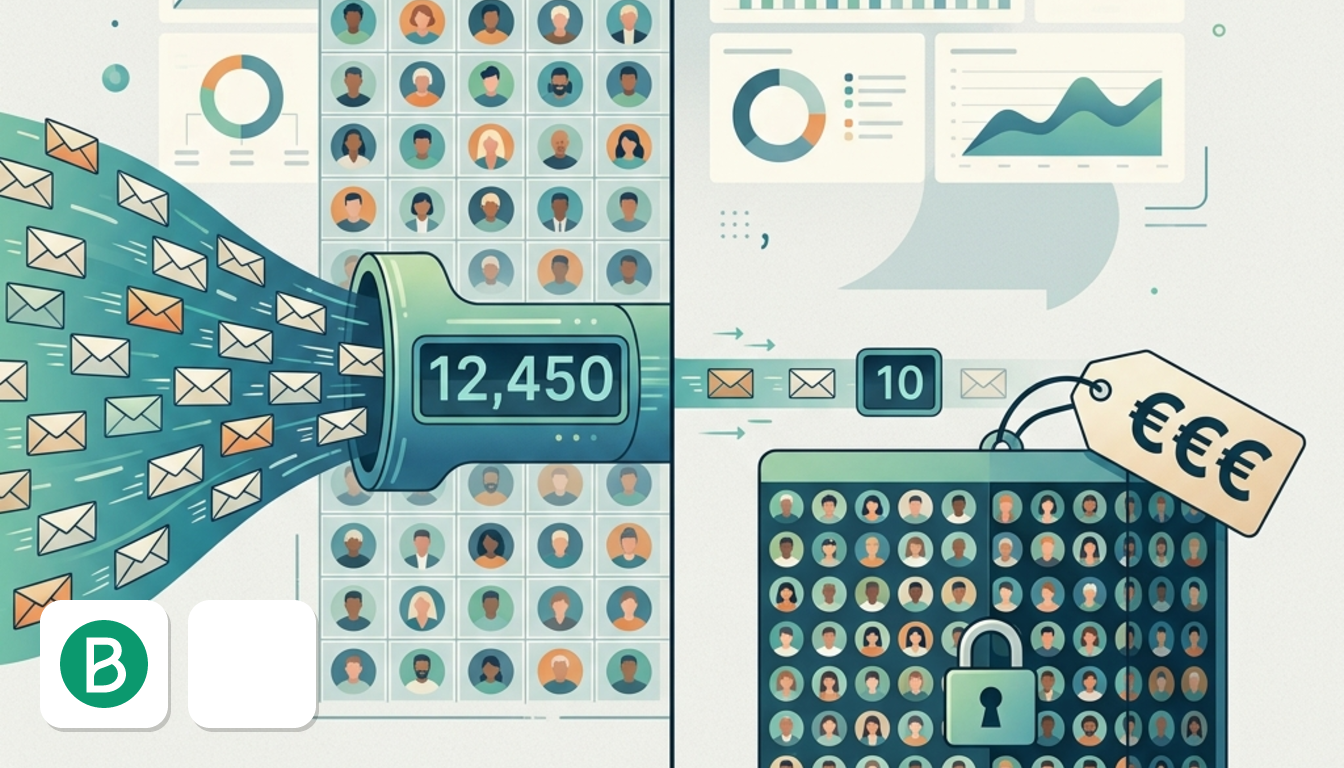
The single biggest reason Brevo and Mailchimp quotes can look so different for the same business is that they don't charge for the same thing. Understanding which variable drives your bill matters more than comparing headline numbers.
Brevo: pay for emails sent
Brevo uses volume-based pricing: the cost depends on how many emails you send per month, not how many contacts sit in your list. A business with 50,000 contacts that emails them twice a month can pay less than a business with 5,000 contacts emailing daily, because Brevo counts sends, not stored records. According to Brevo's pricing page, checked October 2026, the free plan allows 300 emails a day with no limit on contact storage. For stores or associations with large, mostly dormant lists, this structure can avoid the "pay more just because your database grew" problem.
Mailchimp: pay for contacts stored
Mailchimp works the opposite way: subscriber-based pricing, where the plan cost is set by the total number of contacts in your audience, regardless of how often you actually email them. A list that grows from newsletter sign-ups, event registrations or old customers who never unsubscribed can push you into a higher tier even if your sending frequency stays flat. For current Mailchimp plan tiers, limits and free-plan details, see the dedicated Mailchimp page rather than relying on older screenshots, since subscriber-based tiers are the kind of figure vendors adjust most often.
Why this changes the "brevo vs mailchimp" decision
- Large, low-frequency list → Brevo's volume model is usually more forgiving.
- Small, highly engaged list emailed often → Mailchimp's subscriber model may still work out competitively; check the current tiers on its own page.
- Outbound-style senders comparing against other volume tools like lemlist or ActiveCampaign, or contact-based tools like Kit, should apply the same question: does the vendor bill by send or by stored contact?
One practical EU detail: Brevo lists its official pricing directly in EUR (€) and GBP (£) for European buyers, so there's no currency-conversion guesswork when budgeting in euros or pounds. All prices mentioned across this comparison, for every tool, are before VAT.
Email Editor, Design, and Ease of Use

Choosing between Brevo and Mailchimp often comes down to how the campaign gets built, not just what it costs. Brevo's drag-and-drop editor, as described on its own documentation, lets users assemble emails from content blocks (text, image, button, social, dividers), apply saved templates from its template library, and reuse past campaigns as starting points. Mailchimp's builder, per its official feature pages, works on a similar block-based structure, with its own template gallery and support for dynamic content blocks that can show different content to different segments within the same send.
What SaaSEuro can and cannot confirm
For exact template counts, block types or advanced dynamic-content rules, see each vendor's own documentation, linked from /deals/brevo/ and /deals/mailchimp/.
Mobile responsiveness and design testing
Both platforms document mobile-responsive output as a default behaviour of their drag-and-drop editors, meaning emails built in either tool are designed to adapt to phone and tablet screens without a separate mobile template. Design testing — previewing how a campaign renders before sending — is a documented feature on both platforms' official sites, though the depth of preview tools (such as inbox or client-by-client previews) is set out in each vendor's own documentation.
| Capability | Brevo | Mailchimp |
|---|---|---|
| Editor type | Drag-and-drop, block-based | Drag-and-drop, block-based |
| Template library | Yes (per Brevo documentation) | Yes (per Mailchimp documentation) |
| Dynamic content | Not detailed in verified facts | Documented on Mailchimp's site |
| Mobile-responsive output | Documented | Documented |
For automation and outreach-heavy alternatives built around similar editor logic, ActiveCampaign, Kit, and lemlist are covered elsewhere on this site.
Marketing Automation, CRM, and Workflows
Both platforms build automation around a visual, drag-and-drop canvas, but the two approaches differ in intent. Brevo's workflow builder lets you chain triggers, conditions and actions — email opens, site visits, purchase events — into multi-step sequences, with the automation engine sitting alongside email, SMS and WhatsApp sending in the same interface. Mailchimp frames the same idea as "customer journeys," mapping a contact's path across touchpoints and branching the journey based on behaviour or audience segment. Functionally, both solve the same problem — if-this-then-that marketing logic — but Mailchimp leans more on its journey-mapping visuals, while Brevo integrates automation more tightly with its multichannel sending.
CRM functionality
A difference worth flagging for anyone comparing brevo vs mailchimp on more than email: Brevo includes built-in CRM functionality for tracking customer interactions, deals and contact activity directly inside the same account — useful for small sales teams who don't want a separate CRM tool. Mailchimp's contact profiles log campaign and engagement history but are not positioned as a standalone CRM in the same way.
Where the limits bite
- Advanced automation (multi-step branching, conditional logic, higher trigger volumes) is typically gated behind paid tiers on both platforms.
- Free or entry plans usually cover basic autoresponders only, not full customer-journey or workflow automation.
- Exact automation step limits, CRM feature depth and which plan unlocks what changes over time on both vendors' pricing pages.
For the current plan-by-plan breakdown of what's included at each tier, check /deals/brevo/ and /deals/mailchimp/ rather than relying on a snapshot here.
If your workflows need to extend into cold outreach or LinkedIn sequencing rather than lifecycle email, ActiveCampaign and lemlist build automation around sales and outbound motions rather than newsletter journeys — worth a look if that's the actual use case.
SMS Marketing and Transactional Emails
If you need SMTP and SMS alongside marketing email, Brevo and Mailchimp handle this differently, and it affects which tool you'll end up paying for separately.
Transactional email
Brevo includes transactional email sending (SMTP and API) directly inside its core platform, alongside marketing campaigns, so account setup and sending infrastructure stay in one place. Mailchimp historically routed transactional email through a separate product, Mandrill, rather than folding it into standard campaign sending. Because transactional email setup, eligibility and pricing can change, check Mailchimp's own documentation for current requirements before assuming it's bundled into your Mailchimp plan — do not assume parity with Brevo here.
SMS marketing
Both Brevo and Mailchimp offer SMS as a channel alongside email, but neither prices SMS as a flat global add-on: cost depends on the destination country, since carrier fees vary by market. This matters for European senders targeting multiple countries (UK, Ireland, France, Spain, Italy) — a campaign to UK numbers won't cost the same as one to Italian or Spanish numbers. Treat any SMS figure you see as country-specific rather than a universal rate, and confirm the per-country breakdown on each vendor's own pricing page before budgeting an SMS campaign.
Where the comparison set lands
- Brevo — SMTP transactional email built into the main plans, plus SMS by destination country.
- Mailchimp — marketing email is native; transactional sending historically needed Mandrill, so verify current setup in Mailchimp's documentation.
- ActiveCampaign, Kit, lemlist — none of these are positioned as SMTP/SMS-first platforms in their published feature sets; if transactional email and SMS are must-haves, Brevo is the more directly comparable option against Mailchimp for this specific need.
If transactional email is core to your stack, don't infer capability from a competitor comparison — confirm it on each brand's Brevo or Mailchimp deals/documentation page first.
European Business Lens: GDPR, Data Location, and VAT
For an EU buyer comparing Brevo vs Mailchimp, the question of where customer data sits and who is legally the data controller matters as much as the price per thousand contacts. Here is what each vendor's own legal pages say, consolidated in one place rather than repeated across every section of this guide.
Brevo: a French group with a published EU–US framework
Brevo's parent company is a French SAS based in Paris, according to Brevo's press page, checked October 2026. Depending on where a customer is based, the data controller is Sendinblue France SAS, Brevo Inc., or Brevo Germany GmbH, according to Brevo's privacy policy, checked October 2026. Brevo Inc. states it complies with the EU–US Data Privacy Framework, per the same privacy policy. For businesses that want a named EU entity in their data-processing paperwork, this structure gives a clearer starting point than vendors who only list a single US address.
Mailchimp: check the DPA directly
This guide does not state Mailchimp's data location. Instead, EU buyers evaluating Brevo vs Mailchimp on compliance grounds should pull Mailchimp's current Data Processing Addendum and legal pages directly from Mailchimp's own site before signing a contract, particularly if a signed DPA or specific EU data residency is a procurement requirement.
Where the other alternatives stand
- lemlist: data is kept exclusively within the European Union, according to lemlist's privacy policy, checked October 2026 — relevant for buyers prioritising EU data residency for outreach data.
- ActiveCampaign: data may transfer to company locations in the United States, Australia, Ireland, Brazil and Costa Rica, and the company is certified under the EU–US Data Privacy Framework with a DPA that falls back to Standard Contractual Clauses, according to its privacy and DPA pages, checked October 2026.
- Kit: data is hosted in the United States on AWS, and Kit states compliance with the EU–US and Swiss–US Data Privacy Frameworks plus the UK Extension, according to Kit's security and privacy pages, checked October 2026.
VAT reverse charge for B2B buyers
For VAT-registered businesses in the UK, Ireland, France, Spain or Italy buying software from a cross-border vendor, the reverse charge mechanism typically applies: the vendor issues an invoice without VAT, and the buyer self-accounts for VAT at their local rate through their own return, rather than paying it upfront to the vendor. This is standard practice for B2B SaaS purchases within the EU and from non-EU vendors alike, provided a valid VAT number is supplied at checkout. Always confirm the exact invoicing treatment on each vendor's billing or legal page, since terms can change.
Integrations, Reporting, and Deliverability
Integrations, reporting depth and deliverability tooling often decide a brevo vs mailchimp shortlist once price parity is settled, because these are the features that determine whether a campaign actually reaches the inbox and whether the data syncs with the rest of a marketing stack.
Integration ecosystems
Mailchimp is built around a large third-party app marketplace covering e-commerce platforms, CRMs and ad networks, which suits teams that already run Shopify, WooCommerce or a CMS and want plug-and-play syncing. Brevo ships a narrower set of native integrations focused on its own CRM, transactional email and WhatsApp/SMS modules, so it fits teams happy to consolidate inside one French-built platform rather than stitching together many add-ons. Among the alternatives, ActiveCampaign pairs its automation plans with a built-in CRM from the Plus tier up, and lemlist's Multichannel plan adds LinkedIn outreach, in-app cold calls and CRM integrations, per lemlist's pricing page. Kit keeps integrations lighter, aimed at creators running newsletters rather than multi-tool marketing stacks.
Reporting
Both Mailchimp and Brevo report standard campaign metrics such as open rates, click-through rates and geographic tracking in their respective dashboards, but neither vendor's publicly listed pricing or documentation supplied here breaks out exact benchmark figures, so readers comparing dashboard depth should check each tool's reporting documentation directly rather than rely on third-party averages.
Deliverability
Domain authentication (SPF and DKIM) and dedicated IP options are the deliverability levers vendors document publicly, and specifics on which plan tiers unlock a dedicated IP are not detailed in the facts verified for this comparison — check the live Brevo and Mailchimp pages for current tier limits. One verifiable exception: lemlist's Email Outreach plan bundles its "lemwarm" deliverability feature at US$69 (or €69/£69) a month, billed monthly, according to lemlist's pricing page checked October 2026 — relevant context for anyone evaluating deliverability tooling as part of a brevo vs mailchimp decision for cold outreach rather than newsletter sending.
Verified Alternatives to Brevo and Mailchimp
If neither Brevo nor Mailchimp fits your data residency rules, automation needs or budget, three alternatives cover the most common gaps: strict EU hosting, advanced CRM-style automation, and free-tier creator newsletters.
lemlist — for strict EU data residency
lemlist is a French company with the firmest EU data residency position in this comparison. The details from its privacy policy are in the European Business Lens section above. lemlist offers a 14-day free trial with 200 credits and no credit card required, according to lemlist's pricing page. Its Email Outreach plan runs €69/mo (or £69/mo for GB pricing) billed monthly, dropping to roughly €55/mo on annual billing, and includes 50,000 emails/month, lemwarm deliverability warming, unlimited campaigns and an AI email generator, according to lemlist's pricing page. It's built for cold outreach rather than newsletter broadcasting, so teams doing classic email marketing campaigns may still need Brevo or Mailchimp alongside it. Full details and current deals: /deals/lemlist/.
ActiveCampaign — for advanced CRM and automation
ActiveCampaign is positioned around automation and a native CRM, but its data may leave the EU. Its data-transfer locations and DPA terms are covered in the European Business Lens section above. Pricing starts at US$19/mo for 1,000 contacts on the Starter plan (one user, basic automation, email marketing), rising to US$59/mo on Plus for unlimited automation actions, landing pages and a standard CRM, according to ActiveCampaign's pricing page, checked October 2026. According to ActiveCampaign's pricing page, there's no confirmed free plan, but a 14-day free trial needs no credit card. Teams that have outgrown Brevo's or Mailchimp's automation limits and want sales-pipeline features in the same tool should look here. Full details and current deals: /deals/activecampaign/.
Kit — for creators wanting a free tier
Kit (formerly ConvertKit) hosts data in the United States. Its Data Privacy Framework position is covered in the European Business Lens section above. According to Kit's pricing page, checked October 2026, its free plan supports up to 10,000 subscribers with unlimited landing pages, forms and broadcast sending — a larger free ceiling than Brevo's 300-emails-a-day cap, though Kit's limit is on subscriber count rather than daily sends. The paid Creator plan starts at US$39/mo (US$33/mo billed yearly) and adds visual automation funnels and email sequences, according to Kit's pricing page, checked October 2026. Kit is aimed squarely at solo creators and newsletter writers rather than multi-channel marketing teams, so it lacks the broader CRM or SMS features found in Brevo or ActiveCampaign. Full details and current deals: /deals/kit/.
Frequently Asked Questions (FAQ)
Which is cheaper: Brevo or Mailchimp?
In the Brevo vs Mailchimp price question, it depends on how you send email. Brevo bills by email volume, not list size, so a business with a large contact list but modest sending frequency can stay cheap for longer. Mailchimp bills largely by subscriber count, so costs climb as your list grows regardless of how often you email it. According to Brevo's pricing page, checked October 2026, its free plan includes 300 emails a day with no cap on contacts stored — useful for anyone sitting on a big but quiet list. For current Mailchimp tiers and limits, see the Mailchimp page; for Brevo's live tiers, see the Brevo page.
Does Brevo store data exclusively in the EU?
Not exclusively. Brevo's parent company is a French SAS based in Paris, but according to Brevo's privacy policy, checked October 2026, the data controller is Sendinblue France SAS, Brevo Inc., or Brevo Germany GmbH depending on where you're based — and Brevo Inc. relies on the EU–US Data Privacy Framework. So a French-headquartered company doesn't automatically mean EU-only processing; check your specific entity.
Can I use transactional emails on Brevo's free plan?
Brevo's free tier is built around its 300-emails-a-day allowance across marketing and transactional sending, per its pricing page. For exact transactional quotas, API limits and any plan-specific restrictions, check the current details on the Brevo deals page rather than relying on a fixed number here.
How do I claim VAT exemption?
EU businesses with a valid VAT number can usually apply the reverse charge mechanism at checkout, shifting VAT reporting to the buyer instead of the vendor charging it upfront. The VAT reverse charge section above explains how this works. Confirm the exact process and any required fields on each vendor's billing settings or invoicing page.