


Compare Similarweb vs Semrush for European businesses. Review pricing, AI visibility, clickstream vs crawl data accuracy, team seats, and GDPR terms.
TL;DR: In the Similarweb vs Semrush decision, Semrush suits you if you run keyword research, rank tracking and site audits, but it will not size a whole market for the board. Similarweb suits analysts who benchmark traffic and audiences, but it will not audit pages or hunt backlinks.
Similarweb vs Semrush at a Glance
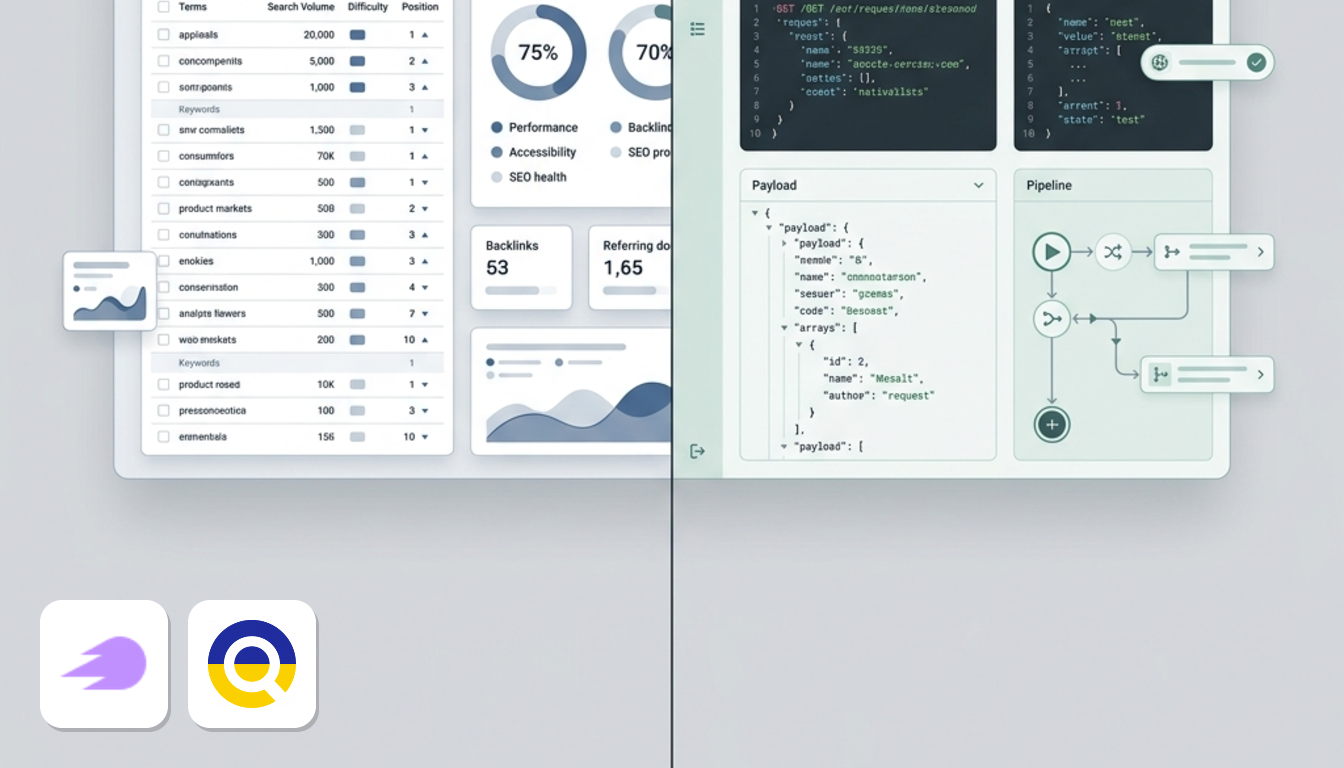
Semrush suits marketing operators who need tactical keyword research, rank tracking, technical audits and link analysis. It does not suit executive teams that want full market share estimates or mobile app intelligence. Similarweb suits corporate analysts, M&A teams and brand strategists who need macro traffic benchmarks and cross-channel audience metrics. It does not suit SEO specialists who need on-page auditing or backlink prospecting.
So the real question is which job you are hiring the tool for. The index sizes show how differently the two products are built.
| Point | Semrush | Similarweb |
|---|---|---|
| Keyword database | 22.3 billion keywords | 1 billion keywords |
| Backlink database | 43 trillion backlinks | Unavailable |
| Rank tracking | Available | Unavailable |
| Historical data | Dates back to 2012 | Up to 3 years on custom plans, 3 months on Starter |
| Cheapest paid plan | US$117.33 a month billed annually (US$139 monthly) | US$149 (Starter) |
| Free trial | 7 days | 7 days |
According to Semrush's pricing page and TrafficThinkTank's comparison, checked October 2026.
Semrush also has a permanent free tier with 10 reports a day. Similarweb's Starter comes with strict feature limits, and the next step up, Professional, costs US$399 a month. The pricing section below lays out the full ladder.
If Semrush fits your team, the Semrush page on SaaSEuro covers its plans and free plan. Teams that build their own intelligence stack sometimes skip both platforms and buy raw data through an API, for example from DataForSEO.
Choosing the Right Tool for Your Workflow
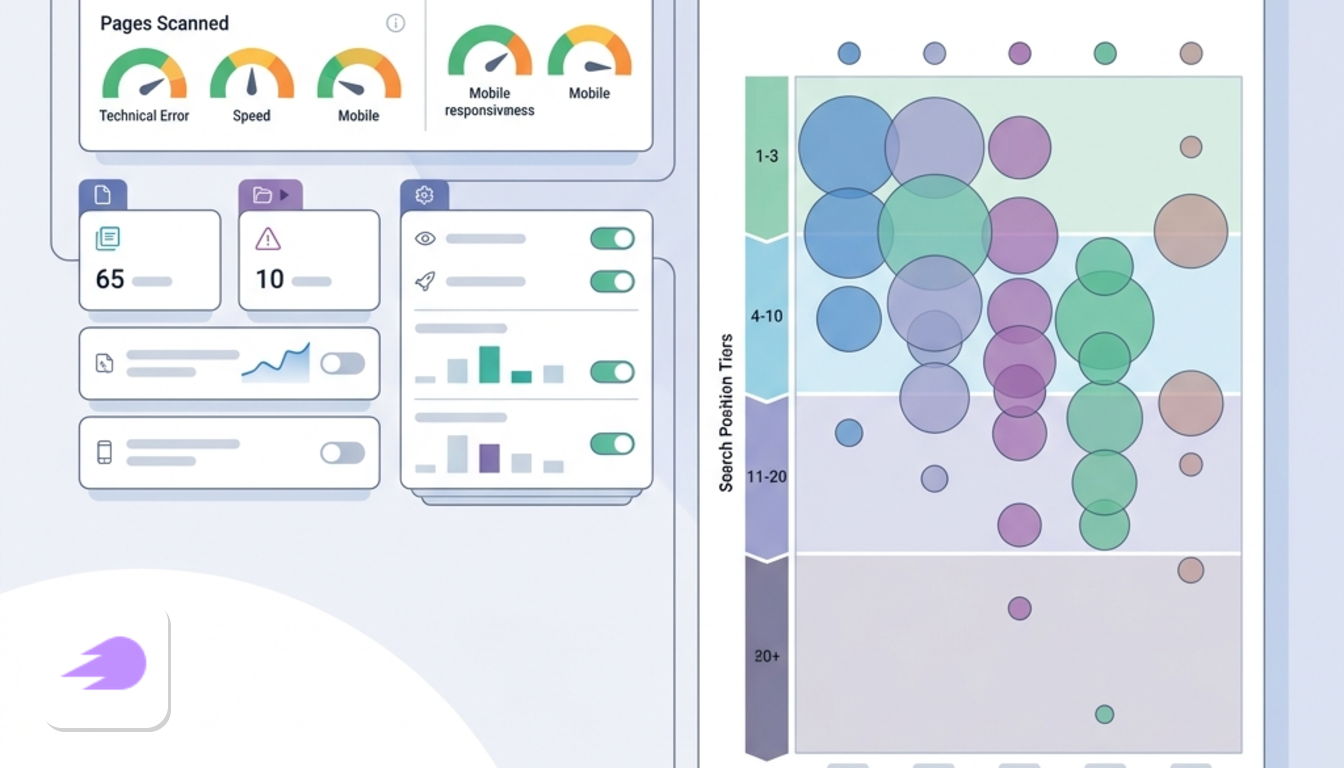
Pick by what your team does every week, not by the longest feature list. The details below come from Semrush's pricing page, Spike AI's decision guide and TrafficThinkTank's review, all checked October 2026.
Hands-on execution with Semrush
Semrush works as the daily system of record for SEO. Position Tracking runs daily on 500 keywords in the SEO and Starter plans, 1,500 in Pro+ and 5,000 in Advanced. Site Audit crawls your pages, and keyword cannibalization analysis arrives with Pro+.
Picture an SEO lead preparing a site migration. They need a crawl-based audit first, then weekly ranking checks, then a list of terms a competitor ranks for and they do not. Semrush covers that loop, and Spike AI points to its Keyword Gap tool for the last step.
Executive benchmarking with Similarweb
Similarweb works top-down. Spike AI describes it as extrapolating traffic for over 100 million domains from a statistical panel. That gives you channel mix, demographic splits, referral sources and audience overlap between competitors.
Now imagine a Head of Growth building a board slide on a rival's traffic share. Similarweb is made for that question, and Spike AI says private equity and M&A teams default to it for market-level due diligence. Semrush's .Trends add-on approximates some of this, but Spike AI calls it a bolt-on, not the core product.
Paid search research
The two tools answer different paid-search questions, according to Spike AI.
- Semrush: the terms competitors bid on, their estimated CPCs, ad copy variations and landing page URLs.
- Similarweb: channel-level spend estimates, the display ad networks in use and publisher-level referral data.
Use Semrush to reverse-engineer a Google Ads account keyword by keyword. Use Similarweb to estimate a rival's overall advertising budget for a briefing.
Where each tool frustrates the wrong user
Marketing operators struggle when they use Similarweb for daily keyword mapping. TrafficThinkTank notes that its keyword overview lacks SERP and competitor keyword analysis. Strategists hit the reverse problem, because Semrush's organic traffic figures are proxies built from rankings and not measured visits.
A common mistake is buying for the wrong team. A VP buys Similarweb for market intelligence and the SEO team cannot use it. An SEO lead buys Semrush and cannot produce the traffic-share report the board wants.
Clickstream Panels Versus Search Engine Crawling
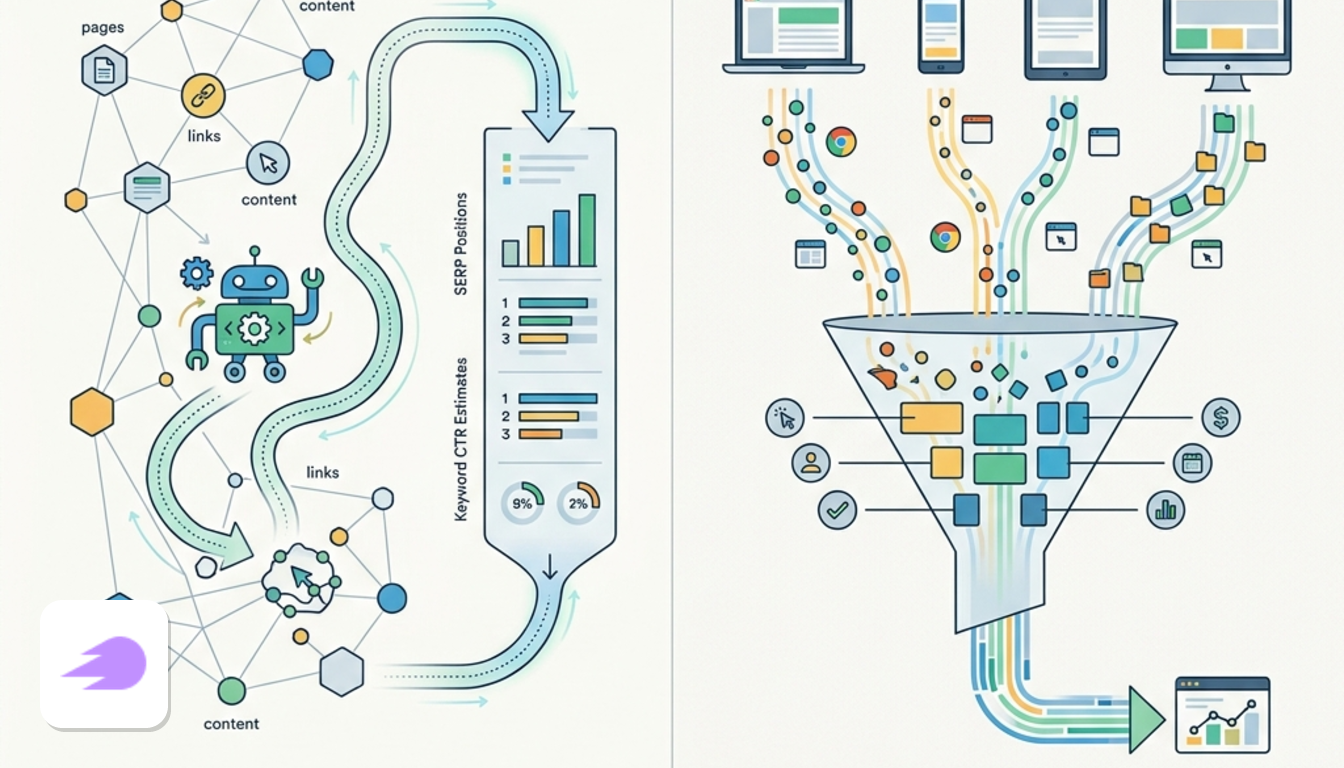
The two tools measure the web in opposite ways, and that explains most of the gap between their numbers. This section draws on Similarweb's comparison page, Spike AI and TrafficThinkTank, checked October 2026.
How Similarweb collects its data
Similarweb combines ISP-level data, browser extensions and direct measurement partnerships, then normalizes the result with statistical models. Spike AI adds public data sources and app SDKs to that list. Similarweb says it covers over a billion websites and over 8 million mobile apps.
That coverage claim sits next to Spike AI's figure of over 100 million domains with extrapolated traffic, so treat the larger number as the vendor's own claim. Panel data also has a known bias. It skews toward consumer-heavy sites, so estimates for niche European B2B domains carry a wider margin of error. They still work for comparing relative share.
Similarweb also says it offers a "Last 28 days" view, so you do not wait for monthly updates. And its page cites a SparkToro study that found it closest to Google Analytics data. Both are vendor-quoted claims, which is why a test on your own site matters (more on that in the FAQ).
How Semrush collects its data
Semrush behaves like a search engine. It crawls the web, tracks keyword positions in the SERPs and watches ad copy. Similarweb's own comparison page says Semrush draws on 808 million websites and no apps, which is Similarweb's characterisation, not Semrush's.
The catch is traffic. Semrush estimates organic visits by multiplying a domain's keyword rankings by estimated search volume and click-through rate for each position. That makes the numbers a useful proxy for SEO performance. However, visits from direct, email or unranked sources never appear in a ranking-based estimate.
Keyword depth and history
Semrush holds 22.3 billion keywords with history dating back to 2012, according to TrafficThinkTank. On Similarweb's Starter plan, you see only the last 3 months and cannot filter by location. Longer history comes with custom plans. On the Semrush side, the pricing page lists historical SEO data as a Pro+ feature.
Tracking Brand Visibility in AI Search Engines
Semrush includes AI visibility tracking in its standard plans, while Similarweb reserves it for custom enterprise contracts. The Semrush figures come from its pricing page, and the Similarweb and platform details come from Style Factory's review, all checked October 2026.
What Semrush includes
Even the entry SEO plan lists AI search performance tracking, AI sentiment monitoring, AI visibility reports for any domain and custom prompt monitoring. The prompt allowances grow with each plan.
- Starter (US$165.17 a month billed annually): 50 prompts tracked daily, 1 domain for AI brand performance, 300 AI visibility reports a day and an AI-ready Site Audit.
- Pro+ (US$248.17 a month billed annually): 100 prompts tracked daily.
- Advanced (US$455.67 a month billed annually): 200 prompts tracked daily.
Style Factory says the visibility data covers mentions and citations in ChatGPT Search, Google's AI Overviews, Gemini and AI Mode. The AI-ready Site Audit helps you see how AI models read your pages and entities.
What Similarweb gates
Similarweb offers an AI Brand Visibility feature, but Style Factory says it exists only on enterprise-level custom plans. The Starter (US$149 a month in TrafficThinkTank's listing) and Professional (US$399 a month) plans have none.
What this means for your budget
Suppose you run marketing for a French e-commerce brand and want to know whether ChatGPT mentions you. With Semrush, you can start on a self-serve plan and add prompts as you grow. With Similarweb, you would negotiate a custom contract before seeing a single prompt result.
Subscription Costs and Team Seat Add-ons
Semrush lists every self-serve price publicly, while Similarweb moves quickly to custom quotes. Semrush figures come from its pricing page, and Similarweb figures from TrafficThinkTank and Style Factory, all checked October 2026. Prices are in US$, before VAT.
Semrush plans
| Plan | Per month, billed annually | Per month, billed monthly |
|---|---|---|
| Free (1 demo project, 10 reports a day) | US$0 | US$0 |
| SEO | US$117.33 | US$139 |
| Starter | US$165.17 | US$199 |
| Pro+ | US$248.17 | US$299 |
| Advanced | US$455.67 | US$549 |
According to Semrush's pricing page, checked October 2026. Annual billing saves up to 17%.
Similarweb plans
TrafficThinkTank lists Starter at US$149, while Style Factory puts the entry Starter plan at US$199 a month. Professional costs US$399 a month. Features such as longer history, location filters and API access sit on higher tiers or custom enterprise quotes.
Seats and reporting add-ons
Seat rules differ sharply. Semrush lets you add colleagues with individual logins, with additional users starting at US$45 a month. Advanced also lists team users and reporting.
Reporting add-ons are cheap:
- Base Report, US$10 a month: data from 20+ Semrush tools, Google Analytics and Search Console integrations, scheduling and PDF export.
- Pro Report, US$20 a month: adds 20+ external integrations, white-labeling, AI-generated summaries and sharing by link.
Similarweb is stricter. TrafficThinkTank reports that standard plans have no extra user seats, and teams needing more than five seats must move to a custom plan. If you run a five-person agency team, that gap alone can decide the purchase.
European Compliance and Data Privacy Safeguards
For European buyers, Semrush publishes the clearest compliance terms of the two. The sources behind this comparison give no DPA terms for Similarweb and no data-storage location for either tool, so this section works with what is documented.
Semrush's legal and DPA terms
According to Semrush's Terms of Service, the contracting company is Semrush Inc., a Delaware corporation with its principal place of business in Boston, USA. Its data processing agreement, per Semrush's DPA documentation, has Semrush acting as processor. It incorporates the EU Standard Contractual Clauses (Decision 2021/914) and the UK transfer mechanism, and the Clauses are governed by Czech law. Both documents were checked October 2026.
So your data protection officer gets a signed transfer framework to review. It is a US company, though, and that is a real downside if your policy prefers European providers.
VAT for business buyers
Both vendors list prices in US$ and before VAT. VAT-registered businesses in the UK, Ireland, France, Spain and Italy can normally treat a cross-border B2B subscription under the reverse-charge mechanism. Individuals and unregistered buyers should expect VAT on top of the listed price.
If you need a European data supplier
If your privacy officer wants a European counterparty, an API provider is one route. DataForSEO is a company based in Tallinn, Estonia. Its privacy policy names Hetzner Online GmbH (Germany) as a data center operator, alongside Google and Microsoft Azure in the United States, and it does not say which data sits where. It keeps written GDPR Article 28 agreements with its sub-processors and uses standard contractual clauses or adequacy decisions for transfers outside the EU.
It is pay-as-you-go with a US$50 minimum top-up, so it is a developer tool, not a dashboard like the other two.
Frequently Asked Questions About Both Tools
Why do the two tools show different traffic?
Because they measure different things. Similarweb infers visits from a panel, while Semrush reverse-engineers organic visits from rankings and click-through models. Neither is a direct count of your real traffic.
Spike AI suggests a quick test. Compare each tool's estimate for your own site with your Google Analytics 4 and Search Console data, then see which one tracks closest in your market. For a niche European B2B site, expect the panel-based figure to be the looser one.
Can Similarweb replace Semrush for an agency?
Probably not if rank tracking, backlink audits and site crawling are part of your service. TrafficThinkTank lists the backlink database and rank tracking as unavailable in Similarweb, and Style Factory says site audits and backlink analysis sit behind very expensive plans. Similarweb's own comparison page does list a site audit, backlink analysis and rank tracker in its toolkit, so the answer depends on the plan you could afford.
Where Similarweb clearly helps an agency is client-facing market reports. Spike AI's advice for lean teams is to pick one primary tool and fill gaps with free options such as Search Console.
What do the free plan and trial include?
Semrush offers a 7-day free trial, cancel anytime. Its free plan gives you 1 demo project and 10 reports a day across the main tools, with no credit card required, according to Semrush's pricing page, checked October 2026. Similarweb also lists a 7-day trial, as the comparison table shows.
When should you move to Enterprise?
Move when Advanced's caps start to block work. Advanced covers 40 websites, 5,000 daily tracked keywords and 200 AI prompts. Semrush's Enterprise plan is custom priced and adds:
- unlimited projects and custom limits;
- custom large-scale AI prompt tracking and multi-brand AI visibility;
- multi-million-page crawling;
- SSO, audit logs and team governance;
- a dedicated account manager and an enterprise SLA with 24/7 support.
A publisher with several country sites and many editors is a typical case. If your needs stay within one brand, Advanced is likely enough. For more on the available plans, see the Semrush page, and browse other options in our SEO and content software category.