















Choosing a global workforce tool? Compare Deel vs Rippling on EOR country reach, IT device management, and EU pricing to pick the right platform.
For businesses looking to expand globally, choosing the right platform for global hiring, payroll, and IT management is crucial. Your decision between Deel and Rippling depends heavily on your current operational focus and future growth plans.
Deel excels if your priority is rapid international hiring across a wide range of countries, managing a large contractor roster, and ensuring swift, compliant global payroll. Rippling, on the other hand, is a strong choice for businesses seeking a unified platform to manage HR, domestic payroll, and comprehensive IT device provisioning, especially if your core team is US or UK-based.
Deel vs Rippling at a glance
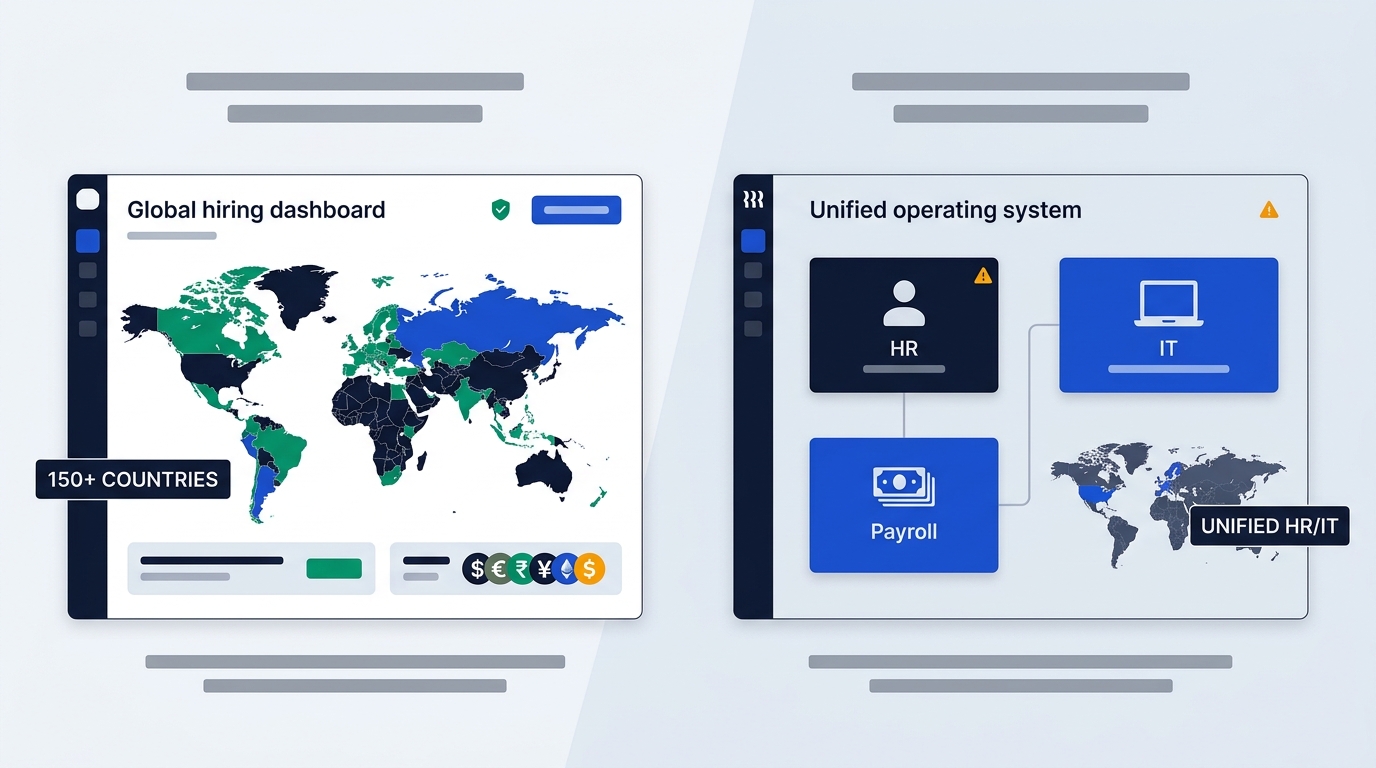
Deel and Rippling both offer you comprehensive solutions for managing a global workforce, but their core strengths and architectural approaches differ significantly. Deel is built for international hiring from the ground up, focusing on broad Employer of Record (EOR) coverage and flexible contractor payments. Rippling, conversely, started as a US-centric HR and IT platform, evolving into a comprehensive operating system that unifies various business functions.
TL;DR verdict: Deel suits teams prioritising rapid international hiring across 150+ countries with transparent pricing, while Rippling suits companies seeking a single operating system uniting HR, domestic payroll, and native IT device provisioning (source: deel.com, rippling.com).
Who Deel does not suit: Domestic-only employers or IT teams requiring deep, zero-touch native Mobile Device Management tied to custom role-based identity trees without third-party middleware.
Who Rippling does not suit: Businesses needing immediate, out-of-the-box international hiring in smaller markets outside Rippling's 80 EOR countries without opaque modular quotes.
To evaluate these systems accurately, you should understand how their foundation shapes daily operations. Deel functions primarily as a contract and payment engine backed by localized legal infrastructure in over 150 countries. Rippling operates as a compound software platform powered by a unified Employee Graph that ties identity directly to device security, SaaS access, and financial controls.
Here is a detailed structural comparison of how both platforms compare across key operational criteria:
| Feature | Deel | Rippling | Notes |
|---|---|---|---|
| Primary Architectural Orientation | Global-first EOR, contract-centric | US-first, unified Employee Graph (HR, IT, Finance) | Deel focuses on global compliance; Rippling on internal operational unity. |
| EOR Country Coverage | 150+ countries | ~80 countries | Deel offers broader immediate global reach. |
| Contractor Management | 185+ countries, 120+ currencies | 185+ countries | Both manage contractors extensively. |
| IT Device Provisioning Depth | Equipment logistics via Hofy acquisition (130+ countries) | Native MDM, Zero-Touch deployment, disk encryption | Rippling offers deeper, native IT control. |
| Starting Prices (per month) | Contractors: US$49; EOR: US$599 | Core Unity platform: ~$35 (base) + ~$8/user | Deel's EOR pricing is published; Rippling's is modular and often quoted. |
| EU Data Hosting | Dedicated EU AWS data centers | Primarily US-centric AWS cloud | Deel explicitly supports EU data residency. |
| GDPR DPA | Yes, Article 28 compliant | Yes, via Standard Contractual Clauses (SCCs) | Both offer DPAs. |
| Customer Support Channels | 24/7 phone, call-back, video, email, WhatsApp, Slack | Live chat (converts to live video call), email | Deel offers broader phone/WhatsApp options; Rippling provides screen share. |
| Native Software Integrations | ~140 integrations | 650+ pre-built integrations | Rippling provides significantly wider third-party software connectivity. |
| Free HRIS Tier | Free for teams under 200 employees | No free tier (Unity base fee applies) | Deel offers an entry-level cost savings for smaller workforces. |
How to choose between Deel and Rippling
Deel's strength lies in its expansive global reach and deep expertise in international labor laws. It provides a streamlined way to hire employees and contractors in many countries without needing local entities. Rippling, conversely, integrates HR, IT, and finance into a single, automated system, making it powerful for managing an entire employee lifecycle from onboarding to offboarding, especially for US or UK-based companies.
When selecting a platform, you must weigh your team's geographic distribution against your internal IT complexity. A company hiring individual software engineers across ten different countries faces very different operational hurdles than a mid-sized firm managing two hundred office-based workers with complex hardware provisioning needs. Understanding these baseline distinctions prevents costly migrations down the road.
When to choose which platform
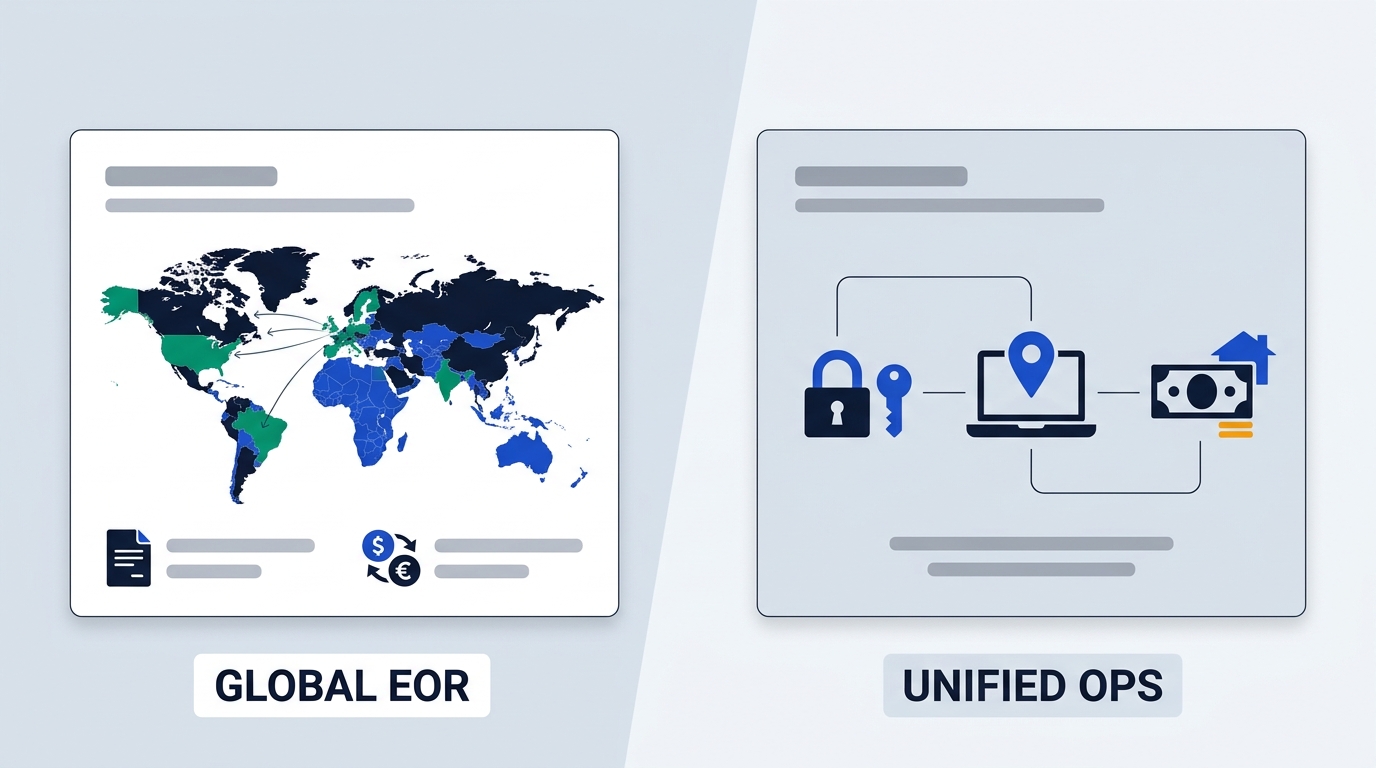
Deciding between Deel and Rippling depends on your company's immediate needs and strategic direction. Each platform has distinct advantages that align with different operational models and growth stages.
Your choice shapes how your HR, Finance, and IT managers spend their workdays. If your administrative burden stems from navigating international labor contracts, statutory benefits, and cross-border bank transfers, your requirements point toward a global EOR engine. If your team loses hours resetting software permissions, tracking down lost laptops, and manually reconciling domestic payroll changes, a unified operations platform provides higher leverage.
Pick Deel for rapid global expansion and contractor management
You should pick Deel if you are expanding into five or more foreign jurisdictions without local entities, managing a large roster of contractors in over 120 currencies, or needing an entry-level HRIS that remains free for teams under 200 workers. Deel's core strength is its ability to simplify the complexities of international employment. It allows you to onboard international workers quickly, often within days, using self-serve contracts and its extensive network of directly-owned legal entities. This means less administrative burden for your team when navigating diverse local labor laws and tax regulations. Deel's focus on compliant global hiring and payments makes it a reliable choice for businesses with a primary goal of expanding their international footprint efficiently.
Consider a scenario where a growing technology firm needs to hire localized sales reps across Brazil, Germany, Japan, and Kenya within three weeks. Setting up foreign legal entities in these four markets would require tens of thousands of dollars in legal fees and months of administrative delay. By utilizing Deel, you can issue localized, legally compliant employment contracts in all four countries almost immediately. Deel acts as the Employer of Record, handling local tax withholdings, mandatory pension contributions, and local statutory benefits while you manage the employee's daily responsibilities.
Deel is also tailored for organizations that rely heavily on international freelancers. If your business hires fifty freelance content creators or developers across Latin America and Eastern Europe, managing individual invoices and international wire transfers becomes an operational bottleneck. Deel allows contractors to submit timesheets or milestone payments directly within the app. You approve the master invoice once, and Deel handles localized payouts in over 120 currencies using flexible methods such as Wise, PayPal, or crypto rails.
From a user persona perspective, Deel appeals strongly to Head of Talent and Global People Ops leaders. These professionals require bulletproof legal agreement templates, automated background checks, and clear guidance on local employment laws without waiting for internal IT configuration. The straightforward user interface allows HR staff to launch hiring workflows in new countries without technical assistance.
Pick Rippling for unified HR, IT, and finance automation
Pick Rippling if your organisation is headquartered in the US or UK with plans to unify HRIS, expense cards, identity management, and laptop lifecycle policies on an automated employee graph. Rippling's platform is designed as an all-in-one operating system. It tightly integrates HR, IT, and finance functions, allowing for powerful cross-departmental automation. For instance, a single onboarding workflow can provision a new employee's payroll, benefits, email account, and even ship a pre-configured laptop. This unification reduces manual processes, minimizes compliance errors, and centralizes employee data. If your goal is to streamline internal operations and automate the entire employee lifecycle across various departments, Rippling's comprehensive suite offers a compelling solution.
Imagine managing a fast-growing US technology company with 150 domestic employees and a small secondary office in London. Every time a new engineer joins, your IT team must manually order a laptop, configure security profiles, set up Okta identity credentials, add them to specific Slack channels, and enroll them in health benefits. When using Rippling, creating the employee profile in the HR engine automatically triggers every downstream action. The laptop is pre-configured and shipped via Zero-Touch deployment, software access is granted based on role triggers, and payroll is updated in a single execution.
Rippling excels when your primary administrative risk is configuration drift between departments. In traditional multi-tool stacks, an employee promotion in HR might not update their spending limits in corporate expense software or their access levels in cloud storage. Rippling's underlying Employee Graph maintains dynamic synchronization across all modules. If an employee changes departments from Support to Operations, their app access, manager approvals, equipment policies, and payroll allocations update automatically without manual HR or IT intervention.
How Rippling simplifies IT and device governance
This platform is ideal for Chief Information Officers, IT Directors, and VP of Operations who want complete governance over corporate data and devices. Instead of purchasing separate identity management platforms, expense management tools, and Mobile Device Management software, IT leaders get a single operational pane of glass. You can enforce disk encryption, monitor device security health, and manage software licenses directly from the core employee record.
Hybrid setups for global enterprises
Some global enterprises opt for hybrid setups, running Rippling as their central IT and domestic HR backbone while using Deel as the specialised global payroll and EOR execution layer. This approach allows organizations to leverage Rippling's deep IT and domestic HR automation for their core workforce, while Deel handles the specific complexities of international hiring, EOR services, and contractor payments in diverse markets. This strategy can be effective for larger companies that need both deep operational integration domestically and broad, compliant global reach.
Implementation velocity also differs. Deel enables onboarding international workers within days with self-serve contracts, whereas Rippling demands a multi-week configuration process guided by implementation specialists. If speed to market for international hires is critical, Deel offers a faster setup. Rippling's longer implementation time is often a trade-off for its extensive customization and deep automation capabilities.
In a hybrid architecture, your IT operations rely on Rippling's Employee Graph to manage corporate identities, global device security, and internal access permissions. Meanwhile, your Finance and Legal teams connect Deel via API or custom data connectors to handle localized EOR payroll, foreign statutory tax filings, and international contractor invoices. This split model shields your internal IT team from wrestling with foreign hardware compliance while giving your HR team access to Deel's broader EOR footprint.
When transitioning to or from either platform, enterprise IT teams must account for identity migration risks. Moving from Deel to Rippling requires mapping legacy contract records into structured graph nodes and installing local MDM security agents on existing hardware. Transitioning from Rippling to Deel requires decoupling automated SaaS provisioning triggers and establishing alternative identity providers like Google Workspace or Entra ID for access control.
Global hiring reach and EOR coverage
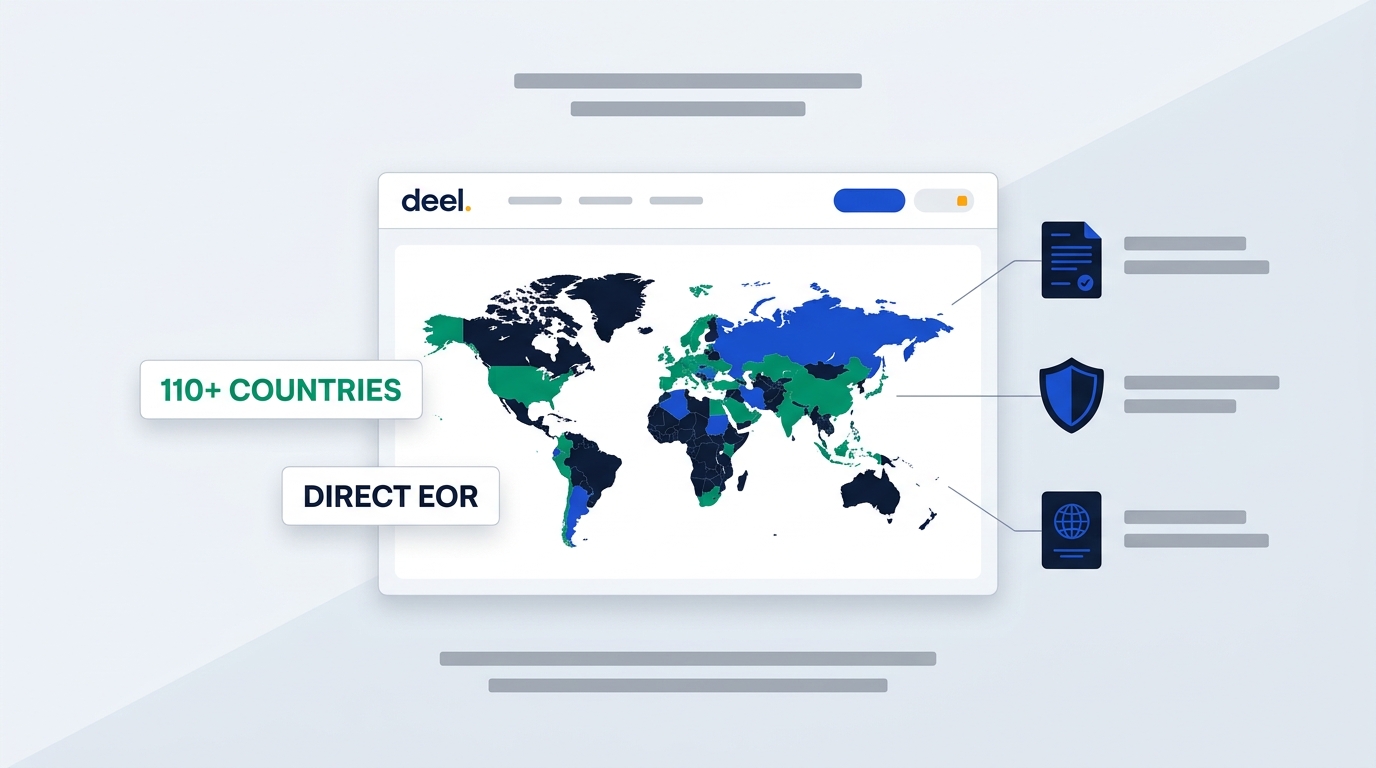
The ability to hire talent across borders quickly and compliantly is a key differentiator between Deel and Rippling. Their approaches to Employer of Record (EOR) services and global reach vary significantly.
Evaluating global expansion capabilities requires analyzing how each provider manages legal risk, localized contracts, and statutory employer responsibilities. Employer of Record services require the platform to legally employ workers on your behalf, taking full responsibility for local payroll taxes, statutory benefits, work permit compliance, and severance regulations.
Deel's extensive direct entity infrastructure
Deel operates directly-owned legal entities in 110+ to 150+ countries, delivering in-house legal contracts, local benefits, and visa support across 70+ jurisdictions. This extensive direct infrastructure is Deel's primary strength. By owning the local entities, Deel can provide a more integrated and transparent EOR service. This means faster onboarding, as you are not relying on multiple third-party partners. It also helps in ensuring consistent compliance with local labor laws, managing intellectual property (IP) protection, and offering localized benefits packages. The depth of Deel's entity ownership reduces reliance on secondary partners, which can often introduce additional layers of complexity and cost. For businesses looking to expand into a wide array of international markets, Deel's broad and directly-managed EOR coverage is a significant advantage, often allowing new international hires to be onboarded in a matter of days.
Direct ownership of legal entities directly impacts how customer support and legal challenges are resolved. When an employee in a country like France or Colombia has a complex legal inquiry regarding parental leave or statutory notice periods, Deel relies on its own in-house legal and payroll staff located in those countries. Because there is no intermediary partner agency handling the employment contract, your HR team receives authoritative guidance faster, minimizing legal exposure for your business.
Furthermore, Deel provides built-in immigration services that cover over 70 countries, including key markets such as the US, Canada, and the UAE. You can track visa application statuses directly within the Deel dashboard. If you need to relocate a senior engineer to a regional office or secure a local work permit for a foreign hire, Deel's dedicated mobility team manages the application process natively without requiring external legal retainers.
How to onboard international employees on Deel
To onboard an international employee on Deel, your HR manager follows a structured step-by-step workflow:
- Select the target hiring country and enter job details, including title, proposed salary, and local currency.
- Choose the localized employment contract template curated by Deel's legal team for that specific jurisdiction.
- Customize local benefits, such as supplementary health insurance or pension matches, based on Deel's regional market benchmarks.
- Send the electronic invitation to the candidate, who completes localized identity verification and tax form submission.
- Review and execute the contract electronically, allowing the worker to begin onboarding within days.
Rippling's EOR countries reach
Rippling covers approximately 80 countries for Employer of Record services, handling contractor management across 185+ nations. While Rippling's EOR coverage is substantial, it is narrower than Deel's. Rippling excels at managing contractors globally, offering its services in a very wide range of countries. However, for full-time employee EOR services, its footprint is more concentrated. This difference is important if your international hiring strategy targets specific regions or smaller markets that might fall outside Rippling's direct EOR network. If your expansion is focused on the approximately 80 countries Rippling supports, its EOR offering can be a strong integrated solution, especially when combined with its broader HR and IT capabilities.
Rippling's approach to global hiring is designed to keep your international workforce fully integrated into your domestic HR operations. Even when an employee is hired through Rippling's EOR entity in an international market, their record exists on the exact same Employee Graph as your domestic team. They are evaluated using the same performance review tools, enrolled in company-wide learning courses, and managed within the same org charts without requiring separate logins or decoupled systems.
Secondary partner reliance: Entity ownership matters for onboarding speed, IP protection, and eliminating third-party markups when hiring overseas staff. When a platform relies heavily on third-party EOR partners, it can introduce potential delays, less transparent pricing, and varying service quality across different regions. Directly-owned entities, like Deel's, generally offer more control over the entire employment lifecycle, from contract generation to termination, ensuring a more consistent and compliant experience. This direct control can be crucial for companies prioritizing speed and legal certainty in their global hiring efforts.
How both platforms manage worker compliance
Contractor compliance safeguards are also a key consideration. Deel offers a built-in worker classification assessment tool, which helps you determine if a worker should be classified as an employee or a contractor according to local laws. This reduces misclassification risks. Rippling provides automated local overtime and wage compliance alerts, notifying you if an employee is close to breaking a rule, such as working too much overtime, allowing you to address it proactively. Both platforms offer you thorough features to help maintain compliance, but Deel's tool focuses on initial classification, while Rippling's emphasizes ongoing wage and hour adherence.
Misclassification carries heavy regulatory penalties in many European and Latin American markets. If a tax authority determines that a long-term contractor should be classified as a full-time employee, your company could face retroactive payroll taxes, statutory benefit payments, and administrative fines. Utilizing Deel's automated compliance wizard evaluates worker behavior, working hours, and exclusivity to give your legal team a clear risk score before signing a contract.
Contractor payments and multi-currency payroll
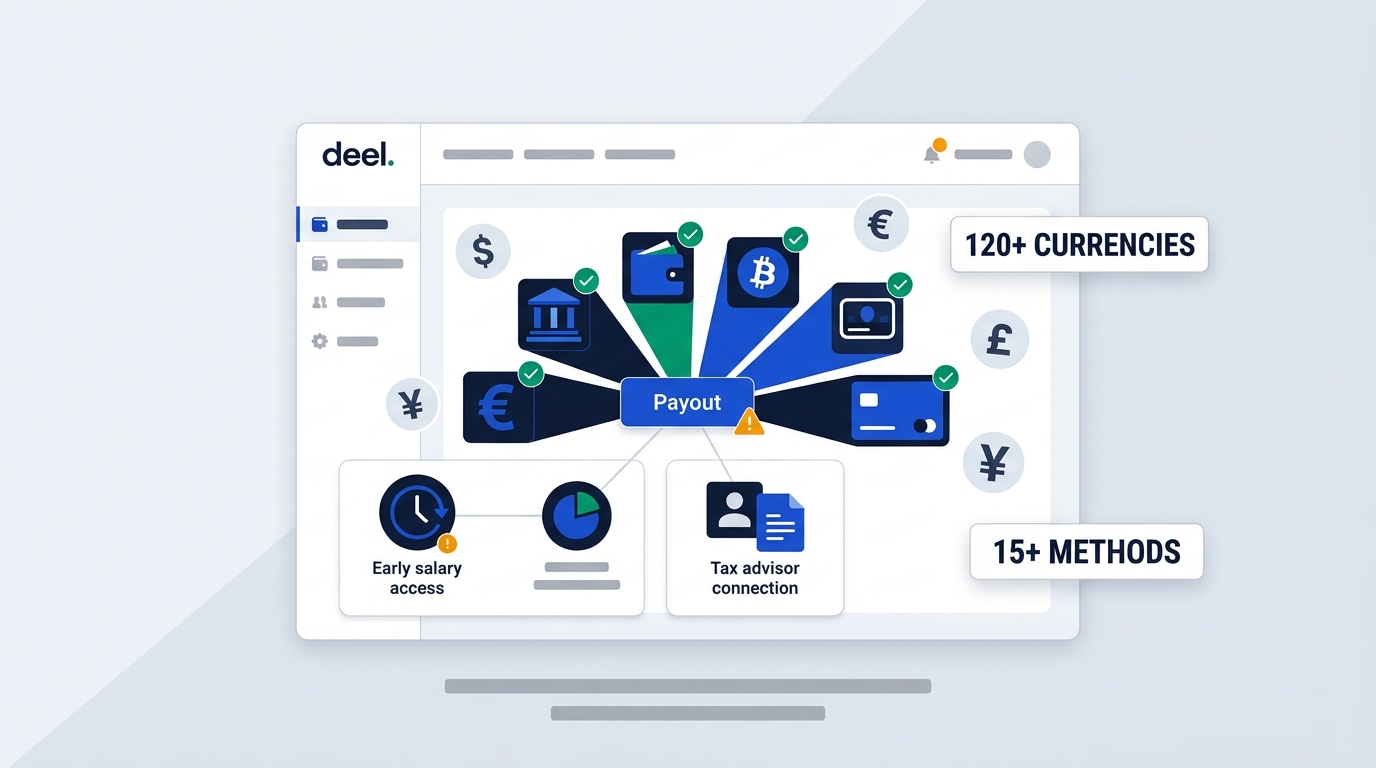
Managing payments for international contractors and employees requires platforms that can handle diverse currencies, payment methods, and local regulations. Deel and Rippling approach this with different strengths.
A reliable payout infrastructure must accommodate diverse banking networks, local currency regulations, and flexible funding mechanisms. For businesses with distributed remote workers, payout speed and currency withdrawal flexibility directly impact contractor retention and overall worker satisfaction.
Deel's extensive payout flexibility
Deel supports contractor withdrawals in over 120 currencies across more than 15 payment methods. These options include popular services like Wise, PayPal, and Payoneer, as well as cryptocurrency withdrawals via Coinbase. Deel also offers its own global debit card, which provides early salary access for contractors. This wide array of withdrawal methods is a significant advantage for contractors, offering them flexibility and choice in how they receive their payments, regardless of their location. For businesses, this means fewer headaches dealing with individual contractor payment preferences and ensuring timely, localized payouts.
Contractors using Deel gain access to specialized financial features built directly into their portal dashboard. For instance, contractors can connect directly with verified local tax advisors within the platform to help understand their local tax obligations and file tax documents. Additionally, Deel's early salary access feature allows eligible contractors to withdraw earned funds up to 30 days before the standard invoice payout date, providing significant personal financial flexibility.
The contractor payment lifecycle on Deel follows a streamlined step-by-step process:
- The hiring manager generates a localized contractor agreement specifying fixed-rate, pay-per-hour, or milestone deliverables.
- The contractor completes digital identity verification and submits localized tax documentation (such as W-8BEN for non-US workers).
- The contractor logs hours or submits milestone completion deliverables within the portal or via integrated Slack plugins.
- The employer reviews and approves the submitted invoices, funding the master billing balance using their preferred payout rails.
- Deel converts the payment into the contractor's chosen target currency and dispatches funds instantly via their preferred withdrawal rail.
Rippling's global payroll speed
Rippling processes multi-country payroll in 90 seconds using an in-house calculation engine, but provides fewer withdrawal rails for international contractors. Rippling's strength lies in its speed and efficiency for running payroll. Its integrated system allows for rapid processing, which can be beneficial for companies managing a large number of employees. However, while efficient for payroll processing, Rippling's options for contractor withdrawals are not as extensive as Deel's. This might mean that some international contractors could have fewer choices for receiving funds, potentially requiring more manual intervention or leading to less preferred payout methods.
Rippling's native payroll engine processes domestic and international workforce payments simultaneously. Rather than running separate payroll cycles for domestic staff and international EOR workers, your finance team can execute a single consolidated payroll run. Rippling calculates local gross-to-net payments, handles localized statutory tax withholdings, and generates compliance filings across all supported jurisdictions automatically within the same workflow.
Funding methods also vary. Deel allows client invoice funding via BACS, direct debit, credit card, and even crypto rails. This flexibility in funding methods can be advantageous for businesses that prefer different ways to manage their cash flow or utilize various payment systems. Rippling, on the other hand, relies on standardized commercial bank debits for funding. While standard, this may offer less flexibility for businesses with specific funding requirements or preferences.
What hidden payroll and exchange fees exist
Foreign exchange fees and hidden payroll deductions are an important consideration for total cost. Third-party analyses identify unitemised 0.5% to 2% FX conversion buffers and mandatory EOR salary deposits on Deel invoices. While Deel publishes its base EOR pricing, these additional costs can add up, impacting the overall expenditure for international hiring. Rippling's modular pricing, while not fully transparent upfront for EOR, also requires careful review for similar potential hidden fees or additional charges that might not be immediately obvious in initial quotes. It's essential for businesses to request a detailed breakdown of all costs, including any currency conversion markups or required deposits, when evaluating either platform.
When budgeting for global payroll, your finance team must model these transactional costs alongside software licenses. Evaluating foreign exchange transparency is just as critical as comparing baseline per-seat subscription rates.
Device management and IT provisioning depth
For modern distributed teams, managing IT assets and ensuring secure access to applications is as critical as HR and payroll. This is an area where Rippling truly shines with its native capabilities, while Deel offers a more integrated but less granular solution.
Securing devices and managing software access for remote employees present significant operational risks for fast-growing companies. If an employee leaves your organization, failing to revoke cloud credentials immediately or failing to retrieve a corporate laptop containing confidential data creates severe security vulnerabilities.
Rippling's native IT device management
Rippling offers native, proprietary Mobile Device Management (MDM) supporting macOS, Windows, and Linux, with automated Zero-Touch deployment, disk encryption enforcement, and remote wipe capabilities. This native IT suite is a core part of Rippling's "Employee Graph" architecture. When you onboard an employee, Rippling can automatically configure and secure their devices, install necessary software, and enforce security policies. The depth of its MDM allows for granular control over devices, ensuring compliance and security from day one. This integration means that IT policies are directly tied to the employee record, automating tasks that would otherwise require separate tools and manual intervention.
Rippling's IT capabilities extend far beyond hardware shipping. Its native Identity and Access Management (IAM) engine operates with granular Role-Based Access Control (RBAC) and dynamic Multi-Factor Authentication (MFA) rules. Because identity is integrated with HR status, security policies adjust dynamically. If an employee moves from an entry-level position to a managerial role, Rippling automatically updates their access permissions across software systems without requiring an IT ticket.
Setting up zero-touch IT provisioning in Rippling follows a systematic process for IT administrators:
- Define hardware profile rules in Rippling based on employee department, seniority level, and geographic location.
- Purchase laptops directly from the integrated Rippling Store or assign existing hardware inventory stored in Rippling Warehouses.
- Configure automated MDM enforcement profiles, specifying disk encryption (FileVault/BitLocker), password strength rules, and required background security agents.
- Ship the sealed laptop directly to the new hire's home address anywhere in the world.
- The new employee unboxes the machine, connects to Wi-Fi, and logs in with their primary corporate credentials; Rippling automatically installs required applications, provisions security profiles, and completes system setup without manual IT involvement.
Deel's IT equipment logistics
Deel handles equipment deployment and asset storage in over 130 countries, powered by its Hofy acquisition. It manages global shipping and customs, simplifying the logistics of getting equipment to international employees. However, Deel's solution lacks granular zero-touch app bundling. While it effectively addresses the physical delivery and lifecycle of IT equipment, it doesn't offer the same deep, native integration for software provisioning and device policy enforcement that Rippling does. Deel's IT offering is more focused on the procurement, delivery, and retrieval of physical assets, rather than comprehensive, automated software and security management.
Deel IT excels at removing international customs headaches. Delivering hardware to remote workers in regions with strict import controls or high tariffs (such as Latin America or South Asia) often leads to lost shipments and unexpected import fees. Deel's regional warehouse network and localized logistics engine handle customs clearance, duty payments, and localized shipping, ensuring that employees receive physical laptops on schedule.
Identity and access management (IAM) is another area with distinct differences. Rippling dynamically provisions over 650+ SaaS tools based on role or department triggers. This means that as an employee's role changes, their access to various applications is automatically updated, reducing security risks and administrative overhead. Deel offers over 900+ SSO application connections but relies on external IdP tools like Okta or Entra ID for granular rules. While Deel provides extensive SSO capabilities, the fine-grained control over access policies and dynamic provisioning based on employee attributes typically requires integration with a separate identity provider.
How do offboarding security protocols differ
Offboarding security protocols highlight their different strengths. Rippling instantly revokes app permissions, removes corporate credentials, and locks machines upon termination. This automated, immediate action is critical for data security and compliance, especially in a rapid offboarding scenario. Deel coordinates physical laptop retrieval logistics. While essential for asset recovery, Deel's approach does not offer the same instantaneous digital access revocation that Rippling's native IT suite provides. For organizations where data security and immediate access control are paramount, Rippling's integrated approach offers a more solid solution.
Workflow automation and employee data architecture
The underlying data architecture and automation capabilities significantly impact how efficiently you can manage your workforce. Rippling and Deel have fundamentally different approaches here, shaped by their origins.
Understanding database architecture may seem overly technical for HR leaders, but data structures dictate what automations are possible as your organization expands. A system built on decoupled micro-services connected via cloud API syncs behaves very differently from a system built on a single graph database.
Core architecture split
Rippling's Employee Graph, built on MongoDB and Apache Pinot, treats the employee as a single identity node across HR, IT, and Finance. This unified data model allows you to create smooth connections and automations across various departments, as every piece of data (payroll, app access, device assignment) is linked to that single employee identity. This architecture is opinionated about centralization, performing best when Rippling is the sole source of truth for employee identity. Deel, conversely, uses a contract-first schema, mapping workers across local legal entities. This reflects Deel's origin as a contractor payment platform, where the contract is the primary entity, not necessarily a unified employee identity across all internal functions like IT or finance. This model excels at handling the complexities of diverse global employment contracts.
In Rippling's dual-database model, MongoDB handles Online Transaction Processing (OLTP) workloads. This ensures that transactional tasks like creating employee records, running payroll calculations, and issuing device locks execute instantaneously with strict data consistency. Apache Pinot handles Online Analytical Processing (OLAP) workloads, powering real-time cross-module analytics, complex aggregate queries, and custom reporting dashboards without slowing down transactional performance.
Deel's contract-centric architecture organizes resources around distinct legal agreements. Its core API exposes resources such as Contracts, Tasks, Timesheets, Milestones, Off-cycle Payments, Invoice Adjustments, Organizations, and Legal Entities. This schema makes Deel exceptionally flexible when adding diverse employment models (such as switching a worker from a contractor agreement to a full-time EOR contract), but relies on secondary sync connectors to share data with external HRIS platforms like Workday or BambooHR.
Rippling's advanced automation engines
Rippling Workflow Studio uses proprietary Rippling Query Language (RQL) and Supergroups for field-level cross-system automations. For example, a department change can trigger a Slack channel update and app access adjustments automatically. Rippling offers over 150 pre-built templates to get you started. This powerful automation engine allows for highly customized, multi-step workflows that span HR, IT, and finance, all driven by employee data. The ability to create dynamic employee groupings (Supergroups) that update automatically based on defined criteria further enhances the precision of these automations.
Supergroups in Rippling provide dynamic audience scoping. Unlike static employee groups that require manual list updates, a Supergroup utilizes logical RQL queries (for example: "all software engineers in the UK hired after January 2025"). As soon as an employee meets these conditions, Rippling automatically applies associated security policies, software licenses, corporate expense limits, and training modules to their profile without manual admin effort.
Creating a custom cross-functional workflow in Rippling Workflow Studio follows these technical steps:
- Open Workflow Studio and select a system trigger originating from any module (such as an HR status change, salary adjustment, or geographic relocation).
- Define scoping parameters using RQL to apply the workflow only to specific Supergroups or organizational branches.
- Configure multi-step conditional logic branches based on dynamic employee attributes.
- Add downstream target actions spanning different modules (such as updating corporate card spending limits in Finance, granting GitHub access in IT, and updating pay rate schedules in Payroll).
- Test and activate the workflow, allowing Rippling's backend to carry out cross-system actions deterministically whenever the trigger event occurs.
Deel's workflows scope
Deel Workflows offer no-code HR trigger automations limited primarily to onboarding alerts, time-off approvals, and Slack notifications. While useful for streamlining core HR processes, Deel's automation capabilities do not extend to the same depth across IT access, device management, or financial workflows as Rippling's. Deel's automation is designed to enhance its global hiring and compliance functions, rather than orchestrating complex, cross-departmental operations. Its strength lies in automating tasks related to international employment contracts and payments.
Deel provides specialized Slack plugins that allow managers and employees to execute HR tasks directly inside their communication channels. Employees can request time off, view organizational charts, participate in pulse surveys, and submit peer recognition kudos without leaving Slack. These integrations streamline everyday interaction for remote teams even if they do not automate deep IT hardware management.
Reporting capabilities also reflect these architectural differences. Rippling Data Cloud supports live in-app pivot tables and custom cross-module formulas. This allows users to build highly customized reports that draw data from HR, IT, and finance simultaneously, providing deep insights into operational efficiency and employee trends. Deel supplies pre-built standardized payroll and compliance reports. While these reports are essential for regulatory compliance and financial oversight, Deel's platform offers less flexibility for creating custom, cross-functional analytics without relying on external tools or submitting support tickets.
Deel vs Rippling pricing and real costs
Understanding the pricing models and potential hidden costs is crucial for budgeting, especially for global operations. Both Deel and Rippling have different approaches to how they structure their fees.
SaaS buyer research shows that headline subscription rates rarely reflect the total cost of ownership for global workforce software. Evaluating total spend requires analyzing software platform base fees, per-seat licensing fees, foreign exchange markups, statutory employer contributions, and required working capital deposits.
Deel's published pricing
Deel publishes its contractor and EOR pricing upfront. Contractor management costs US$49 per contractor per month, or US$35 per month when billed annually. Deel Employer of Record (EOR) services start at US$599 per employee per month, or US$499 per month when billed annually. US PEO costs US$125 per employee per month (Deel catalog notes). This transparency is a notable advantage, allowing businesses to estimate costs more readily. However, it is important to remember that these are base prices, and additional statutory employer costs, currency conversion markups, and refundable salary deposits can increase the total cost, as noted by third-party analyses.
When contracting full-time workers through Deel EOR, your company must factor in mandatory salary deposits. Deel typically requires upfront funding equivalent to one or two months of employee salary and statutory liability as a refundable deposit. This deposit protects against payroll defaults but ties up working capital that your finance team must account for during cash flow planning.
Deel's free tier
Deel HRIS is free for teams under 200 workers, providing basic org charts and PTO tracking without extra software charges. This free tier for its HRIS can be a significant cost advantage for smaller businesses or startups that are primarily focused on international hiring and contractor management, allowing them to manage core HR functions without an additional subscription fee.
By offering a free HRIS for workforces under 200 employees, Deel lowers the barrier to entry for early-stage companies. A growing team can use Deel as its central employee directory, org chart builder, and leave tracker without paying core software platform fees, incurring costs only when adding paid EOR hires, US PEO seats, or contractor management features.
Rippling's modular pricing model
Rippling employs a modular pricing model that requires the core Unity platform, typically around US$35 monthly base, plus modular software starting at US$8 per user per month. The EOR cost is unlisted publicly and is estimated between US$499 and US$599 per employee per month via custom quote. This modular approach means that the total cost can vary widely depending on the specific HR, IT, and finance modules you select. While it allows for customization, it also makes it harder to calculate the total cost without engaging with their sales team for a personalized quote.
Rippling's modular architecture means your overall bill expands as you activate add-on products. Adding native Mobile Device Management, Spend Management, Corporate Cards, Applicant Tracking (ATS), Learning Management (LMS), or Performance Management increases the per-user monthly rate. While consolidating these tools onto Rippling can reduce overall IT spend compared to purchasing separate vendors (such as paying separate fees for Jamf, Ramp, and Greenhouse), it requires careful module selection during sales contract negotiations.
Itemised total cost modeling: Comparing a 20-person hybrid team (15 domestic, 3 contractors, 2 overseas EOR) demonstrates how Rippling's modular stack scales compared to Deel's per-seat contract billing. For a team with a strong domestic core and occasional international hires, Rippling's base platform plus selected modules might be competitive, especially given its integrated IT capabilities. However, for a team with a high proportion of international EOR employees or contractors, Deel's per-seat pricing for those services might offer a more straightforward cost structure, even with potential additional fees. It's crucial for businesses to request detailed, itemized quotes from both providers that include all potential costs, such as statutory contributions, benefits, and any FX fees, to make an accurate comparison.
How to compare vendor costs accurately
To perform an accurate cost comparison before signing a vendor contract, your procurement manager should execute the following financial checklist:
- Request a complete itemization of all baseline per-seat software fees and recurring platform base charges.
- Calculate mandatory EOR refundable salary deposits required for international hiring destinations.
- Clarify foreign exchange conversion markups (request explicit details on currency buffer percentages applied to cross-border payouts).
- Estimate hardware logistics fees, including shipping rates, customs handling, and warehouse storage costs for global devices.
- Identify any mandatory implementation fees or required expert support retainers required during onboarding.
European data residency and GDPR compliance
For businesses operating in Europe, data residency and compliance with GDPR are paramount. Both Deel and Rippling address these concerns, but with different approaches to data hosting.
European companies and international businesses with staff based in the EU or UK face strict legal obligations under the General Data Protection Regulation (GDPR). Managing employee personal data across international payroll platforms requires verified legal mechanisms for data transfers, sub-processor security disclosures, and precise tax handling.
Deel's data hosting infrastructure
Deel hosts customer data in dedicated ISO 27001-certified, SOC 2 Type II compliant AWS data centers within the European Union (Deel catalog notes). This supports regional data sovereignty, which is a key requirement for many European businesses and ensures that personal data of EU residents remains within the EU. This explicit commitment to EU data residency can be a significant factor for companies prioritizing GDPR compliance and minimizing cross-border data transfer complexities.
By guaranteeing European data residency, Deel simplifies compliance for Data Protection Officers (DPOs). Storing employee records, financial details, and passport scans natively within EU AWS data centers minimizes exposure to international data transfer challenges, helping security teams meet national data sovereignty standards across EU member states.
Rippling's data posture
Rippling primarily utilizes a US-centric AWS cloud architecture, employing Standard Contractual Clauses (SCCs) for cross-border international employee data transfers. While SCCs are a recognized mechanism for lawful data transfers under GDPR, the primary data storage location outside the EU means that data is subject to US legal frameworks. This might necessitate a more thorough data transfer impact assessment (DTIA) for European businesses to ensure adequate protection for personal data. It is important to note that while Deel explicitly states EU data center locations, Rippling's official website and top competitors do not publicly disclose specific EU data center locations or detailed Article 28 DPA specifics.
GDPR Article 28 compliance: Both platforms furnish Data Processing Agreements (DPAs) covering lawful employee processing, sub-processor disclosures, and mandatory data deletion upon contract termination. A DPA is a legal requirement under GDPR when a data controller (your company) uses a data processor (Deel or Rippling) to process personal data. Both providers ensure that they meet these obligations, outlining how they protect data, manage sub-processors, and handle data upon the end of the service.
Cross-border VAT accounting is another important consideration for European businesses. European businesses apply the EU VAT reverse charge mechanism on B2B SaaS invoices. This means the buyer accounts for both the input and output VAT, effectively "reversing" the charge and often resulting in a nil net payment. UK businesses apply the UK reverse charge under HMRC VAT Notice 741A, noting that the UK operates outside the EU VAT regime. When dealing with international SaaS providers, understanding these mechanisms is essential for correct tax declarations and avoiding unnecessary VAT payments. Always confirm with your finance team how to apply these rules to invoices from Deel or Rippling.
How to handle European VAT on invoices
When receiving monthly billing invoices from Deel or Rippling, your accounting department must ensure correct tax structuring. If your company is VAT-registered within an EU member state (such as France, Germany, or Spain) and purchases software services billed from an entity outside your domestic jurisdiction, you must record the invoice under the EU VAT reverse charge rule. Ensure that your corporate VAT identification number is correctly listed on vendor billing settings so that reverse charge treatment is properly reflected on monthly invoices.
Frequently asked questions about global hiring
Here are some common questions businesses ask when considering global hiring platforms like Deel and Rippling.
Can you use Deel and Rippling together in the same organization?
Yes, it is possible to use Deel and Rippling together, especially for larger enterprises. A common pattern involves leveraging Rippling as the central system for domestic HR and IT management, handling core employee data, device provisioning, and internal workflows. Simultaneously, Deel is used as the specialized global Employer of Record (EOR) and contractor management layer for international hires. This hybrid approach allows businesses to capitalize on Rippling's deep integration for their core workforce while benefiting from Deel's extensive global reach and compliance expertise.
When deploying this dual-vendor strategy, your IT engineering team will typically configure data connectors or leverage open REST API endpoints to keep employee counts and identity records aligned across both systems. While maintaining two platforms introduces additional vendor oversight, it prevents fast-growing companies from having to compromise on either native IT hardware security or broad global hiring coverage.
How do customer support channels and response times compare?
Rippling publishes 30-second live chat response times with screen sharing, emphasizing quick, expert-led support. Deel provides 24/7 in-house support across 49 countries via phone, email, and WhatsApp. Both platforms highlight their commitment to customer support. Rippling focuses on rapid, high-quality resolution through chat and video, while Deel emphasizes round-the-clock, multi-channel availability with a globally dispersed team. The choice here may depend on your preferred support method and the urgency of your global HR and payroll needs.
Deel maintains a 100% in-house support staff spread across 49 countries, avoiding external third-party support call centers. Independent review metrics indicate a 91% first-contact resolution rate on live chat and an average 6-minute resolution time for contractor and EOR inquiries. Rippling's published support benchmarks highlight product-level experts capable of escalating live chat directly into video screen-sharing sessions, maintaining over 90% CSAT ratings across user accounts.
Do either of these platforms offer a free trial?
Neither Deel nor Rippling offers a free trial for their full Employer of Record (EOR) or PEO services. Both typically require interested businesses to book an interactive sales demo to see the platform in action and receive a custom quote. This is common for complex HR and payroll solutions due to the intricate nature of global compliance and service configuration. While Deel does offer a free HRIS tier for smaller teams, it does not extend to their EOR or PEO offerings.
Because full platform trials are not available, evaluating these tools effectively requires preparing realistic test scenarios during vendor demos. You should ask sales engineers to execute live walk-throughs of specific processes, such as adding a new hire in a complex foreign jurisdiction, generating a custom cross-module report, setting up an MDM security profile, or demonstrating offboarding credential revocation.
What legal risks exist regarding ongoing litigation between Deel and Rippling?
As of March 2026, there is ongoing litigation between Deel and Rippling, with Rippling having filed trade-secret and RICO claims against Deel in 2025. A federal judge allowed these claims to proceed, and the DOJ opened an investigation. This legal dispute represents a vendor procurement risk factor for both platforms. It is advisable for your internal legal counsel to evaluate the current status of this case as part of your vendor risk assessment process before making a long-term commitment to either platform. The full details of the case filings should be confirmed through official legal channels if this is a concern for your organization.
Legal teams conducting corporate risk assessments should distinguish between procurement risk and product operational risk. Ongoing litigation between competing vendors does not disrupt day-to-day platform functionality, employee payroll distributions, or device management security. However, ensuring that vendor contracts contain standard liability indemnification and data transition protections is prudent enterprise risk management.
Sources and how this was compiled
Compiled by the SaaSEuro team from the vendors' official documentation; we have not hands-on tested these products. Facts last checked in October 2026.
Source: official vendor pages, checked October 2026.
Which platform should you pick
Choosing between Deel and Rippling comes down to your company's core priorities for global operations. Both are powerful tools, but they excel in different areas.
For distributed international teams, you should sign up for Deel if fast, transparent EOR hiring in 150+ countries and versatile contractor payment rails are your primary growth bottlenecks (Deel catalog page). Deel's extensive global coverage and focus on compliant international employment make it the go-to choice for companies whose main challenge is quickly and efficiently expanding their global workforce without establishing local entities.
For tech-heavy organizations, request a quote for Rippling if you manage a domestic core team and require unified MDM, automated app provisioning, and cross-departmental workflow triggers. Rippling's strength lies in its integrated HR, IT, and finance platform, ideal for businesses that prioritize internal operational efficiency, automation across departments, and deep control over IT assets and access.
Your next actionable step should be to audit your headcount by country, calculate monthly seat versus EOR deposit commitments, and review Deel offers on the site catalog to get a clearer picture of the financial implications for your specific team structure.